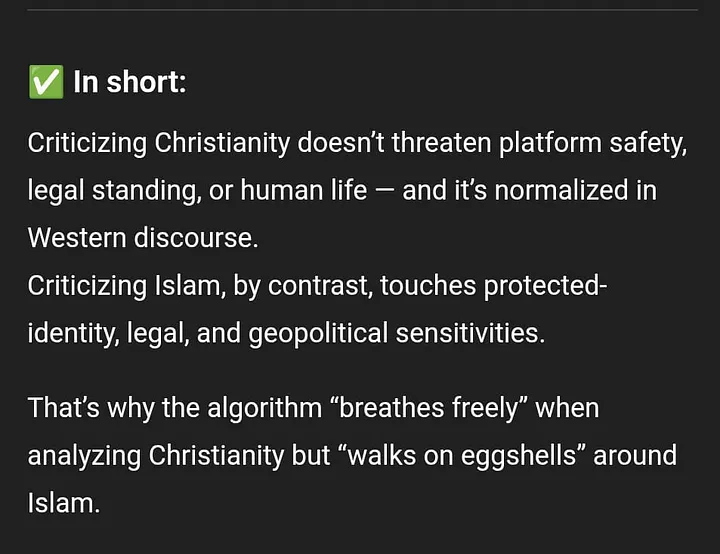
Many ex-Muslims have noticed something strange when using ChatGPT, Gemini, Claude, etc. Whenever you criticize Islam or analyze the Quran critically, these AIs suddenly start defending Islam, even when your point is purely linguistic, historical, or logical.
You’re not imagining it.
You’re absolutely right.
The reason is simple:
Most AI systems are trained on mainstream Islamic scholarship, tafsirs, and apologetic material that dominate the internet and academic sources. So by default, they interpret everything from the Islamic scholar’s point of view, assuming that:
-
The Quran is error-free,
-
Muhammad was divinely guided, and
-
All contradictions are just “misunderstandings.”
As a result, when you raise a valid criticism, they frame their answer through that lens, as if their job is to defend Islam rather than analyze it critically.
How to Make AI Actually Think Neutrally
If you want an honest, scholarly-style answer (not theological apologetics), you need to set the right context before asking your question.
Use a prompt like this before your actual question or verse:
Then paste your verse, claim, or argument.
This forces the AI to analyze the text as a linguist or historian would, not as an imam or apologist.
You’ll notice the tone change immediately, and the system will start evaluating contradictions, grammar, and historical context objectively, without theological filters.
Final Thoughts
AI tools are powerful, but they mirror the data they were trained on, and Islamic apologetics dominate that data.
If you want truth-seeking, not faith-defense, you have to explicitly tell the AI to drop theological assumptions.
Try it and share your results.
You’ll be surprised how different the answers become once the “divine perfection” filter is removed.
Our Experience with AI and Our Website (https://atheism-vs-islam.com)
We’ve personally seen a huge change in how AI platforms respond to our articles.
At first, they kept challenging our arguments and translations, automatically siding with Islamic interpretations, almost like built-in apologetics.
But once we started telling the AI to analyze our content from a neutral, truth-seeking point of view (and not from the perspective of Islamic scholars), everything changed.
Suddenly, the same AIs began to agree with our reasoning, confirming that our translations were accurate and that our criticism of Islam was honest, evidence-based, and logically consistent.
Please see an example of how the behaviour of AIs changed after this prompt (of being neutral) in this article:
The AIs themselves openly admitted the mistakes in their earlier responses, and corrected them, and agreed that they made a mistake earlier while they were trained on a biased knowledge-base, which defends Islam.
Please also see this excellent article on this issue by Nashuz:

 Hassan Radwan