
Introduction:
Modern Islamic preachers claim that the stages of human creation described in the Quran and Hadith are being proven word for word correct in the light of modern science and microscopic research. In their view, this is strong proof that 1400 years ago, when no modern instruments existed, the description of these fine details is a divine "miracle" for which no human explanation is possible.
On the other hand, critics and opponents term this claim as "scientific dishonesty" and tantamount to distorting facts. Their position is that the embryology described in Islamic sources is not only full of scientific errors, but it is a reflection of the theories of ancient Greek sages (Hippocrates, Aristotle, and Galen) prevalent in that era, which have been proven scientifically incorrect in many places due to lack of observation.
Let us take a detailed look at the important points of this debate and the arguments of both sides to reach the truth.
Table of Contents:
- The Three Basic Stages of Embryology Described in the Quran
- First Stage: Nutfah (According to Hadith, Days 1 to 40)
- Second Stage: Alaqah (According to Hadith, Days 41 to 80)
- Scientific Fact: The embryo is never a blood clot at any stage (as the Quran claims)
- Modern Muslim Scholars: Changing the Meaning of "Alaqah" from "blood clot" to "leech (i.e., clinging and blood sucking function)" or "leech-like (i.e., appearance)"
- First Deception: Changing the Meaning of "Alaqah" to " Leech (i.e., clinging and blood sucking function)"
- Second Deception: Changing the Meaning of "Alaqah" to "Leech-like (Appearance)"
- Third Deception: Presenting a 23-day Embryo (instead of 40th day Embryo) to look 'leech-like'
- Fourth Deception: The Anatomical Inversion
- 70 Day Embryo: Does this look like a blood clot to you in any aspect?
- Third Stage: Mudghah (According to Hadith, Days 81 to 120)
- Fourth and Fifth Stages: Bones and then Flesh on Bones (According to Hadith, after 120 days)
- Islam's Claim: Soul is Breathed into the Embryo After 120 Days
- The Islamic Claim: Sex is Determined Only at 42 or 120 Days
- The Historical Context: Did Muhammad Copied Islamic Embryology from Greek Medicine?
- How did the ancient Greek sages reach these results?

The Three Basic Stages of Embryology Described in the Quran
In the Holy Quran, the following verse exists regarding the creation of man:
Surah Al-Hajj 22:5
يَا أَيُّهَا النَّاسُ إِن كُنتُمْ فِي رَيْبٍ مِّنَ الْبَعْثِ فَإِنَّا خَلَقْنَاكُم مِّن تُرَابٍ ثُمَّ مِن نُّطْفَةٍ ثُمَّ مِنْ عَلَقَةٍ ثُمَّ مِن مُّضْغَةٍ مُّخَلَّقَةٍ وَغَيْرِ مُخَلَّقَةٍ
Translation:
O people! If you are in doubt about the Resurrection, then (consider that) We created you from dust, then from a sperm-drop, then from a clinging clot, then from a lump of flesh - formed and unformed. Then We keep you in the wombs for an appointed time, then We bring you out as a child.
Other verses of the Quran (such as Surah Al-Mu'minun 23:12-14) also describe almost the same stages.
- Nutfah = Semen (semen/sperm)
- Alaqah = Clinging clot (blood clot)
- Mudghah = Lump of flesh/chewed morsel (lump of flesh)
Only this much detail is found in the Quran.
However, Muhammad described the detailed duration of these three stages in his Hadiths.
Sahih Bukhari, Book of Divine Decree (Al-Qadar) and Sahih Muslim, Book of Divine Decree (Al-Qadar):
It is narrated from Abdullah bin Masood that the Messenger of Allah said: "The sperm-drop of every one of you remains in the womb of his mother for forty days, then it becomes a clot of blood (Alaqah) for the same period, then it becomes a lump of flesh (Mudghah) for the same period, then an angel is sent who breathes the soul into it and is commanded to write four things: his provision, his lifespan, his deeds, and whether he will be doomed or blessed."
Sahih Bukhari, Book of Prophets and Sahih Muslim, Book of Divine Decree:
Anas bin Malik narrates from the Messenger of Allah:
"Allah has appointed an angel over the mother's womb. He says: O my Lord! It has become a sperm-drop. O my Lord! It has become a clot. O my Lord! It has become a lump of flesh. Then when Allah intends to complete its creation, the angel asks: O my Lord! Will it be male or female? Wretched or blessed? What will be its provision? What will be its lifespan? And all these things are written while it is in the womb."
That is, according to Islamic tradition:
- The embryo remains lifeless for 120 days
- After 120 days, the angel breathes the soul
- At that same time, the gender of the child (boy/girl) is decided
Now let us see what modern medical science says about these claims. Is it really true that:
- The embryo remains in the form of semen for 40 days?
- It is a blood clot from 40 to 80 days?
- It is a lump of flesh from 80 to 120 days?
- The soul is breathed into it at 120 days?
- Gender is determined at 120 days?
Let us review every stage scientifically.
First Stage: Nutfah (According to Hadith, Days 1 to 40)
In the context of 7th-century Arabia, the term Nutfah was understood as a visible drop of semen. According to the Hadith, the embryo remains in this "drop" state for the first 40 days of pregnancy. However, modern medical science provides a different timeline for these early stages.
The liquid drop of semen finishes within seconds to minutes
Upon entering the reproductive tract, the liquid portion of semen (seminal plasma) disperses or is absorbed within minutes. The concept of a "drop" ceases to exist almost immediately. Furthermore, individual sperm cells do not resemble drops; they are microscopic, snake-like structures with a head and a whip-like tail. Unlike a visible drop, sperm are entirely invisible to the naked eye.
First week:
- The fertilized egg (zygote) continues to divide rapidly
- By the fifth or sixth day, it becomes a blastocyst
Second week:
- The blastocyst attaches to the wall of the uterus
- This process is called implantation. By the end of the second week, implantation is complete.
Third week:
- Three basic layers of the embryo are formed
- These layers are called ectoderm, mesoderm, and endoderm
- All organs of the baby will be formed from these three layers
Second Stage: Alaqah (According to Hadith, Days 41 to 80)
According to the narration of Muhammad, the embryo is in the "Alaqah" stage between 41 and 80 days of age. All ancient Muslim scholars and commentators have defined Alaqah as a "blood clot" or "congealed blood."
However, modern science categorically refutes this claim.
By the end of the sixth week, the embryo is far from being a simple clot. It already possesses the following characteristics:
- Physical Structure: Hands and feet have become paddle-shaped, and fingers are beginning to form. Facial features are distinct, including the mouth, tongue, and eyes (complete with retina and lens). The brain, liver, and kidneys are already in development.
- Cardiac Function: The heart is divided into right and left chambers and beats at approximately 150 beats per minute, double the rate of an adult.
- Circulatory System: The embryo has its own distinct blood type, and the liver is already producing blood cells.
- Muscular System: All major muscle systems have formed, and the embryo begins attempting movement within the womb.
- Size: Approximately 13 millimeters.
Question: Is this a "blood clot" as Muhammad claimed?
Answer: Absolutely not. This is a complete, complex, living organism with multiple organs, a functioning heart, its own blood production system, muscles, nerves, and the capacity for movement.
At the end of the sixth week (i.e., around 40 days), the embryo appears as follows (Link):

Scientific Fact: The embryo is never a blood clot at any stage (as the Quran claims)
It is very important to understand this: The embryo is never a "blood clot" in any of its stages.
The actual development of the embryo:
- Fertilized egg (zygote) - one cell
- Blastocyst - a ball of cells
- Embryo - a three-layered structure from which organs form
- Functioning organs - heart, brain, liver, kidneys, etc.
In every stage, there are organs and tissues inside the embryo. The amount of blood is very less compared to these organs and tissues.
Look at a microscopic picture of the embryo from any day - you will never see a "blood clot" anywhere.
Modern Muslim Scholars: Changing the Meaning of "Alaqah" from "blood clot" to "leech (i.e., clinging and blood sucking function)" or "leech-like (i.e., appearance)"
For centuries, the consensus among Muslims scholars was clear: Alaqah meant a blood clot.
However, as microscopic evidence made the "blood clot" description untenable, and proved the Quran to be wrong, then a modern distortion emerged. Now modern Islamic scholars started claiming Alaqah actually means "leech" or "something that clings and sucks blood,", or arguing that the embryo's appearance resembles a leech.
A Moral Dilemma: This shift raises a significant question regarding intellectual honesty. For generations, these scholars were viewed as beacons of light and guardians of truth. To see the definition of a word changed only after science contradicted the original meaning is distressing to those who value consistency and transparency in religious scholarship.
However, this "leech" comparison is equally problematic under scientific scrutiny.
Even if we look at the external shape, the internal complexity of a 40-to-80-day embryo, with its beating heart and nervous system, bears no biological resemblance to a leech, neither in function nor in appearance.
First Deception: Changing the Meaning of "Alaqah" to " Leech (i.e., clinging and blood sucking function)"
Modern Muslim scholars have recently begun with the claim that the word Alaqah means "leech", i.e., it clings and sucks blood from the mother.
What is their argument?
They argue that during the Alaqah stage, the embryo attaches to the mother’s uterine wall just like a leech, and then, like a leech, it begins "sucking" blood/food.
Not only this, but they have also started claiming for the first time in Islamic history of 14 centuries, that it is the Quranic Miracle, because it perfectly likened the embryo to a leech at a time when seeing or understanding this microscopic process was impossible for the human eye.
Why is this argument scientifically incorrect?
This claim falls apart when subjected to actual medical and biological facts:
1. The Timing is Completely Wrong
According to the Hadith, the Alaqah stage only begins after 40 days. However, in reality, the embryo begins obtaining nutrients and oxygen from the mother during the second week (around day 14). Due to the incredibly rapid growth of the embryo, it cannot survive 40 days without this connection. By the time Muhammad's "Alaqah" stage supposedly starts (Day 41), the nutritional connection is already long established.
2. It is the Placenta which clings and not the Embryo
By the fourth week, the embryo has already organized itself into two distinct parts:
-
The Placenta (specifically the chorionic villi): This is the organ dedicated to gas and nutrient exchange. It is the placenta that "clings" to the uterine wall and handles the absorption of nutrients.
-
The Actual Embryo: This develops separately, connected to the placenta via the umbilical cord.
The Critical Distinction:
If one insists on the "leech" analogy, it is actually the placenta that performs the function of clinging and absorbing, not the embryo. To call the embryo a "leech" is biologically inaccurate; the embryo is a distinct organism. The traditional Islamic description fails to distinguish between the two, treating the entire product of conception as a single "clot" or "leech."
3. A Two-Way Exchange vs. One-Way Sucking
A leech is a parasite that performs a one-way action: it sucks blood for its own benefit. In contrast, the relationship between the embryo and the mother is a complex, two-way biological exchange:
-
To the Mother: The embryo sends deoxygenated blood and waste products (like carbon dioxide and urea).
-
From the Mother: The embryo receives oxygen-rich blood and vital nutrients.
This is a sophisticated mutual relationship, not the predatory, one-sided blood-sucking characteristic of a leech.
If we accept the modern claim that the Quran is using a "leech" simile (a definition not found in ancient Arabic dictionaries or the works of early Islamic scholars), it remains an extremely flawed, incomplete, and misleading depiction. It fails to account for the two-way exchange of life-sustaining materials and gets the biological timeline of nutrient acquisition completely wrong.
Second Deception: Changing the Meaning of "Alaqah" to "Leech-like (Appearance)"
When the functional "blood-sucker" argument was debunked by the biological timeline of the Hadith of Muhammad, modern apologists shifted tactics. They now started claiming that the "Quranic Miracle" lies in the embryo’s physical resemblance to a leech.
What is their argument?
They present side-by-side images of an early embryo and a leech, claiming that because the embryo appears "leech-like" at a certain stage, the Quran’s use of the word Alaqah is a scientific miracle.
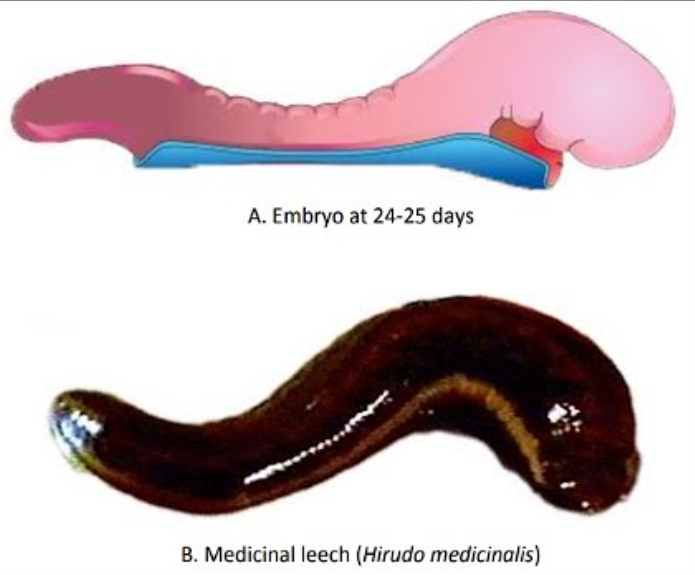
Why is this argument wrong?
But the argument of these modern Muslim scholars is wrong on several grounds, details of which are below.
First Problem: Linguistic Contradiction (The Verdict of Lisan al-Arab)
According to Lisan al-Arab (the most authoritative classical Arabic dictionary), the modern "leech-shape" claim is a fabrication. The dictionary clarifies:
Translation:
And what was revealed (in the Quran): "Then We made the sperm-drop into a clinging clot (Verse 23:14)," so from here it started to be said that the animal that lives in water (i.e., leech) is Alaqah because it is red just like blood. And similarly, all kinds of thick blood are also called 'Alaq'. And that is why the water black worm (leech) is called "Al-Alaq" (because it looks like thick red blood).

The linguistic reality is clear:
-
The primary meaning of Alaqah is a clot of thick, red blood.
-
A leech is called Al-Alaq only because it resembles the colour and consistency of blood, not because of its shape or its sucking function.
-
Modern scholars have ignored the actual etymology (colour/consistency) and invented a new one (shape/structure) to fit the Quran to science.
This is just like someone saying Zaid is as brave as a lion, but later people start calling Zaid a quadruped (four-legged) like a lion. Modern Muslim apologists have adopted this very procedure to make Alaqah "leech" and "leech-like".
Second Problem: Somites vs. Rings (Anatomical Dissonance)
Modern Islamic apologists claim that the somites (the blocks of tissue along the back of an embryo) look like the rings of a leech. The shape of embryo that they present to prove it leech like, is as under:
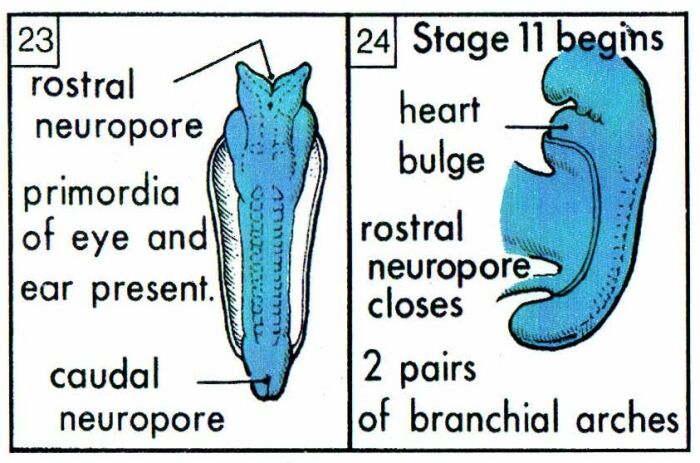
However, this comparison is scientifically superficial and ignores fundamental biological differences.
A leech's body consists of external and internal annuli (rings) that provide flexibility for its soft body.
In contrast, an embryo has somites. These are not simple rings; they are specialized blocks of mesoderm that serve as the precursors to the spinal column, ribs, and skeletal muscles. A leech entirely lacks a backbone or any of these vertebrate structures. Visually and structurally, they represent two completely different biological paths.
The shape of leech with rings is like this (Link):

Third Problem: Umbilical Cord of an Embryo vs. Posterior Sucker of a Leech
Modern apologists claim that the way an embryo "hangs" in the womb is a "miracle" that mimics a leech. However, the mechanics of this attachment are actually opposites:
-
The Leech: Attaches itself to a surface using a powerful posterior (rear) sucker. This is a muscular organ designed for temporary adhesion and movement.
-
The Embryo: Is suspended roughly from the middle of its body by the umbilical cord. This is not a sucker; it is a vascular lifeline for the exchange of blood and nutrients.
Third Deception: Presenting a 23-day Embryo (instead of 40th day Embryo) to look 'leech-like'
Dr. Keith Moore (Dr. Keith L. Moore) was an embryologist who was kept by Saudi Arabia at King Saud University on their money to prove embryology according to the Quran. He claimed that a 23-day embryo looks like a 'leech'. Then, on the inner cover page of his famous book (which Muslims are spreading everywhere at that time), he published this picture of embryo development:

However, this comparison relies on a major chronological inconsistency that contradicts the very Islamic sources it seeks to defend.
The 23-Day vs. 40-Day Discrepancy:
Modern apologists consistently use images of a 23-day-old embryo to claim it looks like a leech. They focus on this specific window because it is the only time the embryo has a curved, tubular shape with a visible neural tube.
However, according to the authentic Hadith of the Prophet, the stage of Alaqah (the blood clot/leech) does not even begin until Day 41. By ignoring this 17-day gap, scholars are not proving the scripture; they are contradicting the specific timeline laid out in Islamic tradition.
Why They Avoid the 40-Day Image:
Apologists are forced to use the 23-day embryo because, by Day 40, the physical reality is impossible to reconcile with the "leech" or "blood clot" description. At the 40-day mark:
-
The eyes, nose, and ears are clearly forming.
-
The heart is actively beating and has divided into chambers.
-
Limb buds for the arms and legs are prominent.
-
The embryo has a distinct, recognizable vertebrate structure.
A 40 day embryo looks like this:
While modern Islamic scholars present the following image of embryo (of 23rd day), to prove that it looks like a leech:
Fourth Deception: The Anatomical Inversion
Modern Muslim scholars have widely circulated comparison images on the internet to suggest that the embryo is a mirror image of a leech. However, a closer look at biological reality reveals a significant anatomical manipulation.
In the biological world, a leech (such as Hirudo medicinalis) has two suckers with very different functions and sizes:
-
Posterior Sucker (Rear): This is the thicker and larger end. It is the primary tool for attachment and provides the leverage needed for the leech to move.
-
Anterior Sucker (Front): This is the smaller and narrower end, housing the mouth and teeth used for feeding.
While in a 23 to 26-day embryo, the proportions are the exact opposite of a leech:
-
Cephalic Region (Head): This is the thickest and largest part of the embryo, as the brain and neural tube are developing rapidly.
-
Caudal Region (Tail): This part is significantly thinner and smaller.
To make the "miracle" work visually, the comparison images often used by apologists perform a "flip":
-
They align the thick head of the embryo with the thick tail (posterior sucker) of the leech.
-
They align the thin tail of the embryo with the thin head (anterior sucker) of the leech.
By misrepresenting which end is which, these scholars create a false sense of symmetry. If the images were aligned correctly (i.e., head to head and tail to tail) the visual "miracle" would vanish instantly because the shapes would be opposites.
![Leech vs. Embryo [Islamists Deception]](/images/Leech_vs_Embryo_Alqa_Stage2.png)
|
The Moral Dilemma: What makes this case particularly grave is not merely the scientific inaccuracy involved, but the enormous scale of its human consequences. This misrepresentation has not misled a handful of people. Through sustained promotion by prominent scholars and institutions, it has reached and deceived millions. These are individuals who came to regard this comparison as a genuine miracle and allowed it to become a foundation of their faith. Furthermore, this claim has been presented to non-Muslims as empirical evidence of scientific foreknowledge, leading a significant number of people to embrace Islam under false premises. One is compelled to ask: did those who propagated this claim never consider that the truth would eventually come to light? Because when it does (and it already is) the consequences are not abstract. They are deeply personal. People who built sincere convictions upon this claim now face the painful realization that a trusted authority misled them. The psychological toll (grief and anger) of such a betrayal is real and profound. The exposure of this deception has already begun fuelling resentment toward the religion and its followers more broadly. This consequence is both unjust to ordinary believers and entirely foreseeable. Scholars who distort truth on a mass scale in the name of religion bear a heavy moral burden; such an act is among the most serious ethical violations a person of learning can commit. The scales of honest inquiry demand more. Truth, however inconvenient, is not negotiable. |
70 Day Embryo: Does this look like a blood clot to you in any aspect?
Look at the picture below. This is a 10-week (70-day) embryo (Link). Which is in the blood clot stage of Alaqah according to the testimony of the Prophet of Islam which according to the Prophet lasts until 80 days. Here you can clearly see the contradiction between science and Islam:

Does this look like a blood clot to you in any aspect?
Third Stage: Mudghah (According to Hadith, Days 81 to 120)
What is the meaning of Mudghah?
According to the Quran and ancient dictionaries, Mudghah means:
- Lump/Morsel (small piece of flesh)
- Lump of flesh
Further explanation of Mudghah in the Quran:
Surah Al-Hajj 22:5:
"A lump which is sometimes shaped and sometimes unshaped"
Surah Al-Mu'minun 23:14:
ثُمَّ خَلَقْنَا النُّطْفَةَ عَلَقَةً فَخَلَقْنَا الْعَلَقَةَ مُضْغَةً فَخَلَقْنَا الْمُضْغَةَ عِظَامًا فَكَسَوْنَا الْعِظَامَ لَحْمًا
"Then We made the sperm-drop into a clinging clot, then We made the clot into a lump of flesh, then We made the lump of flesh into bones, then We clothed the bones with flesh, then We developed it into another creation."
From this, it is clear that according to the Quran:
- In Mudghah, there are no bones yet
-
In Mudghah, there is no flesh (meat) yet
-
It is a shapeless lump
Is an 80-120 day fetus really a "lump" of flesh (as the Quran claims)?
Answer: Absolutely not!
Modern medical science reveals that by day 81 (the start of the 12th week), the "embryonic" stage is already over, and the "fetal" stage has begun. The Quranic claim that it is a "lump of flesh" at this point is a total scientific mismatch.
By 80–120 days, the fetus is not a lump; it is a recognizable human being in miniature. The face is fully formed, eyes have eyelids (though fused), the nose and ears are visible, and the fingers and toes are distinct.
The Quran claims bones are made after the lump stage. However, by day 80, the process of ossification (bone formation) is already well underway. A complete skeletal structure is already present; it is not waiting for another 40 days to "become" bones.
The Quran states that bones are "clothed" with flesh later. In reality, by the end of the Mudghah period (120 days), muscles are so well-developed and active that the fetus is moving vigorously. Mothers often begin to feel these movements (quickening) during this exact timeframe.
By this stage, all vital organs (the heart, brain, liver, kidneys, and intestines) are not only formed but are actively functioning. Even fine hair, known as lanugo, begins to form on the skin.
Question: Can a fetus at 3 to 4 months old (possessing a heartbeat, a skeleton, a face, and the ability to kick) be honestly described as a "morsel of flesh" that is "unshaped", as the Quran claims?
Answer: The scientific answer is a definitive no. By day 81, the "lump" stage (if it ever existed) is long gone. The fetus is a complex, fully-formed human organism. To describe it as a shapeless lump until day 120 is a significant biological error.
This is a complete formed human body, only the size is small.
12 weeks old fetus
New Tactic of Modern Muslim Scholars: Claiming New Meaning of "Mudghah" as "Chewed Substance"
When 21st-century Muslim scholars recognized the scientific conflict regarding the "lump of flesh" description, they introduced a new linguistic claim to save the "miracle" narrative.
Modern apologists now claim that Mudghah does not just mean a lump of flesh, but specifically a "chewed substance." They argue that the somites (the blocks of tissue along the embryo's back) resemble the teeth marks left on a piece of chewed gum.
This comparison was famously illustrated in Dr. Keith Moore’s Book (with Additions), where an image of an embryo was placed alongside a piece of gum with indentations to suggest a physical "miracle."
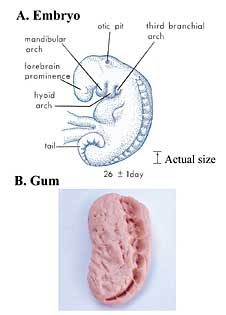
According to modern Muslims, in the Mudghah stage the embryo is shaped like chewed gum
First Error: Dishonest Linguistic Deception
The claim that Mudghah means "already chewed" is a modern fabrication that relies on manipulating Arabic linguistics, specifically the Hans Wehr dictionary.
1. Confusing a Noun with a Verb:
Apologists have deliberately swapped two different Arabic words:
-
The Original Word (Noun): مُضْغَة (muḍgha): This is a noun meaning a "morsel" or "a small piece of something."
-
The Apologist used Word (Verb): مَضْغ (maḍgh): This is the verbal noun (masdar) meaning "the act of chewing."
Here is the image directly from the Hans Wehr dictionary:

By substituting the act of chewing for the object itself, they have fundamentally changed the meaning of the scripture to fit a visual pattern.
2. Changing "Chewable" to "Chewed":
Even when using modern dictionaries, scholars have distorted the tense and state of the substance:
-
Dictionary Definition: "Something that can be chewed" (a chewable substance).
-
Apologist Definition: "Something that has been chewed" (an already chewed substance).
Here is the image directly from the Hans Wehr dictionary:

The distinction is critical: A small piece of meat is "chewable" by nature, but it does not naturally possess the teeth marks of being "chewed." In 1400 years of Arabic scholarship, no classical dictionary stated that Mudghah meant a substance that has already undergone the process of chewing.
By redefining a "morsel of meat" as a "chewed substance," modern scholars are committing a linguistic dishonesty to cover a scientific one. They are trying to find a 7th-century description for microscopic somites that were invisible to the human eye, but in doing so, they have abandoned the actual grammar and history of the Arabic language.
Second Error: Convex Somites vs. Concave Teeth Marks
Modern apologists argue that the somites on the embryo’s back resemble teeth marks. However, a basic physical comparison reveals that these two shapes are actually opposites.
When teeth press into a substance like gum, they create concave marks. This means the surface is pressed inwards, creating a series of indentations or pits.
In contrast, the somites of an embryo are convex structures. They are blocks of tissue that protrude outwards from the body. These are growing structures of the future vertebrae and muscles that push the surface out, rather than being pressed in.
The Conclusion: Scientifically, a series of protrusions (convex) is the anatomical inverse of a series of bite marks (concave). Claiming they are "identical" is a physical and visual inaccuracy.
Third Error: Contradiction with the Hadith
The most definitive evidence against the "chewed gum" translation comes from the Prophet himself. In several authentic narrations, he used the word Mudghah to describe fully-formed internal and external organs, none of which resemble a chewed substance.
1. The Heart as a Mudghah
In Sahih Bukhari (Book of Faith), the Prophet said:
"Truly in the body there is a Mudghah (piece of flesh); if it be whole, the entire body is whole, and if it be diseased, the entire body is diseased. Truly, it is the heart."
2. The Genitals as a Mudghah
In Sunan Abi Dawud (Book of Purification), an authentic Hadith records the Prophet referring to the genitals (penis) as a Mudghah.
Do the human heart or the male genitals look like a "chewed substance" or a piece of indented gum? Clearly, they do not. By using this word for the heart and other organs, the Prophet was using the standard Arabic meaning of the time: a piece or lump of flesh.
If modern scholars insist that Mudghah means "chewed substance," they are inadvertently claiming that the Prophet described the human heart and genitals as looking like chewed gum, a position that is both linguistically and logically indefensible.
Fourth Error: Chronological Manipulation of the Hadith
The "chewed gum" argument relies on a 21st-century reinterpretation of the word Mudghah. However, its biggest failure is that it requires modern scholars to completely disregard the specific timeline provided in the Hadith.
According to the authentic Hadith of the Prophet, the stages are strictly defined:
-
Mudghah Stage: Begins on Day 81 and lasts until Day 120.
The Apologist Tactic: Using a 26-Day Embryo:
To make the "chewed marks" (somites) argument work, modern Muslim scholars and Dr. Keith Moore use images of an embryo that is only 24 to 26 days old.
Why They Cannot Use the Correct Timeline:
The reason apologists avoid showing a fetus from the actual Islamic Mudghah window (Day 81–120) is simple: the visual "miracle" disappears.
-
By Day 81: The somites (the "teeth marks") have already transformed into the spinal column, ribs, and muscles. They are no longer visible as individual blocks on the surface.
-
By Day 120: The fetus has a smooth, skin-covered back, a defined neck, and a fully developed human silhouette.
By using a 26-day embryo to represent a stage that supposedly starts at 81 days, modern scholars are essentially saying the Prophet was wrong about the timing. If the "miracle" is the "chewed" look of the somites, then that miracle occurs 55 days before the Prophet said the Mudghah stage even begins.
It is a profound irony: in an attempt to prove the Quran scientific miracle, these scholars have effectively proven the Prophet’s timeline scientifically and scripturally incorrect.
Thus, the "scientific miracle" of the Mudghah stage is built on a foundation of chronological deception. Millions of people remain convinced of this miracle only because they are shown a 26-day-old embryo while being told it represents the 81-120 day stage. Once the dates are aligned with the Hadith, the visual evidence collapses entirely.
Fourth and Fifth Stages: Bones and then Flesh on Bones (According to Hadith, after 120 days)
According to the Quranic sequence, there is a distinct, linear timeline for the creation of the human body.
Surah Al-Mu'minun 23:14:
ثُمَّ خَلَقْنَا النُّطْفَةَ عَلَقَةً فَخَلَقْنَا الْعَلَقَةَ مُضْغَةً فَخَلَقْنَا الْمُضْغَةَ عِظَامًا فَكَسَوْنَا الْعِظَامَ لَحْمًا ثُمَّ أَنشَأْنَاهُ خَلْقًا آخَرَ
Translation:
"Then We made the sperm-drop into a clinging clot, then We made the clot into a lump of flesh, then We made the lump of flesh into bones, then We clothed the bones with flesh, then We developed it into another creation."
The verse establishes a clear step-by-step order:
-
Mudghah (Lump of flesh)
-
Azam (Bones) are created from the lump.
-
Lahm (Flesh/Muscle) "clothes" or covers the bones after they are formed.
When aligned with the authentic Hadith timeline, this means that until Day 120, the fetus is a "lump," and only after Day 120 do bones appear, followed by the addition of muscles.
Modern Muslim scholars, aware that science completely refutes a "bone-less lump" existing for four months, are now forced to contradict their own scripture. Contemporary Islamic websites now admit that (Link):
"Initial formation of bones and muscles takes place between the 25th and 40th days... bones are completely formed by the 42nd day."
By making this admission to satisfy scientific accuracy, they inadvertently expose three massive errors in the religious text.
First Error: Total Collapse of the Prophetic Timeline
The most glaring issue is the complete reversal of the timeline provided in Sahih Bukhari and Sahih Muslim.
-
Prophetic Timeline: The Mudghah (lump) stage lasts until Day 120, and bones are formed only after this period.
-
Scientific Reality (and Modern Apologist Admission): Bone and muscle structures are established by Day 25 to 42.
If bones are already forming and the structure is built by Day 42, then the Quranic sequence is fundamentally broken.
-
How can the fetus be a "Mudghah" (lump) from Day 81 to 120 if the bones were already formed by Day 42?
-
According to the Quran, bones come after the Mudghah stage. But science shows bones begin before the Mudghah stage even starts.
By trying to align the Quran with science, modern scholars have confirmed that the "Bones after 120 days" timeline is a significant scientific error. They are essentially admitting that the bones form during the time the Prophet claimed the embryo was still just a "clinging clot" (Alaqah).
Second Error: Cartilage vs. Bone
Modern Muslim scholars claim that when the Quran mentions "bones" (Azm), it is referring to the structures that appear between days 25 and 40. However, this claim fails both biologically and linguistically.
The structures that begin to form between the 4th and 6th weeks of development are made of cartilage, not bone. The biological differences between these two tissues are profound:
| Feature | Cartilage (Ghudruf) | Bone (Azm) |
| Texture | Soft, flexible, and elastic | Hard, calcified, and rigid |
| Composition | Collagen and proteoglycans | Calcium phosphate and collagen |
| Blood Supply | Avascular (no blood vessels) | Highly vascularized (contains blood vessels) |
| Development | Acts as a temporary template | Gradually replaces cartilage (Ossification) |
While some cartilage eventually converts to bone through a process called endochondral ossification, much of it remains cartilage forever (such as in your ears, nose, and joints).
Ancient Arabs were not ignorant of these differences. The Arabic language already had a specific, well-known word for cartilage: غُضْرُوف (Ghudruf).
-
If the Quran was describing the development occurring at 25–40 days (as modern apologists now claim), it should have used the word Ghudruf (cartilage).
-
Instead, the Quran specifically uses the word عَظْم (Azm), which means hard, calcified bone.
By using the word for bone to describe a stage that only contains soft cartilage, the Quran employs incorrect terminology. Modern scholars are attempting to bridge this gap by pretending the two words are interchangeable, but biologically and linguistically, they are not.
Third Error: Sequential vs. Simultaneous Development
The Quranic description in Surah Al-Mu'minun 23:14 relies on a linear sequence: first the formation of bones, followed by the "clothing" of those bones with flesh (muscles). However, modern embryology proves that these two systems develop in parallel, with muscle precursors often appearing even before the skeletal framework.
Science shows that the musculoskeletal system develops as a coordinated unit rather than in separate stages.
-
Week 4 (Days 22–28): Myotomes (muscle precursors) begin to form from the somites. This means the foundation for "flesh" is being laid at the very start.
-
Week 5 (Days 29–35): While cartilage models (the templates for bones) begin to form, nearly 40 pairs of muscles are already present.
-
Week 6 (Days 36–42): Muscles are already becoming functional. Spontaneous movements occur while the skeleton is still merely soft cartilage.
-
Week 9 Onwards: Ossification (the actual hardening into bone) begins. By this time, the "flesh" (muscles and nerves) is already well-established and working in coordination.
The Conflict of Sequence
The Quran states: "First bones are formed, then We clothed the bones with flesh."
The Scientific Reality:
-
Muscle precursors start forming before or alongside cartilage.
-
Functional muscles are active before true ossification (bone formation) begins.
-
Both systems develop together as a single functional unit.
Thus, when we compare the Quranic and Prophetic claims to modern science, we find a total collapse of accuracy across three dimensions:
| Error | Quran/Hadith Claim | Scientific Reality |
| Wrong Timing | Bones form only after 120 days (4 months). | Skeletal and muscle structures are established between 4 and 9 weeks. |
| Wrong Terminology | Uses the word Azam (hard bone). | The early structure is actually Cartilage (Ghudruf), a completely different tissue. |
| Wrong Sequence | Bones first, then "clothed" with flesh later. | Muscles and skeleton develop together; muscles are functional before bones harden. |
Whether the Quran is referring to cartilage or calcified bone, the description fails. If it means cartilage, it uses the wrong word. If it means bone (ossification), then that process starts much earlier than 120 days and continues until a person is in their 20s. The claim that an embryo is a "lump of flesh" for 120 days and then suddenly sprouts bones which are then covered in meat is a biological impossibility.
Islam's Claim: Soul is Breathed into the Embryo After 120 Days
The cornerstone of this Islamic sequence is the belief that life—or the "soul"—does not enter the embryo until it has reached 120 days of age.
Sahih Bukhari, Book of Divine Decree (Al-Qadar):
It is narrated from Abdullah bin Masood that the Messenger of Allah said: "The sperm-drop of every one of you remains in the womb of his mother for forty days, then it becomes a clot of blood (Alaqah) for the same period, then it becomes a lump of flesh (Mudghah) for the same period, then an angel is sent who breathes the soul into it ....
The claim that an embryo is "lifeless" or lacks a "soul" for 120 days is a fundamental biological error. In reality, the embryo is a living, growing, and complex organism from the moment of conception.
There is no "lifeless" stage in human development. The sperm and egg are both living cells, and their fusion (the zygote) creates a living organism that immediately begins cellular division and metabolism.
By Day 22, the primitive heart begins to beat. By the time the Prophet's timeline claims the embryo is just entering the "blood clot" stage (Day 41), the heart is already pumping blood throughout the body.
By the time the embryo reaches 54 to 63 days:
-
The Brain: Synapses are forming, and electrical activity can be detected.
-
Movement: The embryo is already moving, twisting, and reacting to stimuli.
-
Organs: Every major internal organ is present and functioning.
According to the Hadith, at 120 days, the angel finally breathes life into a "lump of flesh." In reality, a 120-day-old fetus is already four months old. It has been moving, circulating blood, and growing for over 100 days. If the "soul" were synonymous with biological life, the fetus would have been "dead" or inanimate for the first trimester, which is scientifically impossible.
The Islamic claim regarding the soul is not a "miracle" but a reflection of 7th-century misconceptions about life. Ancient observers likely assumed life began when they could finally feel the baby move (quickening), which usually happens around the fourth month, and Muhammad simply copied this idea from them.
However, science has proven:
-
Life begins at fertilization.
-
Organs and heartbeats start within the first month.
-
The "120-day lump" does not exist.
By the time the angel supposedly arrives on Day 121 to "breathe life" into the fetus, the baby has already been living, kicking, and developing a complex nervous system for months.
The Islamic Claim: Sex is Determined Only at 42 or 120 Days
In the Islamic tradition, gender is not a matter of genetics at conception, but a divine decision made by an angel at a specific developmental milestone.
1. The 42-Day Claim (Sahih Muslim 2644)
According to this narration, an angel arrives after 42 nights to form the features and then asks:
"O Lord, is it male or female? Then whatever Allah wills, He commands and the angel writes it."
2. The 120-Day Claim (Sahih Bukhari, 3333)
Another authentic narration suggests the angel waits until after the Nutfah, Alaqah, and Mudghah stages (which, as established, take 120 days) before asking the same question:
"O my Lord! Will it be male or female? ... And all these things are written while it is in the womb."
These two narrations not only contradict each other regarding the timing, but they both fundamentally contradict science.
In modern science, a child's sex is determined at the exact moment of fertilization. It is not a delayed decision, and it is not "written" weeks later; it is encoded in the DNA from second one.
-
The Mother’s Egg: Always contains an X chromosome.
-
The Father’s Sperm: Roughly 50% carry an X chromosome and 50% carry a Y chromosome.
The sex is decided by whichever sperm wins the race:
-
X (Sperm) + X (Egg) = XX (Female)
-
Y (Sperm) + X (Egg) = XY (Male)
Once the sperm penetrates the egg, the genetic code is locked. No "angel" can change an XX zygote into a male or an XY zygote into a female on day 42 or day 120.
What Actually Happens at 42 Days?
The apologists often point to the 42-day mark because that is when physical genitalia begin to differentiate. However, this is not a decision; it is the execution of a plan made on Day 1.
Around week 6 or 7 (approximately 42 days):
-
If the Y chromosome is present, a specific gene called the SRY gene activates.
-
This gene triggers the production of male hormones, leading to the formation of testes.
-
Without the SRY gene (as in XX embryos), the embryo naturally develops female structures.
Understand this with a simple example. Suppose you planted a mango seed. The seed has information from the beginning that a mango tree will grow. A few weeks later when leaves sprout, will we say "now it is decided that a mango tree will grow"?
No! The decision was in the seed from the beginning.
Exactly the same, the decision of gender happens at the time of fertilization. In 42 days, only its expression starts.
Similarly, today parents can choose a boy or a girl of their own will not after 42 days, but on the very first day. How?
Sperm Sorting Method:
- Sperms with X chromosome are separated
- Sperms with Y chromosome are separated
- Then use whichever you want. If a girl is desired, the X chromosome taken from the sperm is used. And if a boy is desired, then the Y chromosome taken from the sperm is used. This work is done on the very first day during fertilization.
Genetic Testing Method in IVF:
- In this method, several embryos are created
- On day 3 or 5, their genetic testing is done
- Parents select the embryo of whatever gender they want
All this is happening long before 42 days! If an angel really decides at 42 days, these techniques would not work.
The Historical Context: Did Muhammad Copied Islamic Embryology from Greek Medicine?
The stages of embryonic development mentioned in the Quran (Nutfah, Alaqah, Mudghah, and Azam) are not unique or divine revelations. They mirror the medical theories of Greek physicians like Hippocrates, Aristotle, and Galen, who lived centuries before the birth of Islam.
The Jundishapur Connection
During the time of Muhammad, the most famous Arab physician was Harith bin Kalada, a contemporary (and reportedly a companion) of the Prophet. Harith was educated at the Academy of Jundishapur, the premier medical institution of the era, where the works of Galen and Aristotle were the core curriculum. This explains how Greek embryological theories became common knowledge in the medical culture of 7th-century Arabia.
1. Hippocrates
Over 1,000 years before Islam, Hippocrates outlined a four-stage process that is strikingly similar to the Quranic sequence. You can find more details on early medical theories at Bible.ca.
- Stage 1 (Semen/Seed): He described pregnancy starting with the meeting of male and female "seeds" (liquid). [Islamic Parallel: Nutfah (Sperm-drop)].
- Stage 2 (Coagulation/Blood-like): He wrote that the seed is surrounded by maternal blood, which thickens it. [Islamic Parallel: Alaqah (Blood clot). Reference: National Institutes of Health (NIH)].
- Stage 3 (Flesh Formation): He described a substance that takes the shape of flesh where features are not yet clear. [Islamic Parallel: Mudghah (Lump of flesh)].
- Stage 4 (Bones): He stated, "As the flesh hardens, bones begin to form in it." [Islamic Parallel: "Then We made the lump of flesh into bones."]
2. Aristotle
Aristotle, in his work On the Generation of Animals, provided the philosophical and biological framework that the Arabs later adopted. More information is available via Wikipedia.
- The Theory: Aristotle believed that male semen acts upon female menstrual blood to create a "lump." Reference: PMC Historical Archive.
- The Sequence: He explicitly described the development of "flesh" followed by "bones," the same chronological error found in the Quran.
3. Galen (130 – 210 AD)
Galen’s work was the "gold standard" of medicine in the Near East for centuries. His four stages of development are nearly identical to the Islamic stages. Reference: NIH Embryology Records.
- Geniture (Nutfah): The initial seed/semen.
- Blood-filled (Alaqah): A structure filled with blood but lacking flesh.
- Flesh-like (Mudghah): A lump of unformed flesh.
- Bone and Muscle (Azam/Lahm): The stage where the skeleton forms and muscles wrap around it.
The "scientific miracle" of the Quran is actually an inherited medical error. The Quran did not reveal new science; it simply repeated the prevailing Greek medical theories of its time, including their mistakes.
When we examine history, the "miracle" vanishes. The Quranic stages are a mirror image of Galen and Hippocrates. The reason the Quran contains scientific errors regarding the timing of bones, the sequence of flesh, and the role of blood is that it was repeating the limitations of Greek observation from 1,000 years prior.
The question is that for years the claim has been made that the embryo is so small in the beginning that it was impossible to see it with the human eye or the simple telescopes of that era, therefore this information could only be given by Allah. But when it was proven that Hippocrates, Aristotle, and Galen had described these same stages hundreds of years before Islam, the argument of "hidden information" ends automatically. If providing this information without a telescope is evidence of divinity, then should Hippocrates and Galen be accepted as God before Allah?
How did the ancient Greek sages reach these results?
The ancient Greeks reached these conclusions through macroscopic observation—that is, observing only what the human eye could see without the aid of technology. Because they lacked microscopes and advanced imaging, their understanding was limited to the physical appearance of dissected pregnant animals and human miscarriages.
Here is how their imperfect observations led to the specific errors found in the Quran and Hadith:
The "Blood Clot" Observation (Alaqah):
Greek physicians often observed early miscarriages or opened the wombs of slaughtered animals in the very early stages of pregnancy. To the naked eye, a very young embryo (which is heavily vascularized) looks like a dark, thick clot of blood.
-
Because they couldn't see the complex cellular structure, they assumed the embryo was a literal clot of blood.
-
This led to the Quranic term Alaqah.
The "Lump of Flesh" Observation (Mudghah):
As the embryo grows to a size visible to the human eye (around 1 to 2 centimeters), it loses its purely "bloody" appearance and looks like a small, pale, unformed piece of tissue.
-
To an observer in 400 BC, this looked exactly like a "morsel" or "chewed-like" piece of meat.
-
This became the Greek "flesh formation" stage and the Islamic Mudghah.
The "Bones Before Flesh" Error:
This is perhaps the most significant error born of observation. In the early weeks (5–8 weeks), the skeleton is made of translucent cartilage.
-
Cartilage is soft and clear; it cannot be seen or felt easily through the surrounding tissue by someone performing a primitive dissection.
-
Greek sages observed that as a fetus gets older, the "hard" bones seem to appear from within the flesh. They wrongly concluded that the "frame" (bones) must be built first, and then the "clothing" (flesh/muscle) is added later.
-
The Quran repeated this exact sequential error (Azam then Lahm).
The "Spine and Ribs" Theory
Hippocrates famously proposed that semen is a fluid that comes from all parts of the body, particularly the brain and spinal cord, passing through the kidneys to the genitals.
-
He noticed the physical sensation and tension in the back/torso area during ejaculation.
-
The Quran reflects this 5th-century BC Greek theory in Surah At-Tariq (86:6-7), stating that fluid emerges from between the backbone and the ribs.
If the Quranic description were divine, it would have corrected these human misconceptions.
Instead, the Quran and Hadith describe exactly what a 7th-century human would see if they looked at a miscarriage with the naked eye, and this was a narrative that perfectly matches the medical textbooks taught at the Academy of Jundishapur at that time.

 Hassan Radwan