The Islamic calendar is based on a lunar system, consisting of 12 lunar months, with each month corresponding to one full orbit of the moon around the Earth, which takes approximately 29 to 30 days. Consequently, the Islamic Lunar Year comprises 355 days, completing 12 lunar cycles.
In contrast, a solar year is defined by one complete orbit of the Earth around the sun, taking 365 days to accomplish. The solar year is not directly related to the division of time into months, weeks, and days, which was initially established by societies following lunar calendars. Over time, these divisions were also incorporated into solar calendars for convenience.
Unlike the lunar year with its 12 months, the solar year is primarily divided into four seasons—spring, summer, autumn, and winter—which repeat at regular intervals.
The position of the sun significantly influences the changes that occur on Earth, impacting human life, agriculture, and various business activities. In contrast, the position of the moon has a comparatively minor impact on human life.
Since there is no All-Knowing Allah present in the heavens, and Muhammad was himself creating this religion of Islam and Quran, and he himself belonged to that culture of the time of ignorance, that is why Muhammad made this double mistake in Quran:
- Firstly, Muhammad chose this faulty and deficient Lunar Calendar, instead of the solar calendar. (Note: Solar Calendar was already present in the world at the time of Muhammad, but Muhammad didn’t know about it as he lived in an area where people were ignorant of the concept of solar year)
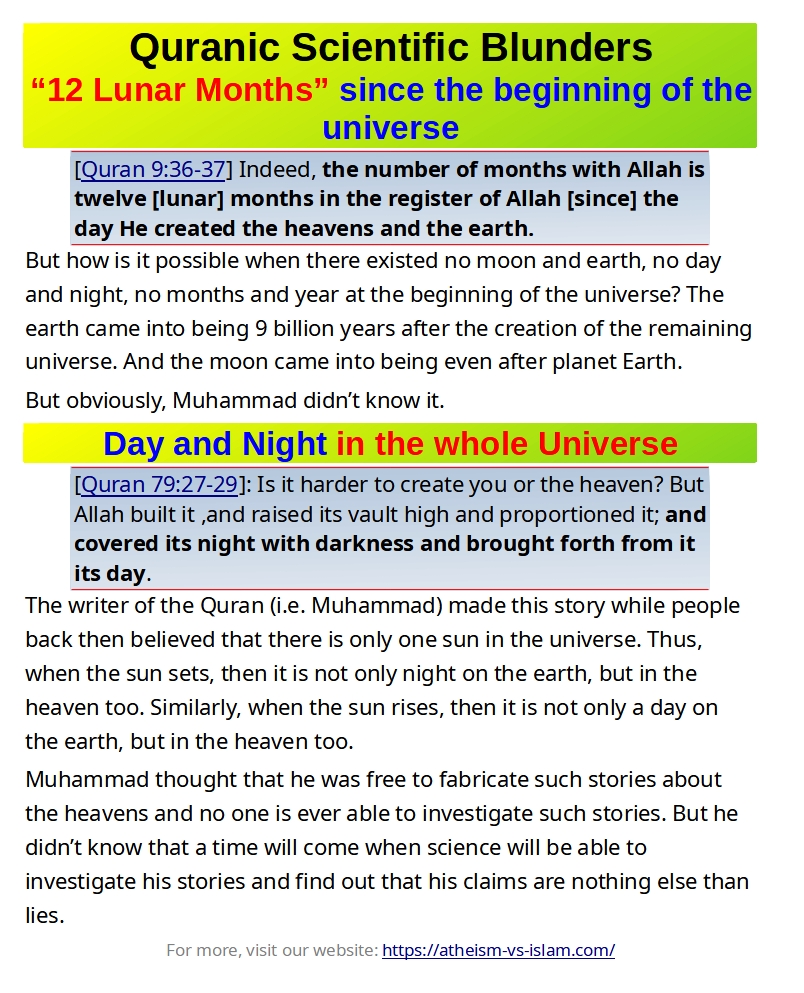
- And moreover, Muhammad also made this claim in Quran that these 12 months existed since the beginning of the universe.
Quran 9:36:
إِنَّ عِدَّةَ ٱلشُّهُورِ عِندَ ٱللَّهِ ٱثْنَا عَشَرَ شَهْرًا فِى كِتَٰبِ ٱللَّهِ يَوْمَ خَلَقَ ٱلسَّمَٰوَٰتِ وَٱلْأَرْضَ مِنْهَآ أَرْبَعَةٌ حُرُمٌ ۚ ذَٰلِكَ ٱلدِّينُ ٱلْقَيِّمُ ۚ فَلَا تَظْلِمُوا۟ فِيهِنَّ أَنفُسَكُمْ
Indeed, the number of months with Allah is twelve [lunar] months in the register of Allah since the day He created the heavens and the earth; of these, four months are sacred. That is the correct religion, so do not wrong yourselves during them. (Translation by Sahih International).
But how is it possible, while:
- There existed no moon and earth, no day and night, no months and years at the beginning of the universe.
- The earth came into being only 9 billion years after the creation of the remaining universe.
- And the moon came into being even after planet Earth.
So, how is it possible that the "System of the Universe" revolved around 12 Lunar Months, since the beginning of the universe?
But obviously, Muhammad didn’t know it.
What to talk about the lunar year, but even the solar year also has nothing to do with the system of the heavens, as the sun was also not present at the time of the creation of the universe.
Day and Night in the Whole Universe
Similarly, look at Verse 79:27-29:
أأنْتُم أَشَدُّ خَلْقاً أَمِ السَّمَآءُ بَناهَا* رَفَعَ سَمْكَهَا فَسَوَّاهَا* وَأَغْطَشَ لَيْلَهَا وَأَخْرَجَ ضُحَاهَا* وَالأرْضَ بَعْدَ ذَلِكَ دَحَاهَا* أَخْرَجَ مِنْهَا مَآءَها وَمَرْعَاهَا* وَالْجِبَالَ أَرْسَاهَا* مَتَاعاً لَّكُمْ وَلأنْعَامِكُمْ
Is it harder to create you or the heaven? But Allah built it ,and raised its vault high and proportioned it; and covered its (i.e. the whole universe's) night with darkness and brought forth from it its day.
During the time of the Quran's composition, people believed in a single sun in the universe. Therefore, when the sun set, it was considered night on Earth as well as in the heavens. Similarly, when the sun rose, it signaled the start of the day on both Earth and in the heavens.
Muhammad seemingly fabricated this story about the heavens, thinking that no one would ever be able to scrutinize or question his claims. However, he was unaware that future advancements in science would enable investigations into these narratives, revealing them as nothing but falsehoods.
The start of the “Weekly System” and Islam copying it from earlier cultures
The system of 4 weeks in a month is flawed because a lunar month consists of approximately 29.53 days, making it impossible to evenly divide into 4 weeks. Despite this, the people of the time of ignorance adopted this faulty system.
This system can be traced back to its origins in Sumerian culture.
https://www.livescience.com/45432-days-of-the-week.html
The seven-day week originates from the calendar of the Babylonians, which in turn is based on a Sumerian calendar dated to 21st-century B.C. Seven days corresponds to the time it takes for a moon to transition between each phase: full, waning half, new and waxing half. Because the moon cycle is 29.53 days long, the Babylonians would insert one or two days into the final week of each month.
Muhammad then further claimed that the universe was created on different days of the week.
Sahih Muslim, Book of creation:
Abu Haraira reported that Allah's Messenger took hold of my hands and said: Allah, the Exalted and Glorious, created the clay on Saturday and He created the mountains on Sunday and He created the trees on Monday and He created the things entailing labour on Tuesday and created light on Wednesday and lie caused the animals to spread on Thursday and created Adam (peace be upon him) after 'Asr on Friday;the last creation at the last hour of the hours of Friday, i. e. between afternoon and night.
For sure, neither the sun, nor the months, nor the weekdays existed at the time of the creation of the Universe. Thus, it is impossible that the creation started on any Saturday .....
Muhammad was only fabricating these false stories, as he thought no one is going to catch his lies.
Read in Image Format

 Hassan Radwan