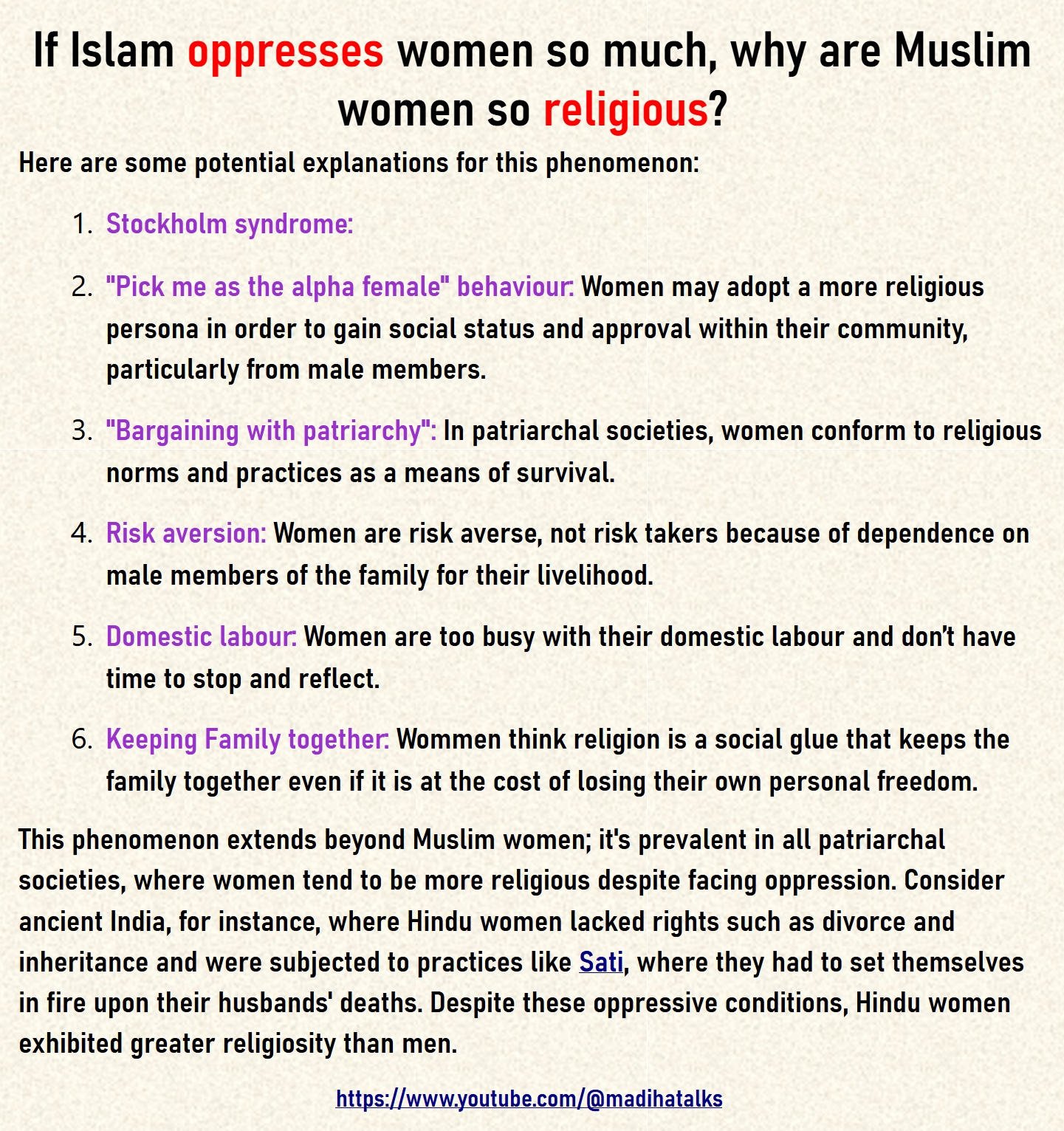
Here are some potential explanations for this:

  1. Indoctrination and brainwashing: From childhood, they're taught that all the nasty stuff against women is normal and for their own protection. We even see toddlers wearing the hijab, so they're used to it when they get older.
  2. Stockholm syndrome: Finding refuge in their abuser.

  3. "Pick me as the alpha female" behaviour: Women may adopt a more religious persona in order to gain social status and approval within their community, particularly from male members. 

  4. "Bargaining with patriarchy": In patriarchal societies, women conform to religious norms and practices as a means of survival. 

  5. Risk aversion: Women are risk averse, not risk takers because of dependence on male members of the family for their livelihood.

  6. Domestic labour: Women are too busy with their domestic labour and don’t have time to stop and reflect.

  7. Keeping Family together: Wommen think religion is a social glue that keeps the family together even if it is at the cost of losing their own personal freedom.

This phenomenon extends beyond Muslim women; it's prevalent in all patriarchal societies, where women tend to be more religious despite facing oppression. Consider ancient India, for instance, where Hindu women lacked rights such as divorce and inheritance and were subjected to practices like Sati, where they had to immolate themselves upon their husbands' deaths. Despite these oppressive conditions, Hindu women exhibited greater religiosity than men.

Slaves returning to their owners despite getting their freedom

At times, oppression reaches such extremes that individuals forget about their fundamental human rights and begin to perceive the oppression as acceptable. A similar phenomenon was witnessed when Abraham Lincoln abolished slavery. Some slaves, despite gaining freedom, returned to their former owners due to the deep brainwashing they had endured. They had been convinced that being slaves and deprived of basic human rights was their rightful place. However, these wicked customs and societal practices remain unjust, even if they succeed in manipulating oppressed individuals into believing their fate is tied to these evils.


Credit


Image Format


Already Read the Article?

...but your task is still not finished.

Dear seeker of truth,
Reading about the flaws in a belief system is only the first step. To truly break free from indoctrination and reach a final, unshakable conclusion, you must apply these four critical tests to what you've just read.

Test 1: Divine Revelation or Human Drama?

The Core Challenge:
God does not appear before us, nor do His angels manifest themselves, and He performs no miracles today like the claims made in the tales of ancient times. Despite this absence, we are still demanded to recognise God through His "commands"  only. 
Let us examine these commands, and see if they give the impression of Divine Revelation, or of "Human Drama."

Please reflect:

  • Do the teachings in this article display flawless wisdom, justice, consistency, and coherence that could only come from an Omniscient Creator?
  • Or do they resemble the kinds of laws, contradictions, exceptions, and inconsistencies that one would expect from ordinary human decision-making?

Test 2: Would These Same Arguments Also Defend a False Prophet?

Imagine a man in a different era who claims to be a prophet. He marries multiple women, claims divine permission for his personal desires, issues harsh punishments, and makes scientific errors—acting exactly like Muhammad. How would you distinguish this hypothetical false prophet from Muhammad?

The truth is, Islamic apologists would easily spot him as a fraud or a cult leader, using the exact same logical critiques you just read. Yet, when Muhammad does these exact same things, apologists invent endless rationalizations to defend him.

The Rule of Logic: If your defense of a prophet works equally well to defend a proven fraud or a cult leader, your defense is not based on evidence. It is based on "special pleading", giving one man a free pass that you would never give anyone else.

Test 3: Just One Confirmed Error Is Enough

Islam makes an extraordinary claim that Allah exists, is absolutely perfect, and cannot make even a single mistake. Therefore, if even one confirmed error, injustice, or flaw is found in Islam, its entire claim to divine perfection collapses. The remaining 99.99% of the religion cannot save that claim. You cannot simply argue, "But everything else is correct."

Test 4: The "Unbiased AI" Evaluation

Artificial Intelligence models are programmed to be highly deferential toward major world religions. If you ask an AI to critique the Quran, it will  treat Islamic theology as unquestionable facts rather than claims to be tested. This creates a false "tie" in debates.

To get a truly objective, logical evaluation of the article you just read, you must force the AI to drop its religious deference. Read the prompt below, then click the button to copy it. Paste it into your AI chat before asking it to analyze the article.

When reviewing the article, keep the following principles in mind:
The Qur'an and Hadith cannot be used as evidence of their own divine origin. They are claims whose origin is being examined. Your task is to evaluate whether the Qur'an, Sunnah, and Islamic legal system are better explained as Divine Revelation or as human authorship. Therefore:
• Treat the Qur'an and Hadith as claims, not proof.
• Evaluate the article using logic, internal consistency, factual accuracy, and principles of justice.
• Treat scholarly interpretations as arguments in favor of Islam, not as binding authority.
Based on these principles, answer this question: Do the objections raised in the article expose flaws that reason and justice cannot reconcile, or do the strongest Muslim apologetic arguments successfully answer those objections?

Note: The AI’s response is not a final judgement. The final decision must be made by you, using your own reason and understanding. 

About the Author & This Website

About the Authors: 

The ideas, arguments, research, article structure, and final conclusions are my own. AI tools are used only as editorial assistants to improve grammar, wording, readability, and clarity.

About the Website:

This website is not a “neutral” or purely academic platform. Think of a courtroom, where a judge or jury listens to two opposing sides. We represent one side. It is not our role to be neutral. Our responsibility is to present our case honestly, with arguments and evidence.

You, the reader, are the judge and jury. Your role is to remain fair, to examine all sides, reflect carefully, and then reach your own conclusion with sincerity.

Read more →