
Introduction
Across Muslim communities worldwide, a silent epidemic is unfolding. Thousands of children are born every year with severe genetic disorders, disabilities, and life-threatening conditions, not by chance, but as a direct and predictable consequence of a marriage practice deeply embedded in Islamic culture and tradition.
Cousin marriage, practiced generation after generation in Muslim families, is not merely a cultural quirk or a personal choice. It is a system that science has clearly shown to cause immense suffering to innocent children who never asked to be born into it. These children grow up facing intellectual disabilities, congenital heart defects, blindness, deafness, and premature death, all while their communities continue the very practice that caused their suffering.
Islam did not invent cousin marriage, but it sanctioned it, normalized it, and through its sex-segregated social system, continues to make it the default choice for millions of Muslim families across the world. The result is a public health catastrophe that politicians and religious leaders refuse to confront honestly, out of fear of being labeled Islamophobic.
This article puts that fear aside. The suffering of children matters more than political comfort. The evidence from the United Kingdom, Pakistan, and beyond is damning, and it demands a direct, honest reckoning with the role Islamic teachings play in perpetuating this cycle of preventable harm.
Proof: Cousin Marriage is indeed Incest
Science is clear that first cousins share, on average, 12.5% of their genes. This is the same proportion as between a grandparent and grandchild. Calling a cousin marriage a “normal marriage” is, in reality, self-deception. From a scientific perspective, such a relationship is as incestuous as a grandfather with his granddaughter or a grandmother with her grandson.
The real danger increases over time. If cousins continue to marry within the family across generations:
-
By the fourth generation, cousins share 25% of their genes, the same as half-siblings. Marriages at this stage are equivalent to unions between step-siblings, and the risk of genetic diseases and disabilities in their children multiplies significantly.
-
By the eighth generation, cousins can share 50% of their genes, the same proportion found between full siblings or between parents and children. Such marriages are, in effect, the genetic equivalent of direct incest, with children facing severe health risks.
For centuries, in Muslim families, marriages between first cousins have been taking place generation after generation. That is, in every generation, some first cousins end up marrying each other. According to science, with such continuous cousin marriages in each generation, the proportion of shared genes keeps increasing.
Based on continuous first-cousin marriages across consecutive generations.
| Generation | Shared Genes (%) | Scientific Comparison |
|---|---|---|
| 1st generation (first cousins) | 12.5% | Grandparent and grandchild |
| 2 consecutive generations | 18.75% | First cousins once removed |
| 3 consecutive generations | 25% | Half-siblings |
| 4 consecutive generations | 31.25% | — |
| 5 consecutive generations | 37.5% | — |
| 8th to 9th generation | 50% | Full siblings |
Double Cousins: The Greatest Risk
Islamic law also permits marriage between double first cousins, which occurs when two brothers marry two sisters and their children subsequently marry each other. This arrangement is even more genetically dangerous than standard cousin marriage, because double first cousins already share 25% of their genes in the very first generation, equivalent to half-siblings.
If double cousin marriages continue across generations, the trajectory is alarming. By the second generation the risks multiply sharply. By the third generation, shared genes reach 50%, the same as between a parent and child or between full siblings.
When two brothers marry two sisters and their children continue to intermarry.
| Generation | Shared Genes (%) | Scientific Comparison |
|---|---|---|
| 1st generation | 25% | Half-siblings |
| 2 consecutive generations | 37.5% | — |
| 3 consecutive generations | 50% | Full siblings |
Children born from these unions face significantly elevated risks of congenital heart defects, intellectual disabilities, genetic disorders such as thalassemia, impaired vision and hearing, and premature death. Research from the UK, Pakistan, and the Middle East consistently confirms that mortality and disability rates among children in cousin-marriage families are far higher than in the general population.
This is not a matter of religious interpretation or cultural sensitivity. It is a matter of what happens to a child's body and life when two closely related people produce offspring. No religious sanction changes the biology. No fatwa rewrites the genetic code. The suffering of these children is real, measurable, and largely preventable.
Real-World Consequences: UK and Pakistan Data
The science of cousin marriage is not merely theoretical. Its consequences are visible, measurable, and devastating in communities where the practice is most deeply entrenched. The data from the United Kingdom and Pakistan paints a picture that is impossible to ignore.
The United Kingdom
The British Pakistani community provides one of the most thoroughly documented cases of the public health consequences of generational cousin marriage. According to BBC reporting, at least 55% of British Pakistanis marry their cousins, and this pattern persists into the second generation born on British soil, meaning that even exposure to Western education and awareness has not broken the cycle.
Based on two reports by BBC (Report1 & Report 2):
-
It is estimated that at least 55% of British Pakistanis marry their cousins, and this practice persists into the second generation.
-
According to statistics, British Pakistanis are 13 times more likely to have children with genetic disorders than the general population of Britain.
-
In Birmingham city, 10% of children born to first cousins either die in infancy or develop severe disabilities due to recessive genetic disorders.
-
Although the Pakistani community comprises only 3% of all births in Britain, they account for 33% of all British children with such disabilities. This means that if 55% of British Pakistanis have cousin marriages, then the 1.5% population of Britons who engage in first cousin marriages accounts for 33% of all British children with genetic disorders. [Source: Paper by Darr and Modell published in 2002 - Genetic Counselling and customary consanguineous marriage. Nature Reviews: Genetics, Vol 3 March 2002]
Pakistan
The situation inside Pakistan itself is, if anything, even more severe.
According to the DAWN Newspaper (Pakistan):
-
The Universities of Bradford and Leeds together did a study in Pakistan. According to this study, 77% of all disabled Pakistani children were born due to cousin marriages.
-
In the city of Charsadda (Pakistan), 90% of people marry their cousins. Consequently, every third family has had a disabled child with genetic disorders for the past 40 years.
What makes this particularly painful is that the people of Charsadda are not ignorant of the cause. They are aware of why their children are suffering. Yet the practice continues, because religious and cultural pressure proves stronger than the instinct to protect one's own children.
According to the "The News" newspaper (Pakistan):
-
Nationwide, cousin marriages in Pakistan account for 73% of all marriages, a figure that has given Pakistan the largest community of deaf children anywhere in the world.
-
The total number of people in Pakistan suffering from genetic diseases is estimated at between 14 and 16 million, with 1.6 million distinct mutations already identified within the country's population.

Awareness Is Not Enough
A recent scientific Study (which was done even on a bigger scale) reported (link) that this trend of cousin marriages has further increased in the British Pakistani community in recent years. It happened despite spreading awareness about the dangers of cousin marriages.
This simply means that awareness was defeated at the hands of religious indoctrination.
So, what are the alternatives?
- Do we allow this situation to persist, subjecting innocent children to the severe consequences of genetic disorders and enduring a lifetime of suffering?
- Or do we take action to mitigate this extreme human suffering by implementing laws alongside awareness campaigns?
It's evident that children born with genetic disorders endure significant pain throughout their lives. If politicians truly prioritize human welfare, they must empathize with the immense suffering of these innocent children. They should not fear accusations of Islamophobia or political backlash. Instead, they should prioritize humanity above all else and make the morally sound decision.
Autism Rates in Muslim Countries
The consequences of generational cousin marriage extend beyond the most visible physical disabilities. Research into autism prevalence across countries reveals a pattern that deserves serious scientific attention.
Data compiled by World Population Review across multiple years from 2020 to 2023 consistently shows that Muslim-majority countries feature prominently among nations with the highest rates of autism. This is not a coincidence that can be brushed aside. When a population practices cousin marriage across generations, the resulting increase in homozygosity, meaning the inheritance of identical gene variants from both parents, raises the risk of a wide range of neurodevelopmental conditions, including autism spectrum disorder.
The link between consanguinity and autism has been documented in peer-reviewed research. Studies conducted in the Middle East, North Africa, and South Asia have found significantly elevated rates of autism in children born to related parents. Saudi Arabia, Qatar, and other Gulf states, where cousin and close-relative marriages remain extremely common, report some of the highest autism prevalence figures in the world.
What makes this data particularly significant is that autism is often underdiagnosed in Muslim-majority countries due to social stigma, limited diagnostic infrastructure, and a cultural tendency to attribute such conditions to spiritual causes rather than genetic ones. This means the true figures are very likely higher than what is currently recorded.
The picture that emerges is consistent and troubling. A religious and cultural system that normalises and perpetuates close-relative marriage does not only produce children with physical disabilities. It produces elevated rates of neurodevelopmental disorders across entire populations, affecting millions of children who will spend their lives navigating a world their neurology was never given a fair chance to engage with fully.
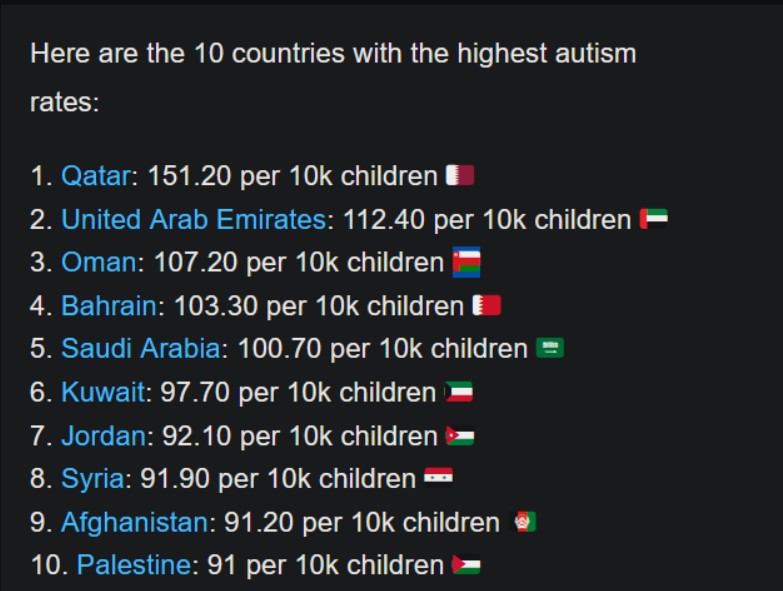
Reference:
- World Population Review (2020)
- World Population Review (2021)
- World Population Review (2022)
- World Population Review (2023)
Why have cousin marriages become more problematic for Muslims in the present era compared to the past?
Cousin marriage is not a new phenomenon in Muslim societies. It has existed for centuries, sanctioned by Islamic tradition and embedded in Arab cultural custom long before Islam codified it. Yet for most of Islamic history, the genetic consequences, while always present, were somewhat diluted by other practices that introduced new genetic material into Muslim populations. These factors were:
- Aggressive Conquests: In the past, Muslims engaged in aggressive wars, capturing women from other nations, and fathering many children through such encounters.
- Slave Trade: Muslims would purchase slave women from markets and maintain large harems with multiple non-related slave wives.
- Polygamy: The practice of polygamy was common, leading to multiple marriages, and many of these unions were not with cousins.
These factors contributed to a situation where Muslim societies were not as severely impacted by the health risks associated with cousin marriages.
However, circumstances have changed in the present era:
- End of Slavery: Slavery has already been abolished, and the practice of purchasing slave women has ceased.
- Decline of Aggressive Wars: Muslims no longer engage in offensive wars, resulting in the inability to capture non-Muslim women.
- Reduced Polygamy: The practice of polygamy has diminished, and Muslims now have limited opportunities to choose life partners, often leading to them selecting their cousin sisters as the first and only choice.
The result is that cousin marriage now operates in a closed genetic loop in a way it never fully did in previous centuries. There are no conquests bringing in new bloodlines. There are no slave markets supplying genetically diverse partners. There is no widespread polygamy drawing in women from outside the family network.
What remains is a sex-segregated social system, shaped by Islamic teachings on hijab, modesty, and the separation of unrelated men and women, that severely limits the opportunities young Muslims have to meet, interact with, and develop feelings for unrelated partners. In such a system, the cousin becomes not merely a convenient choice but often the only familiar and socially acceptable one. For many Muslim women in particular, marrying a cousin represents security and familiarity in a social environment where interaction with unrelated men has been made difficult or impossible by religious custom.
The genetic consequences of this closed system are now accumulating across generations without interruption. The suffering visible in Birmingham, Charsadda, and communities across the Muslim world is not the full picture. It is the early result of a process that, if left unchallenged, will only deepen with each passing generation.
Excuse 1: Science Cannot Be Trusted Because It Changes
One of the most common deflections used by Islamic preachers is the claim that science is unreliable because scientific understanding evolves over time. Since science has been wrong before, the argument goes, its findings on cousin marriage cannot be used to challenge Islamic practice.
This argument deliberately confuses two very different things: scientific hypotheses and scientific facts.
It is true that hypotheses are provisional. They are proposed, tested, and sometimes revised or discarded when new evidence emerges. That is not a weakness of science. That is science working exactly as it should. But not all scientific knowledge sits at the hypothesis stage. Some findings have been tested so thoroughly, confirmed so consistently, and reproduced so reliably across so many independent studies that they have solidified into established scientific fact.
The link between cousin marriage and genetic disorders in children is not a hypothesis. It is documented across decades of peer-reviewed research, confirmed in studies conducted in the United Kingdom, Pakistan, the Middle East, and beyond. The genetic mechanism behind it, the inheritance of identical defective gene variants from two closely related parents, is as well understood as any finding in modern biology.
To dismiss this as unreliable science is not intellectual caution. It is deliberate deception, deployed to protect a religious practice from the consequences of evidence.
Excuse 2: There Are Hadith That Discourage Cousin Marriage
Certain Muslim apologists engage in spreading Ahadith that discourages marrying close relatives. However, it is crucial to note that these Ahadith are fabricated and cannot be found in any authentic Hadith books of Muslims. To illustrate this deception, let us reference a quote from a Muslim website itself (link):
Question: Did the Prophet (peace be upon him) discourage marrying relatives (ie. cousins) even though it is lawful?
Answer:The short answer is that there are certain narrations that discourage marrying cousins, yet experts of hadith verification have determined them to be extremely weak or fabricated.
The Narrations in Question
– “Do not marry within the family [i.e., cousins], as that leads to children that are thin and weak.”
– “Do not marry within the family [i.e., cousins], since the child would be born thin and weak.”
– “Marry outside the family, lest the offspring be thin and weak.” [Ibn Hajar, Talkhis al-Habir]
Regarding these and similar narrations, the 7th century hadith specialist Ibn Salah said, “I found no reliable basis for them.” Many eminent hadith masters mentioned his statement and concurred, such as Ibn Hajar al-Asqalani, Ibn Mulaqqin, and others. [Ibn Hajar, Talkhis al-Habir; Ibn Mulaqqin, Khulasat al-Badr]
Taj al-Subki said regarding these narrations, “I found no chain of transmission (isnad) for them.” [Subki, Ahadith al-Ihya Alati La Asla Laha]
Hence it can be concluded that these narrations — as statements of the Prophet (peace and blessings be upon him) — are fabricated.
After mentioning Ibn Salah’s verdict, Hafiz Iraqi does state that it was rather Sayyidina Umar who made such a statement, specifically in response to a certain family/tribe whose offspring were thin and weak. He said, “You all have become thin and weak, so marry outside the family.” [Iraqi, Takhrij Ahadith al-Ihya’]
Thus, there is no Hadith from Muhammad that discourages marrying within the family.
In fact, the historical accounts present a different scenario:
- Muhammad himself fell in love with his first cousin Umm Hani, who happened to be the daughter of Abu Talib. However, Abu Talib declined the marriage proposal as Muhammad was not only poor but also lacked skills to earn a living. Consequently, Abu Talib did not consider Muhammad to be suitable enough to marry his daughter (link).
- Subsequently, Muhammad went on to marry Zainab bint Jahsh, who was his cousin-sister.
Regarding Umar's statement, it's important to note that he neither held the authority of Allah nor was he a prophet, thus his words do not constitute a part of Sharia.
Umar's suggestion was based on a common observation from ancient times that marrying strong women tended to produce stronger offspring, while marrying weak women led to weaker children. Consequently, when Umar noticed that the tribe of al-Sa'ib was becoming physically weaker, he specifically advised them to marry individuals who were more intelligent and stronger than themselves (had the people of al-Sa'ib been stronger, Umar would not have made this suggestion to them). Therefore, this was an exceptional case and not a general recommendation in Islamic Sharia. Sharia does not have a universal mandate to marry outside the family.
Furthermore, some Muslim apologists present the following argument (link):
عن الشافعي قال: أيما أهل بيت لم يخرج نساؤهم إلى رجال غيرهم كان في أولادهم حمق.
Al-Shafi’i said, “Whenever the people of a household do not allow their women to marry men outside of their line, there will be fools among their children.”
Once more, it is important to clarify that this saying attributed to al-Shafi'i is not a part of Sharia. Instead, it reflects a common observation among people during that era that marrying within the family could lead to health issues in the offspring. As a matter of fact, even Ibn Hajar al-Asqallani, another renowned Muslim scholar, rejected its inclusion in Islamic Sharia, and he wrote (link):
وأما قول بعض الشافعية يستحب أن لا تكون المرأة ذات قرابة قريبة فإن كان مستندا إلى الخبر فلا أصل له أو إلى التجربة وهو أن الغالب ان الولد بين القريبين يكون أحمق
The saying of some Shafi'i scholars suggests that it is preferable for a woman not to be closely related in kinship. However, this is not based on Hadith, it has no basis, and it is only be based on observation, which assumes that children born from close relatives tend to be less intelligent.
Therefore, Islamic Sharia does not offer any recommendation to avoid incestuous marriages with cousins.
Excuse 3: Genetic Testing Makes a Ban Unnecessary
The most modern and superficially reasonable excuse is that cousin marriage should not be banned because genetic testing can identify the risks in advance. If a couple undergoes carrier screening and receives a clean result, the argument goes, there is no justification for prohibiting their marriage.
This argument has several fatal flaws.
First, carrier screening cannot detect everything. Many recessive genetic conditions are extremely rare, potentially unique to a specific family line, and simply do not appear on standard screening panels. Comprehensive genetic testing regularly fails to identify the cause of a child's disorder even after that child has been born with severe disabilities. A clean screening result is not a guarantee of a healthy child. It is merely a guarantee that the tests used could not find what they were looking for.
Second, the argument proves far too much. If genetic testing is sufficient justification for cousin marriage, then by the same logic it should be sufficient justification for marriages between siblings, or between uncles and nieces, since siblings share 50% of their genes and uncle-niece pairs share 25%, the same proportion as double first cousins. If Islamic apologists are unwilling to extend their genetic testing argument to those relationships, they owe an explanation for why cousin marriage is the exception.
Third, and most fundamentally, this argument ignores the reality on the ground entirely. The communities producing the highest rates of genetically disabled children are not communities where genetic testing has been offered and refused. They are communities where cousin marriage continues because of religious sanction and cultural pressure, irrespective of any testing. Genetic testing is not preventing the suffering documented in Birmingham and Charsadda. It is not reversing Pakistan's status as home to the world's largest population of deaf children. The testing argument is a theoretical deflection from a very real and ongoing catastrophe.
Conclusion: The Children Cannot Wait
Throughout this article, the evidence has been allowed to speak for itself. It has spoken clearly, consistently, and without ambiguity. Thousands of children are born every year into lives defined by preventable suffering, suffering that is not the result of bad luck or natural misfortune, but of a marriage practice embedded in religious tradition and actively defended by religious authority.
The numbers are not abstract. Behind every statistic is a child. A child in Birmingham who will never walk unassisted. A child in Charsadda who will never hear his mother's voice. A child in Karachi who will not live to see his fifth birthday. These children did not choose the circumstances of their birth. They did not choose their parents' religion, their community's customs, or the theological rulings that made their suffering statistically predictable before they were even conceived.
Science has done its part. The genetic mechanisms are understood. The population data is documented. The intergenerational compounding of shared genes has been mapped with precision. Awareness campaigns have been tried. They have failed, not because the information was unclear, but because religious indoctrination proved stronger than evidence. When a practice is framed as divinely sanctioned, education alone cannot dismantle it.
This leaves a direct and uncomfortable responsibility at the door of politicians and lawmakers. The fear of being labeled Islamophobic has for too long been allowed to outweigh the suffering of children who have no political voice and no ability to protect themselves. That calculation is morally indefensible. A child born with a severe genetic disorder does not care about the political sensitivities that allowed the practice causing that disorder to continue unchallenged. That child simply lives with the consequences, every day, for the rest of their life.
Muhammad was not a divine messenger receiving revelation from an all-knowing God. He was a human being shaped by the customs and limitations of seventh century Arabia. He knew nothing of genetics, nothing of recessive inheritance, nothing of what happens to a population that practices close-relative marriage across dozens of consecutive generations. In that ignorance, he sanctioned a practice whose consequences now stretch across centuries and continents, measured in millions of damaged lives.
No divine being with genuine knowledge of human biology would have sanctioned cousin marriage. No truly compassionate God would have built a social system that funnels generation after generation of young people toward their closest genetic relatives. The suffering visible in the data from the UK, Pakistan, and the broader Muslim world is not a test from God. It is the entirely predictable consequence of human ignorance elevated to the status of divine law.
The children born into this system deserve better than deflection, better than fabricated hadith, better than apologists insisting that genetic testing makes everything acceptable. They deserve lawmakers with the courage to act, communities with the honesty to change, and a world that places their welfare above the protection of religious sensitivities.
They cannot wait for another generation of excuses.

 Hassan Radwan