
While humans have long recognized the physiological and mental benefits of practices like yoga and fasting, the existence of these rituals does not serve as proof for the divine origin of the religions that adopt them. Fasting, in particular, is a prehistoric human practice that long predates the advent of Islam.
The core issue is not the act of fasting itself, but the specific, "out of balance" framework imposed by Islamic doctrine, which often transforms a health-positive habit into a source of physical and social harm. These systemic imbalances in the rules of Ramadan suggest a lack of divine oversight. Instead, they point to a human origin: Muhammad, acting as an individual without the benefit of infinite foresight, established a set of rulings that reflect human error and a lack of medical and scientific omniscience.
Table of Contents:
- Ramadan: The "out of balance" Islamic approach
- Bad Breath (Halitosis) During Ramadan Fasting: A Common but Avoidable Inconvenience
- The Historical Origins of Ramadan: Where Did It Actually Come From?
- The Enforcement of "Respect": Blasphemy Laws and Public Coercion
- Religious Abuse: The Social Shaming of Non-Fasters
- It is not necessary to stay hungry to understand the miseries of poor people
- The Zakat Argument:
- External Links:
Ramadan: The "out of balance" Islamic approach
Basically, Islamic Fasting is nothing else than:
-
Disturb your sleep and wake up in the middle of the night which opposes the health principles. It is known as Suhur (سحر) i.e. 'pre-dawn meal' before the start of the fast.
-
The duration between night dinner (a heavy meal) and Suhur (again a heavy meal at the last part of the night) is not long enough for the stomach to digest the previous food that was eaten at dinner. Therefore, eating once again at Suhur in the state of an already full stomach is against wisdom (it again opposes the health principles). Even animals are wise enough and if cattle and horses are fed in the middle of the night or even before dawn, then they don’t touch food. They start eating only after dawn.
-
And after eating a meal at Suhur, immediately running towards the mosque and doing sit-ups and prostration during prayer with a full stomach. It is a recipe for stomach upset and again opposes the health principles.
-
Normally, many people go for a long morning walk and morning exercise and to the gym (especially in countries with a warm climates). But in Ramadan, they cannot go for long healthy morning walks or gym, while their stomachs are full of food. Moreover, they also avoid healthy activity in the morning due to the fear of becoming thirsty. Thus, gyms become empty in the morning, and there are hardly any people who go out for long morning walks.
-
And then spend the next 14 to 18 hours in a state of thirst and laziness and weakness and dreaming about food. The output during this whole period is minimal.
-
And in the evening, break the fast (known as Iftar) by attacking the food and eating all types of unhealthy foods. There are two factors involved. One is hunger and thirst, while the other is Muslims cooking their most delicious and their most expensive food during the month of Ramadan, which makes it difficult for people not to over-eat. And most importantly, after many hours of hunger and thirst, the body's hormonal response strongly pushes toward overeating.
-
And after some time again start eating the night dinner (although the stomach is still full of the evening Iftar eating). It again opposes the health principles.
-
After taking dinner, immediately run towards the mosque for the 'Isha and Tarawih Prayer and spend the next one and a half hours in a state of standing and pain (once again it opposes the health principles as the human body does not need this running and standing after the full stomach, but the rest so that blood can gather in the digestive tract (digestive mussels) to digest it (link). You just have to watch how people are standing in Tarawih with full stomachs. They are half asleep and wishing (or perhaps even praying) only for the completion of this punishment i.e. Tarawih.
-
A person needs a certain amount of liquid consumption per day. Since people cannot drink during the fasting period, thus people are Drinking + Eating at the same time at Iftar and at dinner and at Suhur (which opposes health principles). In simple words, there is never enough time to give a break between eating and drinking during Islamic fasting and people are compelled to do both at the same time.
-
People cannot go to bed early to sleep, as they need some time for their families too. Iftar and then Tarawih prayers in mosques waste a lot of their time which they cannot spend with their families. As a result, they are late going to bed for sleeping.
-
It also affects the 'sex life'. Firstly, Muslims are allowed to do sex with their partners only during the night. Secondly, they have to take a whole body bath before the Fajr prayer. This once again reduces the time for sleep. People have to make water hot (especially in cold places and in winter). Women with long hair need a lot of time after bathing to dry their hair. For all that, people have to wake up middle in the night (long before start of fasting). Remember, in the past centuries, people didn't have the luxury of bathrooms in their houses, and they had to go to the common Hammams. Now imagine how difficult it was for men and women to go to Hammams during the middle of the night.
- And then repeat this unnatural cycle of eating and sleeping for the next 30 days.
Bad Breath (Halitosis) During Ramadan Fasting: A Common but Avoidable Inconvenience
One practical downside of Ramadan fasting is bad breath, which many people experience and others notice.
Why it happens:
- No food or water all day causes dry mouth (less saliva). Saliva normally cleans the mouth and fights bacteria.
- Empty stomach leads to more stomach acid and ketones (from fat burning), which can cause bad smells in breath.
- Dehydration makes the tongue dry and mouth taste bad.
Scientific studies confirm this: During Ramadan, saliva flow drops significantly, increasing bacteria and volatile sulfur compounds that cause halitosis. Up to 57% of fasters report bad breath in some surveys (Scientific Study).
Impact on others: In public places like buses, trains, offices, or schools, this can make it uncomfortable for non-fasters or colleagues sitting nearby. It adds to daily stress for everyone during the month.
Islamic rules and limitations:
-
Miswak is considered good. However, it does not address the root causes of bad breath during fasting, such as dehydration, low saliva production, or stomach acid.
-
Toothpaste is generally regarded as makrooh, meaning disliked or not recommended during fasting. If any particles are swallowed and pass down the throat, the fast is considered broken. For this reason, many Muslim scholars advise using toothpaste only before the fast begins.
This shows another "out-of-balance" aspect: A religious practice meant for spiritual benefit creates real-world inconveniences.
Islamic Argument: Allah didn't tell us to overeat, but Muslims are responsible themselves for overeating
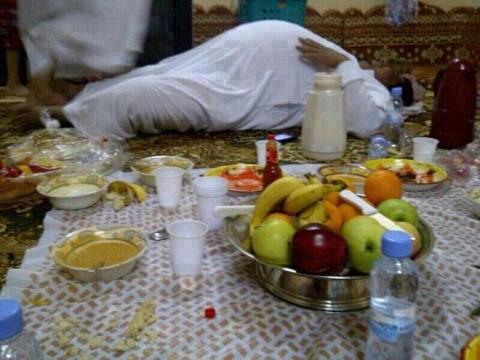
Muslim preachers often respond to the overeating critique by pointing out that Islam does not instruct anyone to overeat, and that individuals are personally responsible for their own choices.
This response deserves a fair and honest examination.
It is true that Islam does not explicitly command overeating. However, this argument overlooks something important about how the human body actually works. After many hours without food, human hormones do not simply return to a neutral state when food becomes available. Hunger hormones like ghrelin rise sharply during prolonged fasting, and the body's natural response when food finally appears is to eat more than necessary. This is not a moral failing. It is a biological mechanism.
This pattern has been observed consistently across Muslim populations for fourteen centuries. Islamic teachings have not been able to change it, because the issue is not one of religious instruction. It is one of human physiology. A system that is genuinely designed by an all-knowing Creator would presumably account for how human hormones and biology actually function.
The Historical Origins of Ramadan: Where Did It Actually Come From?
This is perhaps the most historically significant section of this article, and one that most Muslims have never encountered.
After migrating to Medina, the Prophet Muhammad spent approximately a year and a half attempting to build an alliance with the Jewish community there, hoping they would recognize and accept his prophethood. However, according to Sahih Bukhari, Hadith 3941, not even 10 Jews accepted his prophethood. This rejection created a significant rupture, and Muhammad's relationship with the Jewish community of Medina deteriorated sharply.
In response, Muhammad made a series of deliberate changes to distance Islamic practice from Jewish practice. The direction of prayer was changed from Jerusalem to Mecca. And the fasting practices, which had initially mirrored Jewish tradition, were also changed.
In the first year after migration, Muslims had been instructed to fast on the tenth of Muharram, directly mirroring the Jewish observance of Yom Kippur. After the breakdown with the Jewish community in the second year, Muhammad first added the ninth of Muharram alongside the tenth, to create a distinction. But this was not considered sufficient differentiation. Later that year, following the Battle of Badr, an entirely new month-long fast was introduced during Ramadan.
The model for this new fast was not Jewish. It was drawn from the practices of the Harranians, an ancient pagan people from the city of Harran in what is now southern Turkey near the Syrian border. The Harranians are widely believed to be the group referred to as the Sabians in the Quran.
The historical record of what the Harranians practiced is striking in how closely it mirrors Ramadan:
-
According to the medieval historian al-Nadim, the Harranians honored their moon god Sin by fasting for thirty days during a specific month, abstaining from food between dawn and sunset, and concluding the fast with a celebration.
-
Another historian, Ibn Abi Zinad, recorded that the Harranians also prayed five times a day and fasted from before sunrise until sunset, exactly as Muslims do during Ramadan.
-
A third historian, Ibn al-Juzi, noted that they ended their fast by sacrificing animals and distributing alms to the poor, practices that are also central to the Islamic Eid al-Fitr celebration.
-
Most remarkably, according to al-Nadim, the Harranians called their concluding festival al-Feter, which is the exact same name used for the Islamic Eid al-Fitr.
Dr. Rafat Amari, a scholar who has researched this area extensively, concluded that Ramadan was originally an annual ritual of the city of Harran, practiced by pagan moon worshippers, and was introduced into Arabia by the Harranians before being incorporated into Islamic practice (Source).
This historical evidence does not prove or disprove the truth of Islam on its own. But it does raise serious questions about the divine origin of a practice that appears to have been borrowed directly from a pagan moon-worshipping tradition, motivated at least in part by a desire to distinguish Islam from Judaism following a political and religious rupture.
The Enforcement of "Respect": Blasphemy Laws and Public Coercion
In many Islamic societies, the "out of balance" nature of Ramadan extends beyond the individual’s body and into the legal policing of others. Under the guise of preventing "blasphemy" or "insulting religious sentiments," states often enforce strict bans on public eating and drinking during daylight hours, frequently targeting non-Muslims.
The common justification for these punishments is that seeing someone eat or drink "hurts the feelings" of those who are fasting. This logic suggests that Islamic piety is so fragile that it cannot withstand the mere sight of natural human sustenance.
And if fasting is intended to build self-restraint (Taqwa), then the presence of food should be the ultimate training ground for that restraint. By removing the sight of food through legal force, the spiritual "test" is bypassed entirely, replaced by state-mandated conformity.
Moreover, there is a profound ethical inconsistency in how "hurt feelings" are prioritized during this month:
If eating in front of a hungry person is a moral crime worthy of legal punishment, then the elaborate, public Iftar feasts enjoyed by the wealthy should, by the same logic, be seen as a grave insult to the chronically impoverished. Millions of children suffer from involuntary hunger every day of the year. Yet, the same people who demand "respect" for their 15-hour fast do not ban public eating for the rest of the year to spare the feelings of the starving. This reveals that the law is not about empathy for the hungry, but about the dominance of Islamic ritual.

- An 80-year-old Elderly Hindu man was beaten up in Pakistan for eating during the Muslim holy month (link).
Religious Abuse: The Social Shaming of Non-Fasters
The problems with Ramadan do not stay within mosque walls or state law. In many Western countries, a pattern of social shaming directed at people who do not fast has become a documented and growing problem. This behavior deserves to be called what it is: religious abuse.
For example, watch this video:
In Schools:
Perhaps the most concerning examples involve children. In east London, several primary schools including Barclay Primary School faced situations where children as young as eight and nine were fainting from fasting. But the deeper problem was the social environment surrounding it. When fasting is treated as a mark of moral superiority, children who do not participate, whether for health reasons, age, or personal choice, become targets of peer pressure, exclusion, and verbal harassment.
Organizations like the Council of Ex-Muslims of Britain have documented cases where non-Muslim children and non-practicing Muslim children in schools with high Muslim populations faced harassment and were made to feel that eating their lunch was something shameful. Several UK local authorities, including Waltham Forest, have had to issue specific guidance to schools suggesting that children who eat should be given separate spaces precisely to protect them from this kind of targeting. The fact that such guidance was necessary at all is itself an acknowledgment that religious peer pressure in schools is a real and documented problem.
More discussion here:
Governments should have been clearer much earlier: children under 14 should not be expected to fast during school days, and any child who shames a peer for eating should face the same consequences as any other form of bullying.
In the Workplace:
The same dynamic has moved into professional environments. The most common flashpoint is the argument that the sight or smell of food being eaten near a fasting Muslim is offensive and should be restricted.
This argument needs to be examined carefully, because its logic is genuinely dangerous. The claim that "your eating hurts my feelings and should therefore be stopped" is precisely the same reasoning used by Hindu nationalist groups in India to justify banning meat consumption for Muslim minorities. If that reasoning is rightly rejected when applied to Muslims, it must be equally rejected when Muslims apply it to others. A principle of human rights cannot be selectively applied based on who is making the claim.
Workplaces need to be explicit about this. Harassing or shaming a colleague for eating during Ramadan is not an expression of religious freedom. It is workplace abuse, and it should carry professional consequences in the same way any other form of harassment would.
It is not necessary to stay hungry to understand the miseries of poor people
Muslims also claim:
When rich people have to fast, then they understand the hunger of poor people too, and they help poor people more.
Response:
Firstly, if someone is crippled, then we don't need to break our leg too in order to understand his suffering. Empathy with someone's suffering doesn't necessitate experiencing the same hardships first-hand. Analogously, understanding the plight of the poor doesn't require subjecting oneself to the unnatural and harmful practices of Islamic fasting; instead, it involves cultivating compassion and humanity.
Please also see these realities which Islamic apologists neglect:
1. Muslims Spend More on Food During Ramadan:
Many Muslims buy 50% to 100% more food during Ramadan. They eat bigger meals at Iftar (breaking fast) and Suhoor (pre-dawn meal). This does not reduce hunger, but it often increases eating.
- Study on Moroccan families: Food spending rose by about 50% during Ramadan. Link to study (PMC/NIH)
- Report: Food bills go up 50-100%, and people change eating habits a lot. Link to HLB International report
2. Food Prices Go Up which Hurts the Poor:
In Ramadan, prices for basic foods (like dates, meat, bread) rise because of high demand. This makes life harder for poor families who need cheap food.
- In Malaysia, food prices can rise due to more demand for special Ramadan foods. Link to Khazanah Research Institute (2025)
- In many countries, poor people struggle more with high prices. Link to Al Jazeera on rising prices (2023)
3. Business Slows Down, means Fewer Jobs and Money:
Work slows a lot in Ramadan. Offices close early, people feel tired, and decisions wait until after the month. This hurts poor workers who need daily jobs.
- Productivity can drop 35-50% because of shorter hours and tiredness. Link to BBC News
- Economic growth falls in Muslim countries during Ramadan. Link to Harvard study summary
4. Hard for Poor Workers:
Poor people in hard jobs (like building or farming) must work while hungry and thirsty. This is dangerous and tiring. Fewer jobs are available because businesses slow down. In poor countries, some skip fasting because they have no food anyway.
- In Afghanistan, many cannot fast because of hunger and poverty. Link to Radio Free Europe (2024)
Thus, it is a reality that Ramadan can be hard for poor people with higher prices, less work, and hunger make it worse, not better.
Moreover, fasting exists in many cultures, not just Islam. In non-religious societies, we have new ways to show care (like Mother's Day or charity events). If needed, we could make better fasting traditions, without 30 straight days, without health risks for women, without big food waste, and without hurting the economy or the poor.
The Zakat Argument:
Islamic preachers come up with an excuse that Zakat saves poor people during Ramadan. But we all know that Zakat system is broken in almost all Islamic countries on the state level, and there is no guarantee that every needy person get Zakat. Many people have Ghayrah and they don't want to beg for Zakat, but they are also compelled for it.
And here is a Study of Egypt which tells Zakat is not enough to help alleviate poverty (link):
The study estimates the potential zakat collection in Egypt while the potential zakat as percentages to GDP were 1.05%, 1.04% and 1% for years 2000, 2005 and 2008 respectively. Accordingly, zakat contributes by 0.233$, 0.196 and 0.387 per day in years 2000, 2005 and 2008 respectively and these are not enough to alleviate poverty in the Egyptian Economy.
Does Ramadan Really Make Muslims More Honest?
Some Muslim preachers say that during Ramadan, people become much more honest. They claim fasting stops lies, cheating, and bad behavior.
But this idea has problems.
Muslims believe Allah is always watching, every day of the year. If the fear of Allah does not stop dishonesty the rest of the time, why would fasting for one month suddenly make a bigger difference? Does going hungry have more power than God's constant presence?
Even if some people act better during Ramadan, the change often ends when the month is over. This might help explain why corruption and dishonesty continue in many places year-round.
Compare this to Japan, a largely non-religious society known for strong honesty. In 2024, people in Tokyo turned in a record ¥4.49 billion (about $30 million) in lost cash to the police. Link to Kyodo News report (2025) Link to Japan Today on 2024 record
This honesty comes from education, culture, and values like respect and responsibility. It lasts all year, not just during one special month.
Ramadan may make some people feel more moral or proud of their fasting, but true honesty should not depend on temporary hunger or rituals. It should be steady and come from inner values, not fear or a month-long routine.
External Links:
- https://wikiislam.net/wiki/Islamic_Fasting_and_Health (Highly Recommended)

 Hassan Radwan