Please note that:
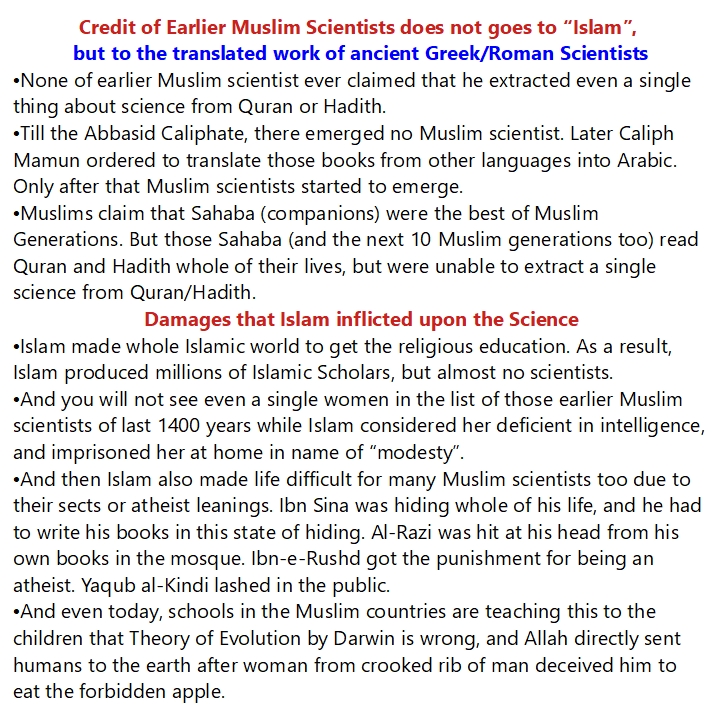
- None of the earlier Muslim scientists ever claimed to derive scientific discoveries directly from the Quran or Hadith.
- Muslims were initially introduced to Greek/Roman scientific works through their conquests in Egypt and other regions. Later, Abbasid Caliph Mamun (d. 213 Hijri year) ordered the translation of these works into Arabic. Only after this development did Muslim scientists begin to emerge.
- Muslims assert that the Sahaba (companions) of Muhammad were the best of Muslim generations. However, despite reading the Quran and Hadith throughout their lives, the Sahaba and the subsequent 5 to 10 Muslim generations were unable to extract any scientific knowledge from the Quran and the Hadith.
- Present-day Muslims also struggle to extract scientific discoveries directly from the Quran/Hadith, often relying on science to make new findings before connecting them to the Quran.
Damages that Islam Inflicted upon the Science
- Islam made the whole Islamic world get religious education like a donkey. As a result, Islam produced millions of Islamic Scholars in the last 1400 years, who were involved only in Fiqh and Sectarian fights. Compared to those millions of Islamic Scholars, Islam was unable to produce even a handful of scientists.
- And you will not see even a single woman in the list of those earlier Muslim scientists of the last 1400 years, while Islam considers women to be deficient in intelligence, and they had to stay at home in the name of "Islamic Modesty".
- Moreover, the prohibition of studying human anatomy by Islam, in the name of "respect" for the deceased hindered medical progress for centuries, impeding critical advancements in the medical field.
- And then Islam also made life difficult for many Muslim scientists too due to their sects or atheist leanings. Ibn Sina was hiding his whole life, and he had to write his books in this state of hiding. Al-Razi was hit in his head by his own books in the mosque. Ibn-e-Rushd got the punishment for being an atheist. Yaqub al-Kindi lashed in public.
- In contemporary times, schools in Muslim countries continue to teach that Darwin's Theory of Evolution is incorrect, promoting the belief that humans were directly created by Allah and that Allah directly sent humans to the earth after a woman from the crooked rib of a man deceived him to eat the forbidden apple.
Various factors contributed to the Islamic Golden Age, which saw significant advancements in knowledge and scholarship. It is essential to recognize that this motivation to learn was not unique to Islam, and religion itself was not a necessary condition for intellectual progress.
A crucial catalyst for this flourishing period was the inheritance and study of pre-Islamic texts, encompassing a wide array of subjects. Additionally, government support and sponsorship of scholars fostered an environment conducive to intellectual pursuits.
Large trading networks facilitated the exchange of new information and technologies, contributing to the cross-fertilization of ideas. During the Islamic Golden Age, scholars from various backgrounds, not limited to Muslims, made valuable contributions. Although some individuals may have been contentious figures, their input was part of a broader tapestry of knowledge enrichment.
The impact of the Islamic Golden Age extended beyond the Muslim world, greatly influencing Europe's subsequent advancements. Intellectual progress is often built upon the works of neighboring and past cultures, whether European, Chinese, Persian, Iraqi, Syrian, Roman, Greek, Indian, and beyond. This cross-cultural exchange is not something to be embarrassed about; instead, it should be celebrated as people learn and improve from one another.
For a comprehensive overview of the causes and decline of the Islamic Golden Age, Wiki's Islamic Golden Age article provides valuable insights.
Read in Image Format

 Hassan Radwan