The Importance of This Topic: Whoever wants to study Islam, it is "essential" that they "begin" here.
The stories Prophet Muhammad narrated to strengthen his new religion included:
- Mecca has been inhabited since the time of Abraham (i.e., 2000 years before Christ).
- Ishmael's descendants spread throughout Arabia, and the entire Arabian Peninsula was monotheistic, believing in the "Abrahamic God." It was only about 300 years before Muhammad's arrival that they inclined towards idolatry.
- Mecca was the most famous and renowned city in Arabia because it was located on a crucial trade route, and due to the Zamzam spring, caravans and Arab nomads came here to fill their water supplies. Moreover, it was the most sacred city for all of Arabia, where people from all over Arabia came for pilgrimage every year (just as Mecca is the most famous and renowned city among Muslims today due to its sanctity).
However, modern science has disproved all these religious stories:
-
Discovery of a Vast Archaeological Treasure in Arabia: Since it doesn't rain in the Arabian region and there's no humidity, things are naturally preserved. With the help of modern science, archaeologists have discovered hundreds and thousands of archaeological treasures in Arabia. These include statues of idols, images, and thousands of inscriptions on rocks and stone tablets. But the ultimate surprise was that no trace of Mecca was found, nor of Allah, nor of Abraham and Ishmael, nor of even a single monotheistic mosque or place of worship. Instead, only Sabian places of worship, their idols, and their teachings were found in these cities (even though, according to Prophet Muhammad's story, the entire Arabian Peninsula was completely monotheistic until 300 years before his birth).
-
Ancient Roman Historians' Books on the History of Arabia: The next issue was that Northern Arabia was part of the Roman Empire, and ancient Roman historians had detailed mentions of every city in the Arabian region in their books. These books provide detailed descriptions of the kingdoms in each region and the genealogies of their kings. They also mention the tribes present in each area. Thus, it was astonishing when modern historians did not find any mention of a city named Mecca, nor any mention of any mosque or Allah, or of Abraham or Ishmael, or of pilgrimage to Mecca in these books. Nor was there any mention of the Zamzam spring (even though, according to Prophet Muhammad's story, Mecca was the most important and renowned city in Arabia where people from all over Arabia came for pilgrimage every year, and the local Bedouin tribes came here to water their animals, and it was located on the most important trade route where all trade caravans passed through).
-
The Current State of Muslims: You can see the current state of Muslims where they have inscribed "Allah", "Muhammad" and other Islamic writings everywhere. Thus, it is impossible that there are thousands of inscriptions and writings in Arabia mentioning the names of idols, but there is a complete absence of any mention of a Allah, Abraham, Ishmael, Mecca, Zamzam, or pilgrimage.
The beginning of these Islamic stories stems from Prophet Muhammad wanting to incorporate his role into the story of Abraham as narrated in the Bible.
According to the Bible:
- When Abraham, at his wife Sarah's request, banished Hagar and Ishmael, they wandered alone in the wilderness of Be'er Sheva (present-day Israel).
- Ishmael was a 16-year-old boy. When he grew tired of thirst in the wilderness of Be'er Sheva, Hagar placed him under a bush and went and sat on a distance to avoid watching her son die. At that moment, a spring of water appeared there.
- Abraham intended to sacrifice Isaac, not Ishmael, and at that moment, a ram appeared.
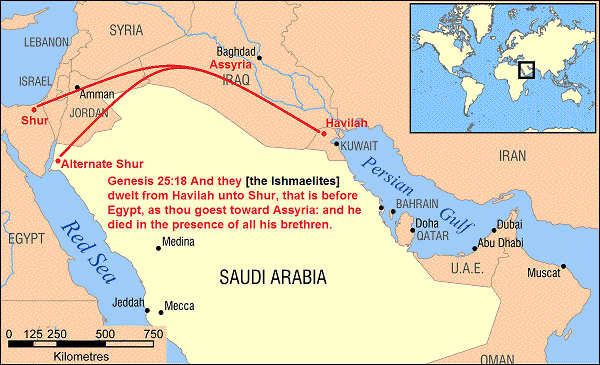 Ishmael's descendants settled from the southern part of present-day Israel to southern Syria and northern Arabia, extending to western Iraq. This is a green, fertile strip that has always been inhabited. You can see this strip marked in red on the map, which is where, according to the Bible, Ishmael's descendants settled.
- In contrast, present-day Mecca is located in central western Arabia, which remained a completely barren and uninhabited area until the time of Christ (i.e. Mecca appeared in history only about 600 years before Muhammad).
- Ishmael's descendants identified themselves as Jews, used the same Bible, and there was no difference between them and other Jews. Later, the descendants of Ishmael and Isaac became so intermixed that distinguishing between them became impossible.
While, according to Prophet Muhammad's modified story:
- Abraham brought Hagar and Ishmael not to Be'er Sheva (present-day Israel) but to Mecca, leaving them there alone and then returning.
- Ishmael was an infant. When he cried out of thirst, Hagar ran between the two hills named Safa and Marwah. Then, a spring of water gushed out from under Ishmael's feet. Later, the Arab nomadic tribe "Banu Jurhum" passed by, saw the water, and settled there.
- Abraham later returned to Mecca and, with Ishmael's help, rebuilt the Kaaba.
- Abraham intended to sacrifice Ishmael, not Isaac, and at that moment, a ram appeared.
- Ishmael's descendants spread throughout Arabia. They identified themselves not as Jews but as followers of Abrahamic religion.
- Prophet Muhammad claimed that he himself was a descendant of Ishmael.
- However, the Arabs of Prophet Muhammad's time were unaware of these stories. They knew nothing of Adam, Abraham, Ishmael, or Hagar, nor did they know that they were descendants of Ishmael. They heard these claims for the first time from Prophet Muhammad.
Bible vs. Muhammad: Who is Correct?
The question now is how to decide who is correct in the clash between the Bible and Muhammad.
Or are both of them wrong?
Modern scientific research has at least proven that the stories Prophet Muhammad narrated about the existence of "Mecca" and the "Abrahamic God" in ancient Arabian history cannot be correct beyond a shadow of a doubt.
The Change of Qibla: The Beginning of Hostility with the Jews and New Stories
Since Prophet Muhammad initially presented his new religion as a continuation of the God of the Jews and Christians, he first changed the direction of prayer (Qibla) in Mecca from the Kaaba to Jerusalem. Upon arriving in Medina, Muhammad adopted more Jewish laws to appease the Jews. However, he soon faced complete failure as the Jews did not accept his claim to prophethood and instead called him a false prophet.
This marked the beginning of hostility towards the Jews, and the Qibla was changed for the second time, redirecting it from Jerusalem back to the Kaaba.
People understood this to mean that Muhammad was angry because the Jews did not accept him as a prophet, and thus, in retaliation, he changed the Qibla. In response to this criticism, Muhammad called these critics 'fools' in the Quran. The Quran mentions:
(Surah Al-Baqarah, Ayahs 143 to 146): "The foolish among the people will say, 'What has turned them away from their Qibla, which they used to face?' ... We only appointed the Qibla which you used to face in order to know who follows the Messenger and who turns back on his heels."
This raised questions in the minds of people (including Muslims) about the nature of God and His wisdom. They wondered why God would first direct them to face the Kaaba, then change the Qibla to Jerusalem, and then revert to the Kaaba after a year and a half due to displeasure with the Jews.
It was difficult for the creator of the Quran (i.e., Prophet Muhammad) to provide a satisfactory answer to this objection. Therefore, to silence the critics, Muhammad called them 'fools' in the Quran and presented the excuse that God wanted to see who would turn back on their heels.
This excuse seemed strange, as it suggested that God made the Qibla change twice just to see if some people would turn back. Interestingly, history does not record a single person who left Islam because of the change of Qibla.
Thus, the question remains for Muslims: if no one left Islam due to the change of Qibla, what was the necessity for God to change it twice? It clearly shows that Prophet Muhammad used God's name to express his personal enmity towards the Jews.
The matter did not stop at the change of Qibla. Muhammad now had to prove himself superior to the Jewish prophets in every way. Hence, new stories were created:
- Hagar and Ishmael did not go to Be'er Sheva (Israel) but came to Mecca with Abraham.
- The next story was that Abraham intended to sacrifice Ishmael, not Isaac. Declaring Ishmael as the one to be sacrificed aimed to give him precedence over Isaac. Then, to elevate his own status, Muhammad claimed he was a descendant of Ishmael.
These stories started in Medina after the change of Qibla.
Why did the name and sign of the Kaaba disappear after Adam, so Abraham had to rebuild the Kaaba?
It was obligatory for the Prophet of Islam to give himself precedence over the People of the Book and their Prophets and Qiblah. Therefore, later the Prophet of Islam claimed after the custody of the Kaaba that the Kaaba is superior to Bait-ul-Maqdis because Abraham and Ishmael built it before Bait-ul-Maqdis. Rather, to give the Kaaba more merit, it was claimed that the Kaaba was the first house of Allah on earth, which was first built by Adam (Surah Aal Imran, verse 93). It should be remembered that in the 13 years of Mecca, Muhammad did not say that the Kaaba was the first house of Allah on earth, but the author of the Qur'an (i.e. Muhammad) at the time of the migration to Medina and the subsequent quarrels with the Jews, and then the possession of the Qibla. remembered to mention that the Kaaba was the first house of Allah on earth, to prove its superiority over Bait al-Maqdis. (See Maududi Sahib's interpretation regarding the time of revelation of Surah Al-Imran).
For example, the author of the Qur'an (i.e. Muhammad Sahib) claimed that the Kaaba was the first house of Allah on earth, but then the reason was not explained why this first house of Allah after Adam was ruined and desolate. And why was the mark erased? Why did Abraham not know about the presence of the Kaaba when he arrived in the desert with Hagar and Ishmael? Why did Abraham have to rebuild the Kaaba? And why did Allah not protect his first and holiest house?
Ask the Muslims a thousand questions, but they will never answer you from the Qur'an and the Sunnah, rather they will keep doing things from their own side.
Why didn't the countless prophets who came after Abraham and the entire Bani Israel come to Mecca every year for Hajj?
The author of the Qur'an (i.e. Muhammad Sahib) further claimed that when Abraham built the Kaaba, Allah commanded him to invite all the people of the world to come on Hajj.
(Surah al-Hajj, verses 26-27) And (remember the time) when We determined the place of the Ka'bah for Abraham (and commanded him) not to associate anything with Me and to circumambulate My House. To keep clean for those who stay and those who bow and bow and those who prostrate. And announce the Hajj among the people, and they will come to you on foot and on all the lean camels that come from far away.
According to this order, it was obligatory for the countless prophets who came after Abraham and the entire Bani Israel to come to Mecca and perform Hajj to the Kaaba every year. But be it the Bible, or hundreds of other books of history written by Jews and Christians, or the ancient books written by the historians of the Roman Empire on the history of Jews and Christians, nowhere is there a single prophet or the Israelites. There is no mention of him coming to Mecca every year for Hajj.
And in the Qur'an itself and in the collection of millions of hadiths, there is no mention of Isaac ever coming to Mecca for Hajj, nor of any other prophets, nor of the entire Ummah of Bani Israel.
And you and the Quraysh and the people of Mecca themselves have never known about the Jews and Christians in their history that they used to come to Mecca every year for Hajj to the Kaaba.
Muslim excuse: Ancient empires erased all evidence of Mecca, Abraham and Hajj in a "systematic perfect global conspiracy" against Islam.
Modern Islam apologist is also a fool. During the excavations, hundreds and thousands of artifacts were recovered from every ancient city in Arabia. If the excuses offered by Islam apologists regarding them are collected, the overall situation is as follows:
- The Jews, the Christians, the Roman Empire and the Saiyans all knew that Muhammad was going to be born in the future and destroy their religions. So, even before the birth of Muhammad Sahib, they worked together to prepare a great, organized and perfect global conspiracy against Muhammad and Islam.
- Under this great conspiracy, the entire world of Jews and the entire world of Christianity (that is, in all the countries where Jews and Christians existed) together distorted all the Torah and Bible manuscripts, and among them Abraham and The prophets who came after them and the entire Jewish and Christian Ummah going to Mecca every year for Hajj and sacrificing millions of animals every year were also removed from the Torah and the Bible.
- And this distortion was not only limited to the Torah and the Bible, but hundreds of other historical books were written in the Jewish world and the Christian world, apart from the Torah and the Bible. And the mention of other Prophets and the entire Jewish and Christian Ummah going to Mecca every year for Hajj was omitted.
- After Torah, Bible and other books came archeology. They destroyed all the archetypes found in the entire Jewish and Christian worlds (rock and stone inscriptions, etc.) related to the Hajj to the Kaaba in Mecca and the slaughter of animals every year. He went to disprove Muhammad and Islam in the future.
- Then the ancient Roman Empire also systematically joined the Jewish and Christian scholars in this conspiracy, and all the ancient Roman and Greek historians who were collecting the history of Arabia, they also recorded Mecca and Hajj and millions of animals every year. The mention of sacrifice was deleted under conspiracy.
- According to Islam apologists, 300 years before the birth of Muhammad, the people of Arabia were monotheists and followers of the Abrahamic religion. But only after that, innovations arose among the Arab people and they left Tawheed Allah and started worshiping stars and idols and became Sabians (see Islamic references further in the same article). And as soon as they became Sabians, they also became part of this global conspiracy of Jews and Christians and the Roman Empire, and they completely erased the mention of Allah, Abraham, Mecca and Hajj and sacrifice from the whole of Arabia, and there was no book about them. No antiquities were left without destruction, and all such inscriptions on rocks and stones were erased, and the places of worship of the Abrahamic religion in every city were destroyed.
- The Saibins not only destroyed the antiquities related to the Abrahamic religion and the Kaaba and Hajj, but after that they carved new texts according to the Sabian religion on the rocks and stones, demolished the mosques of the Abrahamic religion and built Sabian places of worship in their place. . And they did all this because they also knew that Muhammad Sahib was going to be born in the future and they had to block the path of Muhammad Sahib and Islam through this perfect conspiracy.
Can any sane person ever believe in this "Great Perfect Conspiracy Theory" of Muslims?
Who is Zabih Allah? Ishmael or Isaac?
According to the story of the Bible, Muhammad said that Zabihullah was Isaac. But the six Muslims who came later were small when the question arose that Isaac had never come to Mecca, then how did Abraham slaughter Isaac in the Kaaba in Mecca on the day of Hajj?
Imam Qurtubi writes in his commentary on Quranic verse 37:102 ( link ):
Scholars have disagreed about whose slaughter was ordered. The opinion of many is that it means Ishaq ( peace be upon him ) . Hazrat Abbas bin Al-Muttalib, his son, Hazrat Abdullah, is among those who made this statement. This is the Sahih on the authority of Hazrat Abdullah Ibn Abbas. Al-Thawri and Ibn Juraj attribute it to Hazrat Ibn Abbas and said: Zabih is Hazrat Ishaq (peace be upon him). The same has been narrated from Hazrat Abdullah bin Masoud. He heard a man addressing him: O Ibn al-Ashiyakh al-Karam. Hazrat Abdullah replied: He is Hazrat Yusuf bin Yaqoob bin Ishaq Zabihullah bin Abraham Khalilullah, peace and blessings be upon him. Hammad bin Zayd narrates a tradition from the Holy Prophet (peace and blessings of Allah be upon him) who said: They are al-Kareem bin al-Kareem bin al-Kareem ibn al-Kareem, Yusuf bin Yaqoob bin Ishaq bin Abraham (peace be upon him). That is, Karim bin Karim bin Karim bin Karim is Hazrat Yusuf, Hazrat Yaqub, Hazrat Ishaq and Hazrat Abraham (peace be upon him). Abu Zubair has narrated a hadith from Hazrat Jabir (R.A.) that Hazrat Ishaq (A.S.) is the slaughtered animal. It is also narrated from Hazrat Abdullah bin Umar (may Allah be pleased with him) that Zabeeh is Hadhrat Ishaq (peace be upon him). This is also the saying of Hazrat Umar (RA). These are seven companions. The Tabi'een and other scholars have also said this, including Alqamah, Sha'bi, Mujahid, Saeed bin Jubeer, Ka'b al-Ahbar, Qatadah Masrooq, Ikramah, Qasim bin Abi Bazzah, Atta, Muqatil, Abd al-Rahman bin Sabat, Zuhri, Sidi, Abdullah bin Hazil. And Imam Malik is Ibn Anas, they all said: Zabih is Hazrat Ishaq (peace be upon him). This is the view of the People of the Book, that is, Jews and Christians. Many scholars adopted this, among them Hazrat Nihas, Tabari and other scholars. Other scholars said: Zabih is Hazrat Ismail (peace be upon him). Among the scholars who said this are Hazrat Abu Hurairah, Hazrat Abu Tufail Amir bin Wathlah. Narrated by Yusuf bin Mehran, Mujahid, Rabi bin Anas, Muhammad bin Ka'b Qarzi, Kalbi and Alqamah. The first interpretation ( i.e. Ishaq being sacrificed to Allah ) has been narrated from the Prophet, his Companions and followers with a lot of evidence.
131 hadiths say that Ishaq was Zabihullah, but then the Hadith Factory produced 134 traditions to refute them that Ismail was Zabihullah and not Ishaq ( link 1 and link 2 ). This is a clear proof that these traditions were slaves of the Muslims in their own house, which they used to fabricate as they wanted for the sake of the greatness of the religion.
It is a sign of lies that where there is lies, there are such contradictions.
Muslims should think about these questions:
-
Why is there no mention of the Kaaba in the Bible? If Abraham had visited Mecca countless times, surely it would have been mentioned in the Bible. But there is no mention of Mecca or Kaaba anywhere in the Bible manuscripts before Prophet Muhammad. Jews and Christians not only had the Bible, but hundreds of thousands of other historical books were also written, hundreds and thousands of other ancient artifacts exist in the form of inscriptions on rocks and stones, but in no book and Jews and Christians. There is no mention of Mecca in any archeology and not of people going there for Hajj.
-
After Abraham, countless prophets passed among the Israelites, but why did none of these prophets celebrate Eid al-Adha, and why did they not sacrifice animals on this occasion every year? Why the mention of these prophets going to Mecca, performing Hajj and offering sacrifices is not found in the Bible, or in any other history books of the People of the Book other than the Bible or in the archeology of Jews and Christians?
- Why is there no mention of Abraham and Ishmael and Hagar in the old poetry and stories of the Arabs (which are recorded in the books of Muslim traditions)?
- And why did the Arab tribes before Prophet Muhammad not know that they were from the descendants of Ishmael?
- It is said that the memory of the Arabs was very fast and they remembered the names of their previous generations. While the Prophet Muhammad connected his relationship with Ishmael only after 40 generations, but other Arabs had Ishmael and Abraham in their lineage. Why can't you find it?
- None of the thousands and millions of Arabs contemporaries of the Prophet knew that their forefathers were followers of the Abrahamic religion until 300 years ago.
Thus:
- The Bible is also disproving the Islamic story.
- The Arabs of Prophet Muhammad's time also denied these Islamic stories and no one knows that they were descendants of Ishmael. Nor do they remember that until 300 years ago their forefathers followed something called the religion of Abraham.
- Modern science is disproving these Islamic stories in the light of archeology and historical books.
After reading this scientific research, there is not 1% doubt left that these stories about Mecca and Abraham and the Kaaba were first told by Prophet Muhammad.
Why did Muhammad make the rituals of Kaaba and Hajj a part of Islamic law?
- Now the first problem was that Kaaba and Hajj had a lot of political importance in polytheistic Arabia and therefore Muhammad wanted to make it a part of Islam too.
- Then the second problem was that Muhammad had accepted the importance of the Kaaba in his Mecca life and used to pray there, and circumambulate the Kaaba.
- And then the third problem was that when the differences started with the Jews in Madinah, at that time Muhammad Sahib made the Kaaba the first house of Allah once again by taking custody of the Qibla, and all Muslims prayed facing the Kaaba. used to.
- And then Muhammad claimed in the Qur'an that after Adam came to earth, Kaaba was the first house built for Allah.
- In the first story of this series, Muhammad Sahib stated that Muhammad and the Quraysh were descended from Abraham and Ismail (although the Quraysh and the Arabs did not know that Abraham and Ismael and themselves were descended from them). Rather, Muhammad Sahib was the first person who was telling the Quraysh about his lineage, in which he was coming from the generation of Abraham and Ismail).
- The next story Muhammad narrated was that Abraham had traveled to Mecca with Ishmael and Hagar and there the fountain of Zamzam was discovered due to Ishmael's feet. While the Quraysh did not know about the arrival of Ismail or the eruption of Zamzam, but according to Islamic traditions, the spring of Zamzam was first discovered by Abdul Muttalib forty or fifty years ago. will present in this article).
- The next story was that Abraham and Ishmael laid the foundation of the Kaaba at that time (but Muhammad Sahib did not answer the question that the first claim in the Qur'an was that Adam laid the foundation of the Kaaba, the first house of Allah after coming to earth. , then why did Abraham need to lay the foundation again? And why was the Kaaba built by Adam destroyed? That is, when Abraham came to this area with Ishmael and Hagar Even the name and sign of the first house of Kaaba was not there.
- Muhammad also continued the circumambulation of the Kaaba and he could not connect it with any Jewish story by inventing an Islamic story about it as to why these rounds are performed around the Kaaba. Circumcision was related to the ritual of Saibeen. This ritual of circumambulation was derived from the rotation of the planets around the sun. The Saibians considered the number of planets orbiting the sun to be seven, so the Arabs orbited the Kaaba only seven times. For this reason Muhammad could not connect Tawaf with any Jewish story.
- Muhammad Sahib also continued the ritual of sacrifice on the Hajj and linked it to the Jewish story where when Abraham wanted to sacrifice Isaac, God sent a flock.
- But the problem was that Muhammad's story of sacrificing Isaac was not so perfect because Jews and Christians never slaughtered animals for Allah on an annual basis. Therefore, the question remained that when Jews and Christians do not perform any sacrifice, then where did this ritual of sacrifice in Hajj come from? Then the second problem was that Ishaq had never come to Mecca. So, to avoid these questions, later Muslims further distorted this Islamic story of sacrifice and removed Ishaq from it and made Ishmael Zabih Allah.
Archaeological evidence: "Mecca" and "Ibrahimi Allah" did not exist in ancient Arabia
A great treasure of ancient relics has been discovered from many places in Arabia. These ancient monuments (archaeology) prove that Mecca did not exist until the birth of Christ (Jesus). The era of Christ was 600 years before Prophet Muhammad. While Abraham came 2000 years before Christ.
For example, thousands of stone books and inscriptions on rocks have been found which are hundreds of years old even before the time of Christ, but in these thousands of inscriptions, there is no mention of Mecca, nor any of the whole of Arabia. Also in the city there is a word related to any monotheistic Allah, Ibrahim, Ishmael, Prophets or mosque etc.
A stone inscription dating back to 700 BC and found in Yemen ( details on Wikipedia ).

A rock inscription belonging to al-Sabayyun .
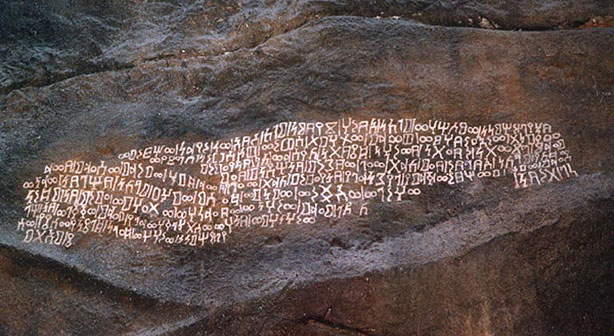
Islam claims that Mecca is an ancient city that came into existence during the time of Abraham (ie about two thousand years before Christ). And it was the most famous city in Arabia because every year people from all over Arabia came here to perform Hajj. Also, it was located on the most important trade route.
But the great evidence against this Islamic claim is that:
- In Mecca, there are no inscriptions or inscriptions on stone books or rocks, monuments or tombs or any ancient relics of any kind. While the great treasure of the relics of the ancient cities and kingdoms of Arabia is still preserved today in the form of stone tablets (inscriptions) and inscriptions and engravings on rocks, places of worship and tombs or other archaeological documents.
- These artifacts found in other cities are so abundant that with their help archaeologists were able to compile a complete record of the kings and cities of these regions.
- From here the experts also got a wealth of information about the wars that were fought between the different cities of the region, and which cities were located in Arabia.
- From here information came to the experts as to which places of worship existed in which areas, and which idols and stars were worshiped there.
But in spite of such a vast treasure of information, in these ancient monuments there is no existence of any city called Mecca, nor is there any mention of the Arabs going there on Hajj, nor is there any monotheistic Allah, Adam, There is only one word related to Noah, Abraham, Ismail, etc.
If Mecca really did exist in pre-Jesus times, surely there should be much more ancient traces of Mecca than the surrounding cities, because according to Islam, the Arabs were descendants of Ishmael, who lived every year. used to go to Mecca for Hajj, and Mecca was located on the trade route. But the situation here is that there are zero antiquities related to Mecca, while there are thousands of antiquities related to the cities north and south of Mecca located on the trade route.
What is more interesting is that the Arab kingdoms located on the trade route that Mecca was located on, are mentioned in historical records many centuries before Jesus. Mecca is located between the two famous cities of Qedar Kingdom of Qedar and Dedan al-Ala on this famous trade route . This trade route runs parallel to the Red Sea.
The region of al-Sabayun is located in southwestern Arabia, and according to archaeologists, the people of this region began to write "written documents" 1000 years before Christ [ link ] . There is the largest number of rock inscriptions. These inscriptions number in thousands. Archaeologists, despite reading thousands of these inscriptions, could not remotely find the existence of Mecca, nor the Hajj, nor the existence of any monotheistic religion of Abraham.
These inscriptions escaped destruction because this region of Yemen receives very little rain compared to the rest of the world. Whereas in Mecca, it rains 10 times less than Yemen. So if ancient Mecca really existed, these writings would have been preserved in greater numbers than in Yemen due to the lack of rains. But the situation is that the number of such ancient monuments in Mecca is zero.
Similarly, in several cities north of Mecca on this trade route, stone and rock inscriptions are found that describe in detail the dynasties that ruled these areas. For example, the cities of Dedan al-Ula and Teima are located north of Mecca on this trade route. From the memorial tombs, inscriptions on rocks and stones and engravings in these cities, we get detailed traces up to 800 years before Christ.
But despite being located between these three cities on the trade route, there is no mention of Mecca in any text, nor of Abraham, nor of Hajj, nor of any monotheistic religion of an Abrahamic Allah.
We find today the names of the series of kings in these other Arab cities in order, which are contained in thousands of inscriptions. They are organized by KA Kitchen and Von Wissmann and many other experts. These records are almost continuous from 1000 BC to several centuries AD.
North Arabia: Thamud , Lihyan and Nabataeans
These are the cities that were located to the north of the present Mecca.
Thamud :
- The traces of Thamud date back to 800 BC and continue until 500 AD.
- The inscriptions on the stone scrolls number in the "several thousands".
- In the archeology of the cities of the rest of Arabia, there are innumerable texts where the tribe of Thamud, their gods and their wars are mentioned, but nowhere is there a mention of Mecca, nor of any Abrahamic monotheism, nor of the Hajj.
Lihian :
- There is a well-documented succession of kings from Lahian, beginning around 330 BC.
- Their gods are mentioned in the books here.
- Antiquities exist in the form of stone books, idols of gods, tombs, and graffiti.
Inference :
- The city was of particular importance as it controlled the trade route that connected northern Arabia with the Syrian region. This road is the one where many hundreds of years after Christ went to Mecca and settled.
- There is both "internal" and "external" evidence for the city of Al-Anbat. The external evidence is that the archeology of other regions mentions Anbat in detail.
- Internal evidence includes "coins" bearing the names of the Anabat rulers. There are many ancient buildings of tombs etc. There are a large number of stone inscriptions found in the Petra and Madain Salih areas , which provide detailed information beyond the rulers of 175 BC.
Traces of cities south of Mecca
- Historical records of all the kings of this city date back to 430 BC. There are names of brothers, sons and other relatives of these rulers.
- There are records of even small towns around the Moin kingdom that were settled and then lost in history.
- The names of the rulers and historical events of this city also exist in continuity (along with religious places of worship). There were 31 ancient rulers who ruled from 330 BC to 160 AD.
SABA Kingdom of Saba and HIMYAR Kingdom of Hamir :
- There were 102 rulers of Saba and Hamir beginning in 900 BC and ending in 600 AD. The names and historical events of all of them are detailed in the monuments here.
A city east of Mecca
Kingdom of Kinda
This kingdom was located to the east of Mecca. His capital was located at a distance of 500 miles from Mecca. External evidence includes inscriptions found in Sabah where this kingdom is mentioned. Internal evidence includes stone inscriptions and other artifacts found here.
Historical monuments from Mesopotamia and the Arabian Gulf regions further east of Mecca are also present in great detail. But there is no mention of Mecca anywhere. For example:
Current Bahrain Dilmun :
- The pottery found here indicates that the history here is as old as the history of Mesopotamia. Traces of the line of kings start from 1800 BC. Ancient Bahrain is mentioned by historians of ancient Iran and other regions.
Current Oman Magan :
- Oman's archeology dates back to 2800 BC, which is documented in countless books. These are signs even before Abraham. Abraham came 2000 years before Christ. External evidence also exists in detail about ancient Oman. Despite the abundance of ancient monuments, there is no mention of Abraham, nor is there any mention of Mecca anywhere.
There is a mention of Medina in the ancient Yemeni books, but the mention of Mecca is missing
- As mentioned above, Yemen also has a lot of historical monuments, but surprisingly there is no mention of Mecca anywhere, and not a single word about any Abrahamic Monotheism.
- Compared to Mecca, there is mention of the Kingdom of Qidar and the Kingdom of Kanda and other cities which were located north of Mecca on the trade route. If there is no mention, then there is no mention of Mecca.
- What is more surprising is that in these Yemeni books there is also a mention of the city of "Madinah" which is located to the north of Mecca, but despite this, the mention of the city of Mecca is completely missing.
The nations that conquered Arabia do not have Mecca in their history, nor the monotheism of Ibrahimi Allah:
- Babylonians and Ninevehs conquered Arabia, but there is no mention of Mecca in their history, nor is there any mention of an Abrahamic monotheistic religion.
- Iran conquered Arabia, but there is no mention of Mecca in their history, and no mention of the Abrahamic Allah religion. Not only that they occupied, but also traded, but they also did not find the name and sign of Mecca anywhere.
- Rome also occupied Arabia and wrote the history of Arabia, but Mecca is also found in their history, and there is no existence of Abrahamic Allah, but other idols and places of worship are mentioned in detail.
Antiquities also disproved the Islamic story of Abraha
An archaeological inscription found on a rock in the area of Al-Sabiyun, south of Mecca, has an official English translation ( link ):
"With the power of the Almighty, and His Messiah King Abraha Zeebman, the King of Saba'a, Zuridan, and Hadrmaut and Yemen and the tribes (on) the mountains and the coast wrote these lines on his battle against the tribe of Ma 'ad (in) the battle of al-Rabiya in the month of "Dhu al Thabitan" and fought all of Bani A'amir and appointed the king Abi Jabar with Kinda and Al, Bishar bin Hasan with Sa'ad, Murad, and Hadarmaut in front of the army against Bani Amir of Kinda and Al in Zu Markh valley and Murad and Sa'ad in Manha valley on the way to Turban and killed and captured and took the booty in large quantities and the King and fought at Halban. and reached Ma'ad and took booty and prisoners, and after that, conquered Omro bin al-Munzir. (Abraha) appointed the son (of Omro) as the ruler and returned from Hal Ban (halban) with the power of the Almighty in the month of Zu A'allan in the year sixty-two and six hundred."
This text completely refutes the claim of the Muslims that Abraha was reduced to ashes eaten by the Abbils. On the contrary, this text tells that Abraha attacked various tribes of Arabia, and trampling them, he reached a distance and collected booty and slaves from everywhere and returned safely to his country and never ate on the way. The wind did not form.
In this writing, there is no mention of elephants, no mention of camels, no mention of Quraysh, no mention of the Kaaba, no mention of the defeat of Abraha, and no mention of Abraha dying by eating pebbles.
Similarly, Procopius of Caesarea is a historian of Abraha's time who wrote details about Abraha in his book, but nowhere does he mention Abraha's elephants, and their journey to a city called Mecca, or Ababil, or the elephants' hides. Didn't mention being done.
This archaeological and historical evidence directly disproves the Muslim claim. Muslims have no answer to this.
Read more details about Abraha's story here. link
Historians and Geographers
In addition to archaeological evidence, many Roman and Greek geographers and historians collected details about Arabia and its history, but none knew of the city of Mecca, nor did they find any Abrahamic monotheistic religion in Arabia. There is a name and sign of far away.
(1) Nabonidus is a Babylonian king of the fifth century BC, who came to Arabia many times and established his kingdom here. A region to the east of Madinah called Tima, his journey is recorded in the form of a poem. He killed the king of Tema and established his kingdom there. After that he also conquered the cities of Madinah and Khyber in Hijaz. In his entire story there is no mention of the name of the city of Mecca, nor is there any mention of the religion of an Abrahamic God, nor is there any mention of people going on Hajj.
(2) Herodotus, a historian of the fifth century BC, writes a book called "History". In it, while writing about Arabia, he says that a new region called Arabia has been settled in the south where incense, frankincense, cinnamon and opium are produced. In it he mentioned many cities but not Mecca. This shows that if Arabia had been settled by Prophet Abraham in 2000 BC, the history writer would never have said that an area called Arab was newly settled. I don't know anything far away.
(3) Theophrastos (Theophrastos') 4th century BC wrote many places about the Yemeni and Arabian regions and their culture, but he also did not mention Mecca, nor did he mention the religion of Abrahamic Allah.
(4) Eratosthenes, in the third century BC, mentioned the Arab societies along the Red Sea, but did not mention the name of Mecca, rather, he said about the entire geography where Mecca is located today that this place It is still completely uninhabited. Even in the rest of the societies, he did not find any existence of any Abrahamic Allah.
(5) Alexander the Great wanted to conquer the Arab territories and in this regard he sent four armies on expeditions, whose task was to study the culture of the Arabs, their military capabilities, their trade and non-subsistence and all It was to get knowledge of the routes. Alexander the Great was famous for taking detailed information of the place before attacking. The record of his four expeditions is very important in history. The greatest importance is given to Anaxicrates, who also measured regular routes, and his work proved useful to many later historians. Even those who took part in these expeditions sent by Alexander the Great do not find a city called Mecca, nor do they find any existence of the Abrahamic Allah in the whole of Arabia.
(6) Agatharchides writes about Arab cities in the second century BC and mentions all the places of worship along the Red Sea but does not mention Mecca or the Kaaba or Hajj. And he does not find any Abrahamic Allah in the whole of Arabia.
(7) Strabo mentions all the tribes and cities of central and western Arabia in the first century BC, but does not mention the Hajj to Mecca and the Kaaba, nor does he mention any Abrahamic Allah in the whole of Arabia.
(8) Romans sent a conqueror Gallus (Aelius Gallus) in 24 BC to conquer Arabia and its adjacent regions. In all his conquests, many other cities of Arabia are mentioned, but there is no mention of any city named Mecca, nor is there any mention of Hajj. If there is an oasis in the desert, everyone knows about it and it is considered a precious place. The occupiers do not leave such places. In the same way, he does not find the existence of any thing called Ibrahimi Allah in the rest of Arabia.
(9) Pliny mentions 92 tribes and 62 cities within Arabia in the first century AD, but does not even mention the name of Mecca and does not mention the religion of an Abrahamic God.
(10) Ptolemy, who made maps of the world, described the geography of 114 cities in Arabia in the first century AD but did not mention Mecca anywhere. Ptolemy mentions a city called Macoraba, which some Muslims consider to be Mecca due to the similarity of the name, but the signs of Ptolemy's Macoraba and the boundaries described by Ptolemy are completely different from the boundaries of Mecca. A more detailed discussion on Muqarabah will be made later).
Read a very detailed article in English with proofs on the works of these historians and geographers here :
Children of Ishaq remember 100% everything. Ismail's children 100% forgot everything? surprise
Abraham came 2080 years before Christ.
Abraham's son Isaac remembers everything. For example: Allah, Adam, Noah, Abraham, Sarah, Hajirah, Ishmael, their story of how Hajirah and Ishmael were expelled, the names of their descendants, etc.
On the other hand, regarding Ismail's descendants, Muslims are claiming that they had 100% forgotten everything by the time of Muhammad. They did not remember Allah, nor did they remember the story of Adam and Eve, nor did they remember Noah and his storm, nor did they remember Abraham, Sarah, Hajrah, and Ishmael, nor did they remember the building of Abraham's Kaaba. They do not remember that they also belong to Bani Israel.
Understand the situation further:
- These descendants of Isaac and Ishmael were living in the area adjacent to each other.
- There was constant trade between Jerusalem and Arabia.
- Many of the Jewish tribes from the descendants of Isaac settled in Arabia and were in constant contact with the descendants of Ishmael.
Therefore, it is very surprising that the descendants of Ishmael did not learn "religion" from the descendants of Isaac. The descendants of Ishmael should have accepted themselves as Bani Israel from the beginning, they should have adopted the holy books of the Jews from the first day. If they had forgotten anything, they should have remembered everything because of their connection with Isaac's descendants through the trade route.
More surprisingly, Muslims continue to claim that the descendants of Ishmael, the Arabs, were monotheists, and became idolaters only 300 years before Muhammad. A website for Muslims Against Atheism writes ( link ):
It is almost a unanimous tradition of the Arab sources that the Arabs, especially the participation in Mecca and the rituals of idolatry, were introduced by a Bedouin Arab chief, Amr bin Lahi Khaza'i, who had become familiar with idolatry during his journey to Syria. Ibrahimi is called a changer, before his heresy, the Arabs were generally followers of the Hanafi religion: "Anh kan ol min ghir din Isma'il finsab al-awthan." . . . (Ibn Hisham, 1/81 and later) "We replaced Badin Abraham and Ishmael, and after that, we saw them before them, and we understood what was left of the covenant of Abraham, and we were satisfied with the worship of the house and the circumambulation of Umrah." (Ibn Hisham, 1/81) 82 Shah Waliullah Dehlavi, Hijjatullah al-Balagha, 1/272 and 279) The innovations of Amr bin Lahi started almost three hundred years before the Prophet's mission . Minhaj Abiham ali in wajfiham Amr bin Lahi and this before the Prophet (peace be upon him) was raised from the third month of the Sunnah. . . . . . ) .
More references:
You can see for yourself how ridiculous it is for Muslims to claim that the descendants of Ishmael memorized the teachings of Abraham from Abraham to Muhammad for 300 years (ie 2300 years), but then in just 300 years they were 100% correct. Everything was forgotten, including Allah, the story of Adam and Eve, Noah's flood and the story of Abraham and Ishmael, and the story of the Kaaba. And many Jewish tribes from the descendants of Isaac had come and settled in Arabia, but still they forgot everything 100% in 300 years.
Anyone with common sense can never accept these huge claims and stories of Muslims.
Analysis of the claims made by Muslims
Baca's Muslim claim:
The next claim of the Muslims was that the Old Testament mentions the city of Baca, which is Mecca. For this, Muslims cite this passage from the Old Testament:
(Psalms 84:5-8) Happy is the man who finds refuge in You, whose mind is on the [pilgrim] highways. They pass through the Valley of Baca, regarding it as a place of springs, as if the early rain had covered it with blessing ..... Better one day in Your courts than a thousand [anywhere else]
Muslims are claiming that Baca is being referred to as the "House of Allah" which was only in Mecca.
The fact is that Muslims are showing extreme "bad faith". They do not give this reference in full where the next sentence clearly mentions the area of Zion.
(Psalms 84:6) They pass through the Valley of Baca, regarding it as a place of springs, as if the early rain had covered it with blessing.
(Psalms 84:7) They go from rampart to rampart, appearing before God in Zion .
And this area of Zion is mentioned 152 times in the Bible because it is a hill to the east in Jerusalem and the valley of the Baca route through which pilgrims passed to the holy land of Jerusalem. ( Link to detailed English article ). Read more about Zion on Wikipedia at https://en.wikipedia.org/wiki/Mount_Zion
It is bad faith of the Muslims that they go after the meaning of Baca, argue at length and cast doubts on it, and then claim that since there are doubts, Baca should be considered the Mecca of Islam. Meanwhile, they completely gloss over the original argument with Zion and don't say a word about it. See this deception and method of the Muslims on their website .
Also remember that compared to Arab history, the Romans and other historians have described the situation of Jews, Christians, Jerusalem and the Kingdom of Israel in great detail. But in the history of these hundreds of years, these Romans, Greeks and other historians do not mention anywhere that Jews and Christians have ever gone to Bakka (Arabs) for pilgrimage.
Muslim Claim: Edward Gibbon mentions the Kaaba before Christ
After Baqa, the next excuse of Muslims is the writing of "Gibban" where it mentions the Kaaba before Christ. Muslims offer this text of Gabon:
The genuine antiquity of Caaba (Mecca) ascends beyond the Christian era: in describing the coast of the Red sea the Greek historian Diodorus has remarked, between the Thamudites and the Sabeans , a famous temple, whose superior sanctity was revered by all the Arabians .
Reference:
Gibbon's Decline And Fall Of The Roman Empire, Volume V, pp. 223-224
Gibbon and his writing contain the following errors:
- Gibbon himself is an eighteenth-century historian. He himself has written before this paragraph that he is ignorant of the history of the Arabs and is careless. Gibbon's main subject was the history of Rome, not the history of the Arabs.
- Gibbon cites the ancient historian Diodorus as a reference. But when we look at the original text of Diodorus, we see that Gibbon made a mistake in copying it. Gibbon calls it the middle region of "Thamud" and "Sabah", while according to Diodorus it is the northern region of "Thamud" (whereas Mecca is south of Thamud ).
- Those who came after Gibbon (eighteenth century) continued to repeat this mistake of Gibbon. Muslims have widely publicized this error of gibbon and despite all the proofs about this error of gibbon, they are not stopping from publicizing this error.
Therefore, this excuse of Muslims is completely based on the "bad faith" of Muslims.
You can read more details about Gibbon and the Kaaba in English here ( link ) .
A historian named Agatharchides :
Just as Gibbon's philosophy was based on Diodorus, so Diodorus himself was based on his older historian, Agatharchides.
Agatharchides dates back to 145 BC. It belonged to the royal government of the Ptolemies. This government had previously conducted a thorough survey of the Red Sea region (in present-day Mecca) in the 3rd and 2nd centuries BCE to identify trade routes to Yemen. So these kings sent several expeditions to this area to conduct this survey. Agatharchides had information about all these expeditions.
In addition to the information from these expeditions of the kings, Agatharchides made full use of the works of 7 other historians of the period and earlier who collected information about the region. In addition, Agartarchides also obtained information from several other eyewitnesses from the region, who were chief among the merchants who were trading in these regions.
The original work of Agatharcides is unfortunately lost, but almost all of his work was collected by the following 3 later historians:
- Diodorus
- Strabo
- Photius (his Bibliotheca contains much material, especially from Agatharcides)
The information collected by Agatharcides was very authentic and has been confirmed by all subsequent research. For example, Agatharcides wrote that the water of the sea opposite Saba is white as the water of the river is white. This is still true today. Then the "tribes" he mentioned living in these areas were found there in much later times.
The kings of the Ptolemies wanted accurate information about the strip of Arabia bordering the Red Sea, which tribes they would have contact with for trade, how wide these areas were, where they were populated and which areas were deserted and are barren, and in which areas are Arab Bedouins present? So it took them more than 100 years to complete this survey (from the 3rd century to the 2nd century BC). From here you can get an idea of how extensive and detailed the information provided by Agachardites was, which not only mentions every city, town and settlement, but almost every tribe and their places of worship. All important routes are mentioned.
But despite all these extensive and detailed descriptions of this region, the Agachardites:
- There is no mention of Mecca anywhere.
- Neither the name nor the mark of the House of Kaaba is found
- Nor is the name of the Jarham tribe found.
- Neither is the name of the Khuza'a tribe found.
- Nor is the name of Quraysh found.
- Neither the name and sign of Zamzam spring is found.
- Neither the name nor the sign of the mountains of Faran is found.
- Nor in all the other cities of Arabia is the name and sign of any monotheistic Allah, Abraham and Ishmael found.
- Nor is it known that people from other parts of Arabia go to Mecca every year for Hajj.
The Agachardites' method of providing information on the region was that they began "north" of the strip along the Red Sea where the first territory belonged to the Nabataeans, whose capital was in Jordan. Then from here downwards he reached the region of Yemen in the south, mentioning each region, tribe, place of worship, port, roads and mountains. In this regard, he also passed through the place where Mecca is today, but he did not mention any Mecca or the House of Kaaba or the tribes of Jarham and Khuza'a, etc., although if Mecca really existed, he would not have been in any trade. It would have been more important than any other city.
Agatharchides mentions a place of worship along the " Gulf of Aqaba " region (which Muslims call Mecca today in reference to Gabon). The Gulf of Aqaba begins south of Israel and ends in northern Arabia (ie, several hundred miles north of Mecca). So how is it possible that this place of worship is the Kaaba in Mecca?
According to Agatharchides, the region of Aqaba where this shrine was located was called Ilat, and the inhabitants were not called Jurhimi, or Quraish, or Khazai, but Batmizomaneis. Agatharchides' own words for this temple are: This temple is highly revered by all the Arabs (the exact same words as later quoted by Diodorus).
Agatharchides wrote (as quoted by Diodorus and Photius) about the boundaries of this region:
One encounters the Laeanites Gulf around which there are many villages of the so-called Nabataean Arabs... After what is called the Laeanites Gulf (ie Gulf of Aqaba), around which Arabs live, is the land of the Bythemaneas.
So here it was found that the territory of Batmizomaneis was adjacent to Al-Nabat i.e. Gulf of Aqaba region. According to a scholar (Arab geographer) named Mosul, this area is the lower part of Wadi Abjaz, which is 50 km long and 20 km wide. Agatharchides writes further:
Next after this section of the coast is a bay which extends into the interior of the country for a distance of not less than five hundred stades. Those who inhabit the territory within the gulf are called Batmizomaneis and are hunters of land animals.
A stade is a measure of length and there are ten stades within a mile of a day. Thus, Agatharchides himself refers to the area of this place of worship as being adjacent to the Gulf of Aqaba. And this is what Diodorus copied, but Gibbon made a mistake in copying it. These are the words of Diodorus:
The people who inhabit the country beside the gulf, who are named the Banizomenes, support themselves by hunting and eating the flesh of land animals. A very sacred temple has been established there which is highly revered by all the Arabs.
So we can see that both Diodorus and Photius place this place of worship as being adjacent to the Gulf of Aqaba (several hundred miles north of Mecca) and nowhere between "Thamud" and "Sabah". is as Gibbon mistakenly claims in his carelessness.
After mentioning Banizomenes, both historians, namely Diodorus and Photius, next mention 'Thamud' in these words: "after these it is the territory of the Thamoudeni Arabs." That is, after that, the area of Thamud begins.
The area of Thamud itself is several hundred miles north of Mecca, while the area of this place of worship is also north of Thamud. After Thamud, Photius has mentioned one by one the areas which are south of Thamud. For example, Ras Karama and Ras Abu Madd, which are located 450 km north of Mecca.
Therefore, the place of worship mentioned by Diodorus cannot be in any way Meccan and this is proved by very clear and solid evidence. But Muslims are also the same scoundrels who are brazenly sticking to their false claim even in the presence of such solid evidence and are misleading innocent people.
Read more details and evidence in the English article :
Muslim Claim of Macoraba:
It is impossible for Muslims to answer why the Greek and Roman historians and other nations did not mention such a famous city as Mecca in their detailed documents about Arabia. By taking it, the Muslims fabricated the pretext that the Greek scholar Ptolemy wrote the name of a city "Macoraba" in his book Geography, which may be Mecca. This "assumption" fabricated by Muslims has no value that can be called "evidence".
Ptolemy's map described the following landmarks of the city of Makaraba:
- There is a river in the north of Makaraba
- The city of Makaraba is located outside the mountain ranges
- It is located south of the ancient city of Carna. There are other cities nearby.
- He gave the coordinates of Makaraba city which were (73 20 22 -AP) in terms of longitude & latitude.
These four signs do not fit the present city of Mecca. There is no river north of Mecca, and Mecca is located in a mountain range, and there is no city called Carna north of Mecca, and there are no other cities around Mecca, and the coordinates of the present Mecca are also located on the map. do not have.
Ptolemy himself did not visit these regions of Arabia, but he compiled the map by listening to the names, signs and distances of these cities from the mouth of the people. These people (on whose testimony the map was based) were able to accurately describe landmarks around the city (such as the presence of a river or the presence of mountains, or the presence of other nearby cities), but were unable to measure distances. They were very inexperienced and made mistakes. Then there was another mistake regarding the distance that the Romans used one scale to measure the distance, while the Arabs used a different scale. So these errors of distance also appeared in Ptolemy's map.
The Romans (where Ptolemy lived) divided Arabia into 3 parts.
- Arabia Petrea which was part of the Roman Empire. Therefore, Ptolemy did not make a mistake in the map here, the cities described here are located on their coordinates.
- Arabia Deserta, which was the desert part of Arabia under the Roman Empire, was desert and barren.
- Arabia Felix which consisted of Yemen, Oman, South Saudia (Najran etc.).
Since Arabia Felix was a rich region, and there were numerous cities, Ptolemy exaggerated the region, which was a mistake. In this regard, Ptolemy reduced the area of Arabia Deseta i.e. the Arabian desert much less than the original. In this desert Ptolemy shows only 20 cities, while in Arabia Felix he shows a frequency of cities above 200.
Modern geographers used Ptolemy's maps to give accuracy to the rivers on the map because rivers rarely change their location over time and their course remains even when dry.
So when modern geographers extended the rivers on Ptolemy's map to the rivers of the current map, the cities of the region began to sit on their correct coordinates. The area is Al-Mahabishah . Other signs are also correct, for example, it has a river to the north, and it is not located in a mountain range, and it is also located south of the Yemeni city of Carna, and other nearby cities are also correct.
Read the full article with details here (link ) and read more about the accuracy of Ptolemy's map here.
Muslim stubbornness regarding Macoraba:
See the duplicitous behavior of the Muslim website ( link ). He says:
- They will simply accept the name of the city of Makaraba on Ptolemy's map, that Ptolemy did not make a mistake here. And although there is no proof that it refers to the city of Mecca, they still claim that it is the city of Mecca.
- But the other 3 signs given by Ptolemy (the presence of the river in the north, not being located in the mountain range and being south of the city of Carna) will not accept it. They reasoned that while Ptolemy could have erred in the distance in the map coordinates, by not having the river in the north, and in the mountainous region, he could also have erred about Carna and other cities.
It is called sweet hip hip and bitter tho tho.
If you have to deny all the landmarks, rivers, mountains, other cities from Ptolemy's map, then you must also deny the city of Makaraba. And if they believe in the city of Makaraba, then they believe in other cities and mountains and rivers too.
Remember, map coordinates required exact distance measurement, which was not an ability among ordinary people of the time. While naming the nearby cities, mountains and rivers was very easy for them.
And this error of coordinates has also been removed by the current geographers and no argument has been presented by the Muslims as to why they are denying it now while all the cities and rivers and mountains are in their place according to the new coordinates. But sitting right.
This attitude of Muslims only consists of 'obstinacy'.
But despite the obstinacy, modern science will only continue to humiliate Muslims for showing obstinacy by piling up evidences and it is not possible for them to escape.
Muslims make 2 more claims:
First: The name of Muqarabah is more similar to Mecca than "Al-Mahabsha".
Answer: If only the name is to be matched, then the name of the city called "Maqarab" is most similar to "Maqarabah". This city named Muqarab has been mentioned by the Muslim historian Yaqut Hamvi. And the coordinates of Muqarb city given by Yaqut Hamwi, they are more complete on Muqarb city than Mecca. So if the Muslims have to run after the name only, then they will have to consider Makarab city as Makaraba.
Second: Muslims sat down with the pretext of etymology of the word muqarab and different "linguists" began to extract different meanings of the word muqarab in different languages.
A linguist said that the origin of the word Muqarabah is "Mecca al-Raba" meaning "the great Mecca" (al-Raba means great in Hebrew). A linguist said that the word Makaraba is derived from "Mihrab" which is the sign of a mosque. One linguist said that Muqarabah is derived from "Muharebah" (fight), another linguist took the word to mean "a great slaughterhouse" (where animal sacrifices are made). A linguist came up with the meaning of Makaraba "Mecca Capital". Etc. Etc. (Read about these languages in detail in the English article here. Link )
None of the claims of these linguists contain any evidence, but only "conjecture", which has no significance. First of all, they do not know what language "Maqarabah" is. Some are making it Hebrew, some Arabic, some something else. This thing is not called evidence, but "conjecture". The time of these experts belongs to the 17th century AD, who first tried to connect Mecca with Mecca. Therefore, there is not a single ancient historian or geographer or linguist who called Muqarabah as Mecca.
Again look at the overall picture. If there was a city called "Mecca al-Raba", then there would be thousands of archeological sites in archeology and it would be the most mentioned city in the books of historians, because this city is not only located on the trade route, but People from all over Arabia used to come to perform Hajj every year. Similarly, traces of the names and teachings of Allah and Adam and other prophets were also found in other cities of Arabia (instead, in other ancient cities, traces of thousands of gods and goddesses and shrines of Saibins are found). But there is nothing like that. Therefore, instead of thousands of proofs, Muslims bring the name of the city called "Wahid" Muqarabah, and that too is so twisted that even if it is pulled, it does not prove Mecca.
Muslim excuse: Mecca was not a famous city in the beginning, so ancient historians and geographers did not mention it
Every ancient city around Mecca yielded thousands of archeological evidences, but the number of archeological evidences from Mecca is “zero”.
Similarly, the ancient historians and geographers mentioned in detail every city, line of kings and small population and tribes on this trade route, but no one knows about Mecca, no one knows about Abraham. And no news of Ishmael and the Kaaba and Hajj and Zamzam, although Muslims claim that Mecca was the “most famous” city in Arabia, located not only on the “trade route” but where people from all over Arabia performed the Hajj every year. came to do Just as today the most famous city in all Islamic countries is Mecca (although it is no longer a commercial city).
No excuses could be made here. But Muslims still found excuses. The Muslim website offers this excuse ( link ):
Here Mulhid Sahib again argues that it was a famous place of trade and that it was a commercial passage, although this is much later, a place that was settled some time after the arrival of Ibrahim, then their trade began, then later. I went somewhere and it was connected with the civilized world and it became a commercial passage and a holy center, therefore, it is a matter of little sense to say that why this commercial city was not seen by the historians of the era of Abraham .
In response, when have we talked about " historians of the time of Abraham "?
- The historians and geographers mentioned above date from 1500 years to 2400 years after Abraham.
- Was it not possible to settle Mecca even after 1500 years to 2500 years after Abraham, which all these historians did not find Mecca?
- Wasn't Mecca located on the trade route for these two and a half thousand years without anyone knowing about it?
- Didn't anyone come for Hajj to the House of Kaaba for these two and a half thousand years that no one knew about Mecca?
These Muslims are extremely "evil". To deceive, they link these historians and archeological evidences only to the time of Abraham, although it is the next one and a half to two and a half thousand years after the time of Abraham, where historians do not see a city named Mecca. In the whole of Arabia, there is a name and sign of Tawheed Allah and Abraham and Ismail.
The Muslim excuse of Wadi Faran:
According to the Bible, Abraham lived in the city of Hebron , which is located 30 miles south of Jerusalem. When Abraham asked Hagar and Ishmael to leave the city, they came to the wilderness of Beer Sheba near the city of Hebron where Ishmael became very thirsty and the well appeared. Ishmael then grew up in another wilderness, the Wilderness of Paran, near Beersheba, which is near Israel's southeastern border in present-day Jordan ( link ).
Just as Ibn Ishaq and other later Muslims tried to invent several different genealogies of the Prophet Muhammad to connect him with Ishmael, a similar attempt was made to make Mecca the Wilderness of Paran. To be given. So the excuse was made that the old name of Mecca was "Paran", and this is the same place that exists in the Bible as the Wilderness of Paran.
Regarding the Wadi Faran excuse, remember that:
- Prophet Muhammad did not know that the old name of Mecca was Faran. The name of Faran is not found anywhere in the entire Qur'an and the entire Hadith literature.
- None of the Sahabi knows far and wide that the old name of Mecca is Faran.
- The infidels of Mecca (indeed the whole of Arabia) had no idea that Mecca was once called Faran.
After him comes a person whose name is "Wahb bin Manbah". He is the first and only person who claimed that the old name of Mecca was Faran.
But remember about this Wahib bin Munba ( link ):
- Wahib was born 24 years after the death of the Prophet of Islam.
- Wahib was of Iranian descent.
- And Wahib was not born in Mecca, but in Yemen.
- Wahib was accused of incorporating Israelism into Islam. Shia Muslims openly call Wahhab a liar, while some of the Sunni Muslims have also called him a liar.
For example, Ibn Khaldun has accused Wahib of narrating false events ( link ).
Abdullah ibn Mas'ud forbade Wahib and Ka'b ibn al-Ahbar to learn Qur'anic exegesis because they included Israelite ( link ).
Wahib is accused of making false claims in support of the Umayyads and their rulers, one of which is that he considered Umar bin Abdulaziz to be the promised Mahdi: Wakil Wahib bin Munbah said : If he is in this nation, he is the Mahdi. Umar bin Abdul Aziz . - Most of the books Wahb wrote (which were based on Israeli fairy tales) are contained in the narrative Arabian Nights (الف ليلة وَليلة) ( link ).
In addition to Wahhab, Muslims also mention the names of historians named Yaqut Hamwi and Makdisi that they also mentioned the fall of Mecca, but this argument of theirs is baseless because these historians came several hundred years after the Prophet Muhammad and they did not provide any evidence or source for his claim, rather he was simply repeating what had become popular among Muslims after Wahib.
Therefore, Wahhab is the first and only person who claimed to be faran of Mecca. No one in the rest of the world knows about it.
According to the Bible, Mecca is not even remotely related to the Wilderness of Paran, but this place is located near the southeastern border of Israel in present-day Jordan ( link ).
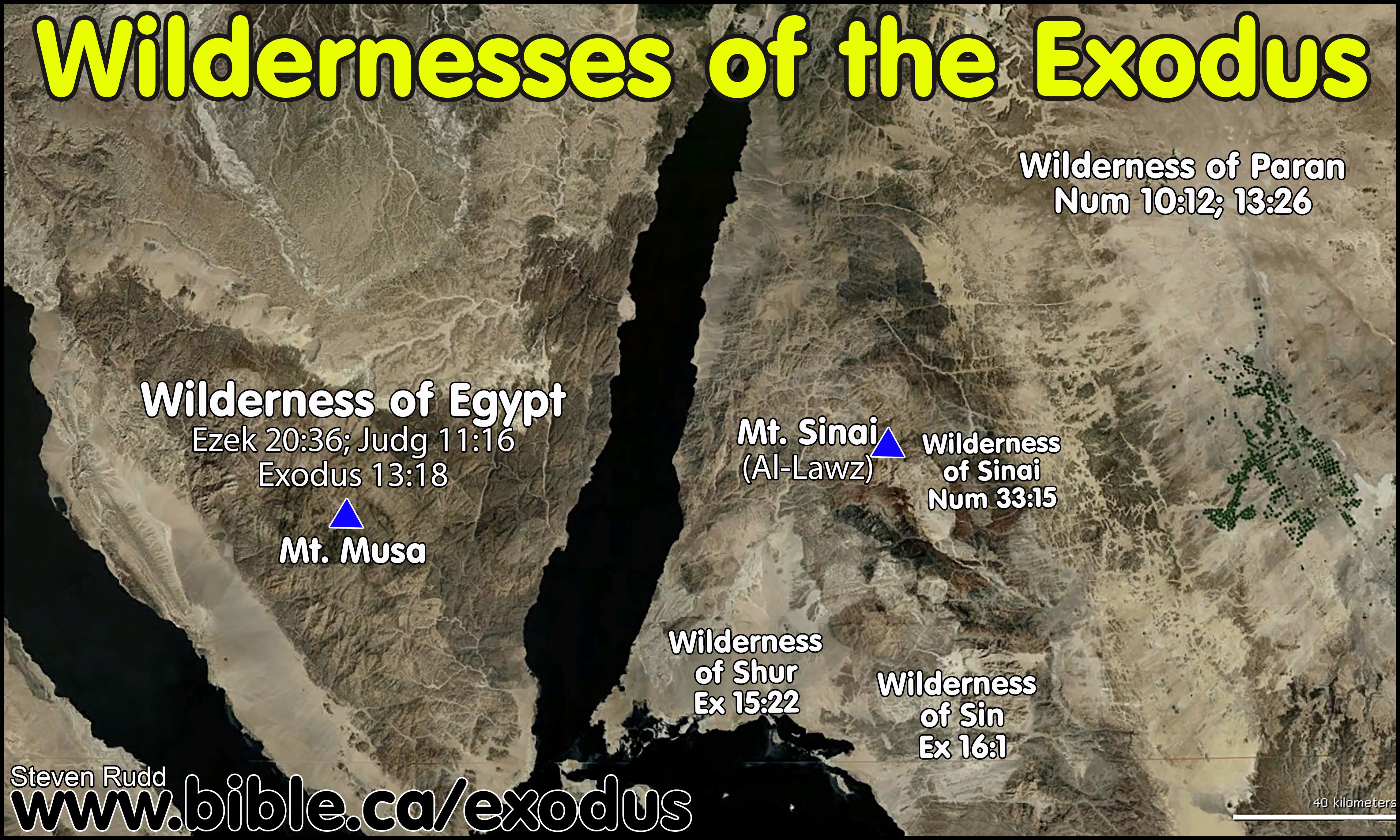
Mecca is about a thousand kilometers away from this place.
Some of the Muslims have tried to prove Paran as Faran by manipulating the words of the Bible, but these tactics are futile. Christians have made clear the evil deeds of Muslims here (links 1 , 2 , 3 ) .
Moreover, ancient Jews and Christians wrote hundreds of thousands of ancient books besides the Bible. But there is no mention of Mecca or Mecca being Faran in any of these books.
Moreover, nowhere in the Arabian archaeological evidence is Mecca or the entire Hijaz region ever referred to as "Faran". Books and other writings recovered from different cities mention the surrounding Arab areas and the city. But there is no mention of an area called Faran anywhere. Nor has there been any archaeological evidence far from Mecca itself (or the entire Hijaz) that the area was once called Faran.
Moreover, the historians of the ancient Romans, Greeks and other nations never mentioned any area called Faran in their history and maps. These ancient historians have been collecting details of the Arab regions since eight hundred years before Muhammad, but they do not find Faran, nor Islamic stories related to Faran, which include Ishmael, Ibrahim, Zamzam, Kaaba, etc.
Excuse of Samaritan Asatir by Muslims:
An excuse is also raised by the Muslims regarding THE SAMARITAN ASATIR which states that Ishmael and his eldest son Nebaioth settled Mecca. But this book was written in 10th century AD (ie 300 years after the advent of Islam) and therefore cannot be presented as evidence. You can read in detail about this book and what is written in it here ( link ).
In fact, where thousands of proofs about Mecca and Ibrahimi Allah should have been scattered everywhere, no one can find a single proof even by searching there.
Narrated by Ibn Abbas that there were images of Abraham and Mary in the Kaaba
Islam apologists present this tradition and claim that the Arabs knew about Abraham.
Sahih Bukhari, Kitab al-Ahadith al-Anbiya ( link ):
Yahya ibn Sulaiman narrated from us, Abdullah ibn Wahhib narrated from me, Amr ibn Harith narrated from him, Bakir narrated from him, Mawla Karib from Ibn Abbas narrated from him, and Hazrat Ibn Abbas (may Allah be pleased with him) said that the Holy Prophet (peace and blessings of Allah be upon him) entered the House of Allah and saw the pictures of Hazrat Abraham and Hazrat Maryam (peace be upon him). He said: What happened to the Quraysh? Although they know that angels do not enter a house in which there are pictures, this is a picture of Hazrat Abraham (peace be upon him) and that too while throwing dice.
The problem with this tradition is that:
- This is not a neutral source, but a Muslim tradition. These traditions were the slaves of the house for the Muslims and it was not a difficult task for the Muslims to invent traditions to give excellence to Islam.
- Then this tradition is also 'Khar-i-Wahid'. And no one else has narrated it except on the authority of Kareeb and Ibn Abbas.
- The Qur'an also mentions the worship of Laat, Uzza, Manat and angels in the Kaaba, but it does not mention the worship of Mary or Abraham in the Kaaba.
- And this tradition mentions the conquest of Mecca when Muhammad entered the Kaaba and removed the idols ( link ). But the problem is that at the time of the conquest of Mecca, Ibn Abbas was a 10-year-old child and the Islamic army that went to Mecca to fight did not include Ibn Abbas.
- As for the rest of the traditions (which are innumerable), which mention the idols of the disbelievers in the Kaaba, they mention other idols (Hubl, Manat, Lat, Uzza) etc., but none of them. There is no mention of images of Abraham or Mary in the tradition.
Rather, the polytheists of Mecca did not even know Abraham, so where did they worship him? The proof of this is this second tradition of Sahih Bukhari himself:
Sahih Bukhari, Kitab Manaqbat al-Ansar, Chapter Hadith Zayd bin Amr bin Nafail ( link ):
Zayd bin Amr bin Nafail went to the country of Syria in search of and following the true religion and met a Jewish scholar. Zayd asked about their religion and said that it is possible for me to adopt your religion, so tell me. Zayd said, "I run away from the wrath of God, and I can never bear His wrath, nor do I have the strength of His wrath, so can you tell me any other religion?" Zayd said , "I don't know what Hanif is." He said the religion of Abraham (peace be upon him), he was neither a Jew nor a Christian and he did not worship anyone except Allah, so Zayd came out and met a Christian scholar and Zayd explained the same to him. He said that you will come to our religion. So you will have to take your share from the curse of Allah. Zayd said, I am running away from the curse of Allah and I cannot bear the curse and wrath of Allah at all, nor do I have the strength. Can you name any other religion? He said that no other religion is known to you except Hanif. He said, What is Hanif? He said the religion of Abraham (peace be upon him) He was neither a Jew nor a Christian and he did not worship anyone but Allah Almighty. He raised it and said, "O Allah, I bear witness that I am on the religion of Abraham." Laith said that Hisham wrote to me through his father and Asma bint Abi Bakr, may Allah be pleased with her, that I saw Zayd bin Amr bin Nafail standing with his back to the Ka'ba, he was saying, O congregation of Quraysh! None of you is on the religion of Abraham except me.
Therefore, the polytheists of Mecca did not know about the religion of Hanif, nor about Abraham, even though they used to worship him by placing the image of Abraham in the Kaaba.
Then the problem is that in this tradition of Ibn Abbas, Muhammad is saying that Quraysh knows that angels do not visit the house where there is a picture. But this claim is also 'Khar-e-Wahid' and it is not found in any other tradition that the polytheists of Mecca knew that angels do not enter the house by putting up pictures. Rather, the polytheists of Mecca remained on one side, even Muhammad Sahib himself did not know about it, even when an incident happened in Madani life, then Muhammad Sahib came to know about it.
Sunan Tirmidhi, Kitab al-Adaab ( link ):
Hazrat Abu Huraira (RA) says that the Messenger of Allah (PBUH) said: Gabriel came to me and said: I came to the Prophet (PBUH) last night. I was prevented from entering you by the pictures of the men at the door of this house. In the house in which the Prophet (peace and blessings of Allah be upon him) was, there was a curtain on which pictures were made, and there was also a dog there. So, the Prophet (peace and blessings of Allah be upon him) order that the head of this image be cut off so that it becomes like a tree.
This tradition of Sunan Tirmidhi is "correct" ( link ).
Rather, even after Muhammad's death, many Muslims were not properly aware of the images. For example, see this tradition of Sahih Muslim ( link ) where Ayesha is saying that she also did not know about the picture and when Muhammad Sahib showed disapproval of it, then he went and Ayesha knew about it. And it is in this tradition that after the death of Muhammad Sahib, a person is asking this question to Aisha.
So when Muhammad himself and even the Muslims did not have any knowledge about the image until Madani life, then how did the polytheists of Mecca know about it and why did they follow it when they worshiped idols like images. .
The Muslim excuse for Abrahamic religion
Another deception Muslims make is that the Arabs (descendants of Ishmael) were followers of the Abrahamic religion. These people came to Mecca every year for the Hajj, sacrificed and were monotheists, and up to 300 years before the Prophet Muhammad they adhered to this true Abrahamic religion. 300 years ago a man named Amr bin Lahi seduced them and only after that they left the Abrahamic religion and became idolaters.
This is a complete lie and in the archeology of all the cities of Arabia, not a single evidence of anything called Deen Hanif or Deen Ibrahimi has been found, but thousands of evidences have been found of the shrines and idols and inscriptions of the Saibins. In the same way, all the ancient historians, etc., who have written about the conditions of Arabia, have not found any existence of the religion of Abraham or Abrahamic Allah in the whole of Arabia (that is, in all the ancient Arab cities). ( Link ).
It is impossible for Muslims to answer the question why there is no mention of Adam, Noah, Abraham, Ishmael or Mecca in the 2600 years of Arab history from Muhammad to Abraham. Of, not of the Kaaba, nor of the Hanif religion / Abrahamic religion?
Look at the contradiction of the Muslims' claim. On the one hand, Muslims say that the descendants of Isaac remember Allah, Adam, Noah, Abraham, Ishmael, etc. 100%, remember their places of worship, remember their history. But on the other hand Muslims say that Ismail's descendants (Arabs) forgot everything 100%.
While the next contradiction is that the second claim of the Muslims is that the Hanif religion was "known" among the Arabs. But despite this, the Arabs of Muhammad's time did not know about Abraham, and he is not mentioned anywhere in the previous Arab history.
The "biggest" proof that a Muslim website created in opposition to atheism has given about Deen Hanif himself is that only 4 people in Mecca were followers of Deen Hanif. 3 of them later went astray and became Christians and only 1 person, Zayd bin Amr bin Nafail, remained steadfast in the religion of Hanif ( link ).
But the problem of this Zayd bin Amr is that he also did not know anything about the thing called Deen Hanif.
According to the tradition of Sahih Bukhari, Zayd bin Amr first came to know the Abrahamic religion when he met a Christian scholar who first mentioned Abraham to him.
Sahih Bukhari, Kitab Manaqbat al-Ansar, Chapter Hadith Zayd bin Umar bin Nafail:
When Hazrat Zayd asked the Syrian scholar about Sahih Deen, the scholar said that it should be Hanif. He said that the religion of Abraham, he was a Jew and a Christian, he did not worship anyone but Allah. When Hazrat Zayd heard his words about Hazrat Ibrahim, he raised his hands and said, "O my God! I testify that I am on the religion of Hazrat Ibrahim. "
Hence, it is also proved that in the Arab society, there was no such thing as Hanif religion or Abrahamic religion. On the other hand, after being told by a Christian scholar, he first went to Zayd bin Amr and learned about Prophet Abraham.
Muslims who claim the Hanif religion require that the Hanif religion / Abrahamic religion has been passed down from generation to generation among the people of Arabia, and the people of Muhammad's time have passed down this religion from generation to generation. , because of the Hanif / Ibrahimi religion, not to believe in Abraham after 2600 years of Abraham when Christians told him.
Therefore, Zayd's belief in Abraham has nothing to do with Arab society, but with the knowledge taught by Christians. Therefore, this incident of Zayd bin Amr is "proof" that the Arabs had no knowledge of Abraham or the Abrahamic religion for a long time.
Just as we atheists are disgusted with our old religion Islam after recognizing it, similar problem was with this Zayd bin Umar and he was disgusted with his native religion of idolatry. Then when he heard about Abraham, he believed in him. In the same way, 3 other people also believed in Abraham, but later they found Christianity to be better and accepted Christianity. While one accepted Islam, but then became disgusted with Islam and left Islam and became an apostate.
Therefore, there is not a single "proof" in this "biggest" evidence of Muslims that the Arabs considered Abraham as their forefather, and because they followed the religion of Abraham, they were firm on the Abrahamic religion. Therefore, the claim of Muslims that the religion of Abraham is "known" is not proven in any way.
Rather, it is ridiculous to claim that the Arabs were monotheists only 300 years before Muhammad, but in the last 300 years they have 100% forgotten all the teachings of Abraham. A website for Muslims Against Atheism writes ( link ):
It is almost a unanimous tradition of the Arab sources that the Arabs, especially the participation in Mecca and the rituals of idolatry, were introduced by a Bedouin Arab chief, Amr bin Lahi Khaza'i, who had become familiar with idolatry during his journey to Syria. Ibrahimi is called a changer, before his heresy, the Arabs were generally followers of the Hanafi religion: "Anh kan ol min ghir din Isma'il finsab al-awthan." . . . (Ibn Hisham, 1/81 and later) "We replaced Badin Abraham and Ishmael, and after that, we saw them before them, and we understood what was left of the covenant of Abraham, and we were satisfied with the worship of the house and the circumambulation of Umrah." (Ibn Hisham, 1/81) 82 Shah Waliullah Dehlavi, Hijjatullah al-Balagha, 1/272 and 279) The innovations of Amr bin Lahi started almost three hundred years before the Prophet's mission . Minhaj Abiham ali in wajfiham Amr bin Lahi and this before the Prophet (peace be upon him) was raised from the third month of the Sunnah. . . . . . ).
You can see for yourself how ridiculous it is for Muslims to claim that the descendants of Ishmael memorized the teachings of Abraham from Abraham to Muhammad for 300 years (ie 2300 years), but then in just 300 years they were 100% correct. Everything was forgotten, including Allah, the story of Adam and Eve, Noah's flood and the story of Abraham and Ishmael, and the story of the Kaaba. And many Jewish tribes from the descendants of Isaac had come and settled in Arabia, but still they forgot everything 100% in 300 years.
The next question regarding Amr bin Lahi is that the history of Arabia written by Greek, Roman and other historians is many centuries older than Omar bin Lahi and even before the time of Jesus. But in this ancient history the religion of the Arabs is constantly represented as Saiyan and idolatrous, and there is no mention anywhere of Abraham or Ishmael or Mecca.
It is impossible that the descendants of Isaac remember 100% of Allah, Adam, Noah, Abraham, etc., and Muhammad could not add to these stories, but the descendants of Ishmael have 100% forgotten everything. Whereas the situation is that the descendants of Ishmael (through trade routes etc.) are constantly in contact with the descendants of Isaac who are constantly telling them about Allah and Adam and Noah and other prophets and teachings.
Basically, if the Arabs were really descended from Ishmael and were followers of the Abrahamic religion, then it would have been constantly mentioned in Judeo-Christian history where the Jews and Christians from the descendants of Isaac would have constantly told the Arabs that they were They are from the generation of Ishmael, they are also followers of the religion of Abraham, their original religion is to believe in Allah, etc. But the fact is that the Jews and Christians considered the people of Northern Arabia to be the descendants of Ishmael and they did not need to remind them about Abraham because the people of Northern Arabia remained Jews and they remembered everything. While the tribes of Central Arabia and South Arabia etc. were never called the descendants of Ishmael by the Jews/Christians, nor did they remind them to be descendants of Ishmael, nor did they remind them that they were followers of the Abrahamic religion.
A Muslim website called Rejection of Atheism cites other people besides Zayd to prove that the Abrahamic religion in ancient Arabia did not believe in idols. Then they have claimed that these people were also followers of the Abrahamic religion. But this claim of theirs is also wrong because these people did not know of any Abraham so far that they believed in him. These people were disgusted with the religion of idolatry just as atheists are disgusted with Islam today. So they were looking for a new system/religion which they thought was better. So some of them left idolatry and became Christians, and some of them converted to Islam and became disgusted with it, because they became disgusted with Islam as well as idolatry.
In short, the Muslim website fails to present a single piece of evidence in its long article that something called the Abrahamic religion existed in ancient Arabia. Similarly, this website is unable to answer the question why there is no mention of Abraham and Ibrahimi Allah in the archaeological remains of ancient Arab cities. Similarly, ancient historians do not find the existence of Abraham and Abrahamic Allah anywhere in Arabia.
Muslim claim : The people of Jahiliyyah knew that the Arabs were descended from Ishmael
It has been claimed by Muslims :
https://en.wikipedia.org/wiki/Ishmael
Some Pre-Islamic poetry mentions Ishmael, his father Abraham , and the sacrifice story, such as the Pre-Islamic poet "Umayyah Ibn Abi As-Salt", who said in one of his poems: Bakrah lim yakan lisabar anuh or yarah fi mashar aqtal ([The sacrifice] of his first-born of whose separation he [Abraham] could not bear neither could he see him surrounded in foes). [18] [19] [20]
" Zayd ibn Amr " was another pre-Islamic figure who refused idolatry and preached monotheism , claiming it was the original belief of their [Arabs] father Ishmael. [21] [22]
Also, some of the tribes of Central West Arabia called themselves the "people of Abraham and the offspring of Ishmael", as evidenced by a common opening of speeches and harangues of reconciliation between rival tribes in that area. [23] [24]
(1) Umayya bin Abi al-Salat
The first Muslim claim is related to Umayyah bin Abi al-Salat that he said in one of his poems : " Bakrah lim yakan lis-sabar unh o yarah fi mashar aqtal " i.e. " Sacrifice of his first-born, whose separation he could not bear, nor did he I could see him surrounded by enemies . "
Umayyah Ibn Abi al-Salat was not a poet of Jahiliyyah, but he was a contemporary of Muhammad. He met Muhammad in Mecca at a time when Muhammad had already claimed prophethood. And the Umayyads also accepted Muhammad's claim of prophethood ( although he later repented ) . So the Muslims will have to prove that he did not write this poem inspired by the stories of Muhammad as a Muslim.
Umayyah was a resident of Taif city. Compared to the Umayyads, the Quraysh living in Mecca do not know that they are descendants of Ismail, although the Kaaba is also in Mecca, and according to Muslims, every year thousands of people came to Mecca to perform the Sunnah of Abraham and Ismaili. After that, what is the status of this claim of Umayyah?
Amiya himself was a great drama character. He begins his religious life with idolatry. Then he meets Zayd bin Amr, a follower of the Hanifah religion, and accepts the " Hanifah religion " to become a great religious figure. The dal does not rot in Hanifa's religion, then when he meets Muhammad in Mecca, he starts following Muhammad. But later he dreams of becoming a prophet himself by denying Muhammad's prophethood. Then the disbelievers become allies of Mecca and recite the dirge of their slain. Then finally he becomes an idolater again and dies in that state. ( Link )
* And the verses that are attributed to Umayyah ( as the Muslims have claimed about Ismail ) , then these verses are themselves false. The famous writer of Arabic ,
Dr. Taha Hussain, writes : These poems which are attributed to the Umayyads and to the Hanif poets of the time of the Holy Prophet are wrongly attributed . Can prove to be ancient and ancient. ( In Al-Adab al-Jahili / Dar al-Maarif / 1958 AD / 145).
Zayd bin Amr bin Nafail :
The Muslims have deceived about Zayd bin Amr bin Nafail. Muslims have written :
"Zayd ibn Amr" was another Pre-Islamic figure who refused idolatry and preached monotheism, claiming it was the original belief of their [Arabs] father Ishmael.[21][22]
https://en.wikipedia.org/wiki/Ishmael#Pre-Islamic_Arabia
This is a lie of Muslims. Zayd himself did not even know about Abraham etc., although he knew that the Arabs were among the descendants of Abraham. According to the tradition of Sahih Bukhari, Zayd bin Amr first came to know the Abrahamic religion when he met a Christian scholar who first mentioned Abraham to him.
Sahih Bukhari, Kitab Manaqbat al-Ansar, Chapter Hadith Zayd bin Amr bin Nafail ( link ):
When Hazrat Zayd asked the Syrian scholar about Sahih Deen, the scholar said that it should be Hanif. The Jewish scholar said that the religion of Abraham, he was a Jew and a Christian, he did not worship anyone but Allah. When Hazrat Zayd heard his words about Hazrat Ibrahim, he raised his hands and said, "O my God ! I testify that I am on the religion of Hazrat Ibrahim. "
Therefore, it is proved from here that Zayd did not know about Prophet Ibrahim, even though he knew that the Arabs were descendants of Ishmael.
Did some Arab tribes claim to be descendants of Abraham?
Muslims have written :
Also, some of the tribes of Central West Arabia called themselves the "people of Abraham and the offspring of Ishmael", as evidenced by a common opening of speeches and harangues of reconciliation between rival tribes in that area.[23][24]
This is also not a proof, because many Jewish tribes came from Jerusalem and North Arabia and settled in Medina and other parts of Arabia, and these Jewish Arab tribes believed that they were descendants of Abraham / Ishmael.
But Mecca and the Quraysh in Mecca do not know that they are from Ismail's generation, while the Kaaba is also in Mecca and thousands of Arabs continue to come to Mecca every year for Hajj, but it is surprising that the people here are Abraham and Forget Ishmael.
The story of Zamzam
Zamzam also stuck in the throat of Muslims:
- In order to refute the People of the Book, and to prove himself as a descendant of Abraham, Muhammad on the one hand claimed that the well of Zamzam was released during the time of Abraham (i.e. 2600 years ago).
- But the Arabs of Muhammad's time knew that Zamzam was not a 2600-year-old well, but that it had been dug thirty or forty years earlier by Abdul Muttalib.
- So the next excuse was made by the Muslims that the well of Zamzam is from the time of Abraham, but it was hidden 400 years before Prophet Muhammad. According to the Muslim excuse, this incident happened when the Bani Jarham tribe occupying Zamzam fell into evil. At that time, Khuza'a tribe defeated them, so the tribe of Bani Jarham kept two gold idols and black stones in the well of Zamzam and hid this well. So later it was excavated by Abdul Muttalib again in his time. ( See this excuse on the Muslim website . Link )
According to the traditions of the Muslims themselves, the well of Zamzam was discovered by Abdul Muttalib thirty or forty years before the birth of Muhammad.
Kitab al-Raheeq al-Makhtoum, page 709 ( link ):
Excavation of Chah Zamzam.
The summary of the first incident is that Abdul Muttalib saw in a dream that he was being ordered to dig a well at Zamzam and in the dream he was also told its location. After waking up, they started digging and gradually found the things that Banu Jarham had buried in Chah Zamzam when they left Mecca. That is, swords, armor and two golden deer. Abd al-Muttalib covered the door of the Kaaba with swords. Two golden deer were also fitted in the door itself and arrangements were made to feed zamzam to the pilgrims.
In the middle of the excavation, this incident also happened that when the well of Zamzam appeared, the Quraysh started a quarrel with Abdul Muttalib and demanded that we also participate in the excavation. Abd al-Muttalib said, "I cannot do this. I have been designated for this work, but the people of Quraysh did not stop." It was even decided to go to a priestess of Banu Sa'd for judgment and the people left Mecca, but on the way Allah showed them such signs that they understood that the work of Zamzam was by nature with Abdul Muttalib. Specific. That's why they turned back from the way. It was on this occasion that Abdul Muttalib made a vow that if Allah gave him ten boys and all of them reached the age to save them, then he would sacrifice one boy at the Kaaba.
But lies have no feet. The story has been questioned for several reasons.
- The first question that arose was that the well of Zamzam was really 2600 years old, then why is this well not mentioned in the books of ancient historians? Zamzam was the only well in this whole area where thousands of Arabs used to drink water during Hajj every year and Bedouin Arabs used to water their animals here throughout the year.
- Then the second question arose that how Bani Jarham hid the well? Khuza'a tribe knew about Zamzam, every year thousands of pilgrims used to drink water from this well, Arab Bedouins used to water their animals from this well all year round. So it is impossible to hide such a well.
Muslims have no answer to these two questions. But then, showing malice, they fabricated an excuse from "their side" that: "Perhaps this well has been forgotten by Bani Khuza'a and the pilgrims and nomads coming from all over Arabia." But this excuse of Muslims cannot be accepted because:
- Muslims have invented this excuse from their side. What can be the importance of such fabricated speculations?
- Then, if the tribe of Bani Jarham were "close" servants of Allah, then perhaps it would be said that they were made to forget Zamzam in order to punish other people. But here, the tribe of Bani Jarham are cruel people themselves. So why is Allah punishing the pilgrims coming from all over Arabia in support of these cruel people and why is he depriving them of the blessing of Zamzam?
- If this well was closed 400 years before Muhammad, then it is 2200 years before Abraham. Then why did the ancient historians who came during this period find no trace of Zamzam and Mecca?
So the stories of Zamzam became a noose around the neck of Muslims. A new story was spun to cover each lie, but the lie was still not covered, and the standard argument of the Muslims was that they had to invent their own "alleged excuses", but they too were unable to provide answers.
Muslims demand that the existing facts and evidence be buried, and their lame excuses be accepted instead.
Moreover, Muslims say that Zamzam is a miracle because its water has been flowing continuously since the time of Ismail. In response, according to the Muslims' own history, the well of Zamzam was closed and Abdul Muttalib went and opened it again. The second is that the water in Zamzam is there because the Kaaba is the lowest point in the valley and all the rain that falls in the whole region and mountains, its water collects underground ( link ). That is, the location of Zamzam is the underground water aquifer. Therefore, the Saudi government has set a specific amount of water to be extracted from Zamzam. If there are no rains, Zamzam will be completely dry. There are countless underground aquifers all over the world that have been leaking water for thousands of years, and in such large quantities that even if there were a well, springs and rivers would flow from there. There are and water has been flowing from there for thousands of years ( link ). Compared to them, the amount of water in Zamzam is less and it is only a well and never became a spring.
And although Muslims claim that Zamzam cures every disease and that a person does not need to eat anything else and only by drinking Zamzam water can he stay healthy (Sahih Muslim, Hadith 2473), but the fact is that Zamzam was home to vermin like snakes.
Sunan Abu Dawud, Kitab al-Salam ( link ):
Abbas bin Abdul Muttalib says that we asked the Messenger of Allah, may God bless him and grant him peace: We want to make the area around the Zamzam clean (by sweeping), are there snakes there? So the Prophet (PBUH) ordered to kill those snakes.
Here the question also arises that why did the infidels not kill these poisonous snakes in Zamzam before the order of Prophet Muhammad?
So the reason for this was that the infidels of Mecca also considered snakes as gods (just as Hindus consider snakes as gods). Imam Tabari writes in his history that the infidels of Mecca used to worship the serpent in Zamzam and gave him gifts ( Tarikh al-Tabari, vol. 1, page 525 ).
And Abd al-Muttalib, who dug this well, was himself a priest and an idolater, and even Abd al-Muttalib wanted to sacrifice his son Abdullah to please the idols. Here you can read in detail about this idolatry of Abdul Muttalib and its intensity along with the evidence. The link
Denial of the Qur'anic story and modern archeology of the great empire of David and Solomon
In many places in the Qur'an, the stories of Solomon's great empire have been described. It was such a grand kingdom where the giants used to build forts and palaces and great buildings for Solomon (Sura Saba verse 13). But the fact is that the grand empire and the grand buildings and the Solomonic temple etc. aside, according to modern archeology, no city called Jerusalem even existed during the reign of Solomon.
Professor Thomas Thomson, one of the world's foremost archaeologists and recognized as an authority on biblical archaeology, wrote a book entitled "The Early History of the Israelites" after fifteen years of research. In this book, he claims that Abraham, Jacob, Moses, David, Solomon, and many other important characters of the Bible did not exist in real life. They were just fictional characters in mythological stories.
According to Professor Thomson, there is no doubt that the first ten books of the Bible are fables, and these books or fables were written at a time when five hundred rather than one and a half thousand years have passed since the fictitious events described in them. History, archeology, anthropology, and sociology are unable to confirm the events that the Bible describes. Therefore, today we can say with complete confidence that the Israelites were never enslaved by the Egyptians, nor were they ever enslaved by the Egyptians. withdrew from Egypt. Likewise, the events of the desert descent in the Sinai desert, the conquest of Canaan or the Promised Land, and the construction of the Temple of Solomon in Jerusalem did not occur.
Excavations around Jerusalem and Judah (Judea) have not found any traces of a population there during the tenth century BC. This is the same time when according to the Bible, the kingdom of David and King Solomon was at its peak. How is this possible? That a great empire should come into being without a population? Keep in mind that Jerusalem became a big and important city 650 years before the arrival of Jesus Christ. Therefore, it is not possible that Saul, David, and Solomon established a great empire in a small town and ruled it. The stories of the Bible are interesting and happy, but devoid of historical facts.
According to Professor Thomson, the stories of the Bible were written in the fifth century BC when Jerusalem and the surrounding area was a part of the Iranian Empire. The creation of the nation of Israel is also credited to the Iranians. Remember Bakht Nasr destroyed Jerusalem. Not only the Jews, but also the Palestinians, Syrians, and Phoenicians were forcibly taken to Babylon. The Iranians resettled their descendants in Jerusalem in 450 BC. They also built a temple for the Jewish God, Jehovah.
It seems that the first temple of Jehovah in Jerusalem was built some five hundred years after the history described in the Bible. Before that, the temple of Jehovah was in Samaria. The Iranians' goal with the construction and development of Jerusalem is the influence of Samaria in the region. The influence was to be reduced. Also, the construction of temples or shrines of local gods and goddesses was a part of Iran's political policy.
Researchers have welcomed Professor Thomson's book. Jonathan Taub, another archaeologist of the Promised Land, also accepts Professor Thomson's research and arguments as correct. According to him, Professor Thomson has not only done very deep research. Rather, the results of this research have been presented without fear. These are the results that researchers have been aware of for a long time but dare not express openly.
Jewish and Christian religious leaders have expressed mixed reactions to Professor Thomson's book. Most rabbis say that the Bible is not a book of history. It was written to establish a relationship between God and His people. Seek wisdom instead of history. According to Rabbi Julian Jacob, the Bible is the Holy Scripture and its authenticity does not require any historical evidence. Some Christian pastors have called this book an attack on the authenticity of the Holy Scriptures.
Israel Finkelstein, a professor of archeology at Tel Aviv University, and Neil Asher Silberman, an archaeologist and historian associated with Archeology Magazine, in their book "The Bible Unearthed" discuss the Israelites' exodus from Egypt, the conquest of Canaan, the kingdoms of David and Solomon, and the Temple of Solomon. seems to support Professor Thomson's position on the construction of
He writes that although excavations in and around Jerusalem have identified many towns and cities mentioned in the Bible, this does not mean that the historical events recorded in the Bible are true. It is that these historical events did not happen as the Bible describes nor in the time described in the Bible. The fact is that many important events described in the Bible never happened.
Moreover, archaeological discoveries in Israel, the Middle East, and around the world, when compared with the history of the Israelites, clearly show that the Bible is a magnificent literary masterpiece of religious predestination, but has no real historical basis.
Also Brian Dunning, "Were the Pyramids of Egypt Built by Jewish Slaves?" In his blog under the title, he describes the events described in the Bible as fiction. He writes that the story of the Bible that the pyramids were built by Jewish slaves in Egypt is very popular. In Hollywood, masterpiece films have also been made on this subject. But historical and archaeological evidence does not support the Bible.
When the pyramids of Egypt were built, there were no Jews in Egypt. Also, in 1990, excavations near the pyramids revealed the tombs of the workers who built the pyramids and their detailed information. These workers were Egyptian farmers. Most of them Their lands were subject to the floods of the Nile and they worked to build the pyramids during this period of unemployment. They received reasonable wages.
Also, they were well provided with food, shelter, and medical care. 21 cows, buffaloes and 23 sheep were slaughtered daily to feed them. Workers who fell sick also received wages. The dead laborers were buried with full honours. Therefore, in the presence of these historical and archaeological evidences, there is no question of Jewish slaves building the pyramids in Egypt.
It should be noted that every year the Jews celebrate the festival of Passover in joy of freedom from the slavery of the Egyptians. After these historical and archeological revelations, Jewish intellectuals, especially young people, have started to raise questions about this festival and the biblical narrative. Many of their blogs and articles have been published in American and Israeli newspapers. Links can be provided to those interested in studying.
link
http://niazamana.com/2018/06/the-bible-unearthed/copied
Ancient Arabia, Judaism and Islam. Actual historical facts
Before we come to our main topic, let's first briefly look at some basic historical facts. Ali Abbas Jalalpuri in his book "Universe and Man" states:
The tradition of Saibiyyah or star worship was apparently received from the Babylonians by the pre-Islamic Arabs. Arabs used to circumambulate the Kaaba in Hajj, which was built for the Black Stone. The Kaaba was sanctified here because of the black stone. In ancient times, circumcision was considered an important ritual of worship. These priests used to circumambulate idols or temples naked. From the biography of Alexander the Great, it is known that he circumambulated the grave of Troyan Excellency with his clothes off. Pre-Islamic women and men used to get naked during Tawaf and they would walk around the Kaaba holding hands and blowing whistles. This ritual of circumambulation was derived from the rotation of the planets around the sun. The Saibians considered the number of planets orbiting the sun to be seven, so the Arabs orbited the Kaaba only seven times. The Kaaba was considered sacred far and wide. Even the Sassanid kings of Iran used to make precious offerings and sacrifices to him. The Magi used to say that the word Mecca is a modified form of "Mah Gah" (Temple of the Moon). According to Shahrestani, the Kaaba was the temple of Kaywan or Saturn. Mullah Mohsin Fani called Hajar Aswad the statue of Kaywan or Saturn. The Arabs used to start their Tawaf from the Black Stone and end it. Like the Kaaba, Homs, a city in Syria, was also famous for its temple. Where the sun was worshiped in the form of a black stone, it was circumambulated and offerings were made. The Caesar of Rome, Helio Balas, took this stone to Rome and established its worship there.
The cultural, civilizational, religious and spiritual effects of Sa'ibism can be studied in the religion and religion of other Semitic nations of pre-Islamic Arabs, Bani Israel and Canaanites. It should be remembered that the Greek philosophers Plato and Aristotle also considered the seven planets as intelligent beings like the Babylonians. Homer in his poems called Helios (the sun) the seer. Arabia has been the cradle of the Semitic race since the beginning. Babylonians, Assyrians, Canaanites and Israelites rose from the land of Arabia and migrated to Iraq, Syria, Palestine and Canaan in search of food. The culture, religion and thought of these nations have a deep impression of cynicism. The chief deity of the Semites was "El" or "Il". who came for God in the Chaldean and Hebrew languages. In Canaan and Israel, he was considered the creator and lord of the universe. In the Agarites, El was the god of the sky and their earth goddess Ashirat was his wife. In Aramaic, "El" means "strong". The Aramaic called God El-Eleven. His other names were, Eloi. Elohim is the plural form of Eli in the Old Testament. Lord Jesus called out to him while dying on the cross. "Ali ali lima sabkatni" (O my God why have you forsaken me). El was the greatest god of Canaan, his alias was Alyan (higher). In the coastal city of Tyre, El was the city guard. His wife was Ashra Devi. Therefore, in all Semitic languages, the word El or El has been used for God. In the Old Testament, the temple was called "Beit-El" (House of God). The name Babylon is also reminiscent of El. That is Bab-il (Gate of God). Pre-Islamic Arabs called it "Illah". Allah is frequently mentioned in the poems of this period, which is essentially Al-Ila (God). The Arabs used to call their three goddesses Laat, Manat and Uzi as daughters of God and named them after their children, for example Abd Manat, Zayd Lat, Abdul Azi etc.
In another place in the same book, Ali Abbas Jalalpuri says:
The words Salawat, Malik (angel), Mushaf (revealed book), Satan, Sadaqah, Zakat, Ushar etc. have come to Arabic from the Hebrew language. The Jews' "Sholom Alikham" (Peace be upon you) has become Salam Alaikum among the Muslims. Mut'ah was also common among the Jews. It was customary for the Jews to take alms, zakat and tithes from the Canaanites, in which these revenues were used to support the priests. Likewise, the Jews took the concepts of Satan and angels from the Magi and then Christianity Islamic law and jurisprudence are also based on retribution and this is the principle of "an eye for a tooth". They used to cut off their genitals and offer them to the goddess. Later, the ritual of circumcision was limited to the rituals of the Israeli religions Not only that, but also influenced their thoughts to the depths of the soul. The concept of the creation of the universe, the creation of Adam, the universal flood, Satan, angels, heaven, hell, the Messiah, Shafi and Mahdi can be considered as the source of Judaism. .
(Reference: Universe and Man by Ali Abbas Jalalpuri)
Important External Links:
* Historical claims regarding Mecca
* Archeology and Mecca - By Dr. Rafat Amari
* The Classical Writers and Mecca - By Dr. Rafat Amari
* The Kaaba and the Arabian Star Worship - By Dr. Rafat Amari
* The Role of the Temple at Mecca in the Jinn Religion and in the Arabian Family Star Religion - By Dr. Rafat Amari
* Occultism in the Family of Mohammed
* The True Story of the Construction of the Temple of Mecca - By Dr. Rafat Amari
* Oldest Arabic inscription is only 150 years before Muhammad

 Hassan Radwan