Muhammad drew inspiration for his new religion from the Jewish faith and incorporated various rituals and teachings. However, in a political move aimed at appeasing the Arab pagans, he also integrated the rituals of Hajj into Islamic Sharia.
The rituals of Hajj extended beyond animal sacrifice alone. There existed additional practices such as making cuts on the humps of camels, smearing blood on animals during the journey, and adorning their necks with strings of shoes.
Following the practices of the polytheistic Arabs, Muhammad included these rituals as part of Islamic Sharia.
Sahih Muslim, Book of Pilgrimage:
قَالَ صَلَّى رَسُولُ اللَّهِ صلى الله عليه وسلم الظُّهْرَ بِذِي الْحُلَيْفَةِ ثُمَّ دَعَا بِنَاقَتِهِ فَأَشْعَرَهَا فِي صَفْحَةِ سَنَامِهَا الأَيْمَنِ وَسَلَتَ الدَّمَ وَقَلَّدَهَا نَعْلَيْنِ ثُمَّ رَكِبَ رَاحِلَتَهُ فَلَمَّا اسْتَوَتْ بِهِ عَلَى الْبَيْدَاءِ أَهَلَّ بِالْحَجِّ .
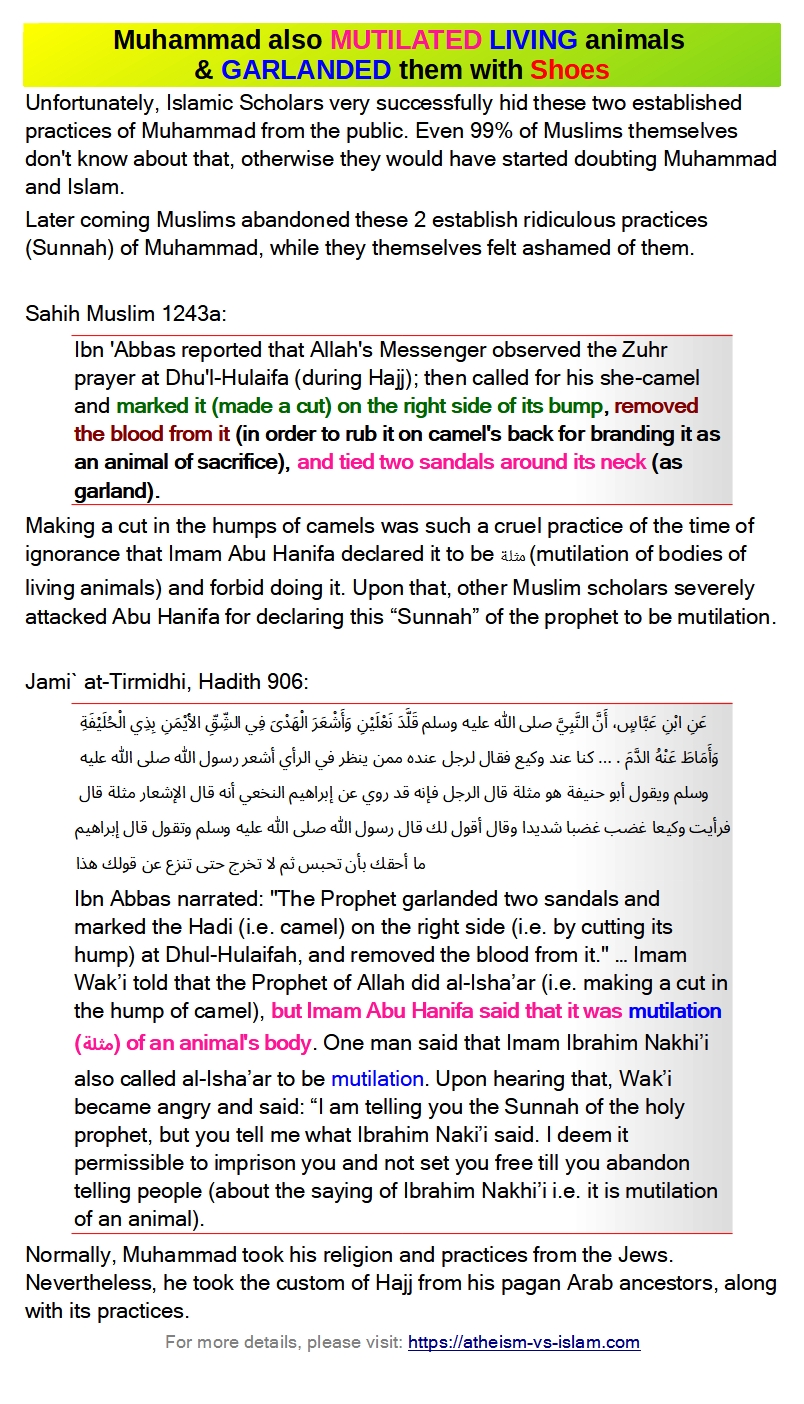
Ibn 'Abbas reported that Allah's Messenger observed the Zuhr prayer at Dhu'l-Hulaifa; then called for his she-camel and marked it (made a cut) on the right side of its bump, removed the blood from it, and tied two sandals around its neck (as garland).
Is it not an act of ignorance to adorn animals with strings of shoes? Why would Allah, the creator of not just the earth but the entire universe, require animals for sacrifice to be decorated with footwear?
Furthermore, what kind of intelligence is displayed by harming a living creature and considering it a symbolic act? Why subject animals to the humiliation of wearing shoe necklaces and causing them harm?
This practice was so lacking in wisdom that today many Muslims are abandoning it, despite it being considered an established "Sunnah of the Prophet."
Even Abu Hanifa, a renowned Islamic scholar, rejected this practice of Muhammad due to its cruelty. He refused to follow this Sunnah and claimed it to be a MUTILATION (مثلة) of animals.
Jami` at-Tirmidhi, Hadith 906:
عَنِ ابْنِ عَبَّاسٍ، أَنَّ النَّبِيَّ صلى الله عليه وسلم قَلَّدَ نَعْلَيْنِ وَأَشْعَرَ الْهَدْىَ فِي الشِّقِّ الأَيْمَنِ بِذِي الْحُلَيْفَةِ وَأَمَاطَ عَنْهُ الدَّمَ . … كنا عند وكيع فقال لرجل عنده ممن ينظر في الرأي أشعر رسول الله صلى الله عليه وسلم ويقول أبو حنيفة هو مثلة قال الرجل فإنه قد روي عن إبراهيم النخعي أنه قال الإشعار مثلة قال فرأيت وكيعا غضب غضبا شديدا وقال أقول لك قال رسول الله صلى الله عليه وسلم وتقول قال إبراهيم ما أحقك بأن تحبس ثم لا تخرج حتى تنزع عن قولك هذا
Ibn Abbas narrated: "The Prophet garlanded two sandals and marked the Hadi (i.e. camel) on the right side (i.e. by cutting its hump) at Dhul-Hulaifah, and removed the blood from it." … Imam Wak’i told that the Prophet of Allah did al-Isha’ar (i.e. making a cut in the hump of camel), but Imam Abu Hanifa said that it was mutilation (مثلة) of an animal's body. One man said that Imam Ibrahim Nakhi’i also called al-Isha’ar to be mutilation. Upon hearing that, Wak’i became angry and said: “I am telling you the Sunnah of the holy prophet, but you tell me what Ibrahim Naki’i said. I deem it permissible to imprison you and not set you free till you abandon telling people (about the saying of Ibrahim Nakhi’i i.e. it is mutilation of an animal).
Grade: Sahih (Authentic) Darussalam.
Muwatta Imam Malik, Book of al-Hajj:
أَنَّ عَبْدَ اللَّهِ بْنَ عُمَرَ، كَانَ إِذَا طَعَنَ فِي سَنَامِ هَدْيِهِ وَهُوَ يُشْعِرُهُ قَالَ بِسْمِ اللَّهِ وَاللَّهُ أَكْبَرُ .
Yahya related to me from Malik from Nafi that Abdullah ibn Umar said, when nicking (making a cut in) the hump of his sacrificial animal to brand it, "In the name of Allah, and Allah is greater."
Muwatta Imam Malik, Book of al-Hajj:
عَنْ عَبْدِ اللَّهِ بْنِ عُمَرَ، أَنَّهُ كَانَ إِذَا أَهْدَى هَدْيًا مِنَ الْمَدِينَةِ قَلَّدَهُ وَأَشْعَرَهُ بِذِي الْحُلَيْفَةِ يُقَلِّدُهُ قَبْلَ أَنْ يُشْعِرَهُ وَذَلِكَ فِي مَكَانٍ وَاحِدٍ وَهُوَ مُوَجَّهٌ لِلْقِبْلَةِ يُقَلِّدُهُ بِنَعْلَيْنِ وَيُشْعِرُهُ مِنَ الشِّقِّ الأَيْسَرِ
When Abdullah ibn Umar brought an animal to be sacrificed from Madina he would garland (i.e. tie sandals/shoes around its neck) it and brand it (i.e. to do al-Isha’ar by making a cut in its hump) at Dhu'l-Hulayfa, doing the garlanding before the branding, but doing both in the same place, while facing the qibla. He would garland the animal with two sandals and brand it on its left side.
The Prophet’s wives themselves used to make garlands of shoes for the animals.
Sahih Muslim, Book of al-Hajj:
عَنْ عَائِشَةَ، قَالَتْ رُبَّمَا فَتَلْتُ الْقَلاَئِدَ لِهَدْىِ رَسُولِ اللَّهِ صلى الله عليه وسلم فَيُقَلِّدُ هَدْيَهُ ثُمَّ يَبْعَثُ بِهِ ثُمَّ يُقِيمُ لاَ يَجْتَنِبُ شَيْئًا مِمَّا يَجْتَنِبُ الْمُحْرِمُ .
'A'isha reported: I often wove garlands for the sacrificial animals of Allah's Messenger, and he garlanded his sacrificial animals, and then he sent them and stayed in the house) avoiding nothing which a Muhrim avoids.
And not only camels, but Muhammad also used to garland sheep too.
Narrated `Aisha: I used to make the garlands for (the Hadis of) the Prophet (ﷺ) and he would garland the sheep (with them)
Mutilation of camels and garlands of shoes are such shameful practices that Muslims of today don’t do it despite it being proven Sunnah of Prophet Muhammad.
And remember that before Muhammad claimed the prophethood, he used to slaughter the animals in name of Pagan gods and ate them.
Allah's Messenger said that he met Zaid bin `Amr Nufail at a place near Baldah and this had happened before Allah's Messenger received the Divine Inspiration. Allah's Messenger presented a dish of meat to Zaid bin `Amr, but Zaid refused to eat of it and then said, "I do not eat of what you slaughter on your stone-altars (Ansabs) nor do I eat except that on which Allah's Name has been mentioned on slaughtering."
Imam Ibn Khuyzamah gave the following heading to one of his chapters (link):
باب إشعار البدن في شق السنام الأيمن ، وسلت الدم عنها ، ضد قول من زعم أن إشعار البدن مثلة ، فسمى سنة النبي - صلى الله عليه وسلم - مثلة بجهله .
Chapter about making a cut in the hump of camel from right side (i.e. al-Isha'ar) and shedding blood from it, in order to refute that person (i.e. Abu Hanifa) who says that al-Isha'ar is equal to mutilation of animal's body, so he called the Sunnah of Prophet (pbuh) to be mutilation due to his own ignorance.
And Imam Ibn 'Abdul Bar wrote (link):
وهذا الحكم لا دليل عليه إلا التوهم والظن ولا تترك السنن بالظنون
There is no proof present regarding the ruling of (Abu Hanifa), except for his delusion and conjecture. And Sunnah of the hold prophet cannot be left due to delusions and conjectures.
Muslim Excuse: Camel's humps were cut and Shoe Garlands Were for 'Identification' of Sacrificial Animals
Muslims have fabricated the excuse in defense of this act that camels' humps were cut and their blood rubbed on their backs to 'identify' them as sacrificial animals, so that people would revere these sacrificial animals and take care of their food and drink along the way.
In response, it is asked: What reverence was being shown to the animal by putting a garland of shoes around its neck? This was a shameful act, which is why today's Muslims themselves have abandoned this practice, despite it being a Prophetic Sunnah, due to embarrassment.
And for identification, it was not necessary to mutilate the animal and put its blood on its hide as a mark; instead, henna or any color could have been easily sprinkled on the animal as a mark. It should be remembered that only camels were mutilated through Ishaar, while sheep and goats were not given blood through Ishaar, but simply had garlands of shoes put on them so that they would be recognized as sacrificial animals. Therefore, the "question" is: When mutilation through Ishaar was not necessary for sheep and oxen, and merely putting on a garland was sufficient, then why mutilate camels through Ishaar? They too could have simply been adorned with garlands to serve as identification that they were sacrificial animals.
And instead of putting a garland of shoes around the neck, a specially colored collar or cloth could have been hung around the neck, or they could have been colored with henna to serve as identification. But since the Prophet was following the customs of his Arabian society from the Age of Ignorance, he continued the mutilation of animals and putting garlands of shoes around their necks for identification.
Islamist gentlemen offer another excuse: that cutting the hump did not cause pain to the animal; rather, it was like how animals are tagged in Europe today by piercing their ears or branding them with a hot iron.
In response, it is submitted that piercing the ear causes negligible pain to the animal because the ear has fewer nerve endings compared to the rest of the body, and the piercing is done on the thin part of the ear.
As for the act of branding with a hot iron, it is painful and constitutes mutilation of a living animal. A strong movement is underway against it in the West. It has been legally banned in New Zealand. In Europe, it is only permitted if pain-reducing medications (analgesics) are administered simultaneously. And gradually, this practice is being completely phased out, with ear tagging being adopted instead. Pressure from animal rights groups and conscious consumers is also pushing the industry to adopt more humane methods and to use pain-reducing medications if branding is necessary.
But Muslims cannot protest against the mutilation of religious symbols in the same way that conscious consumers in the West are putting pressure on the industry. The reason is that, for Muslims, this is a Sunnah, and protesting against a Sunnah would immediately lead to them being labeled as infidels and killed. Imam Abu Hanifa and Imam Nakh'i were extremely fortunate that despite calling Ishaar mutilation and reprehensible, no fatwas of apostasy were issued against them.
And cutting the hump of a camel in Ishaar causes tremendous pain to the animal, and it was for this very reason that Imam Abu Hanifa and Imam Nakh'i were compelled to call it mutilation.
Furthermore, what 'wisdom' was there in Muhammad's decision to travel 500 kilometers with thousands of animals from Medina to Mecca for the sake of sacrifice? Even if people along the way respected these sacrificial animals, countless camels and sheep would still die due to lack of water and fodder along the 500-kilometer journey, as it was impossible for people at every stop to arrange fodder and water for thousands of additional animals.
As the Hajj gathering grew larger, the number of animals dying en route also increased, as people were forced to travel thousands of kilometers from not only Arabia but also Africa, Iran, and Central Asia with animals to perform Hajj.
Images:

 Hassan Radwan