
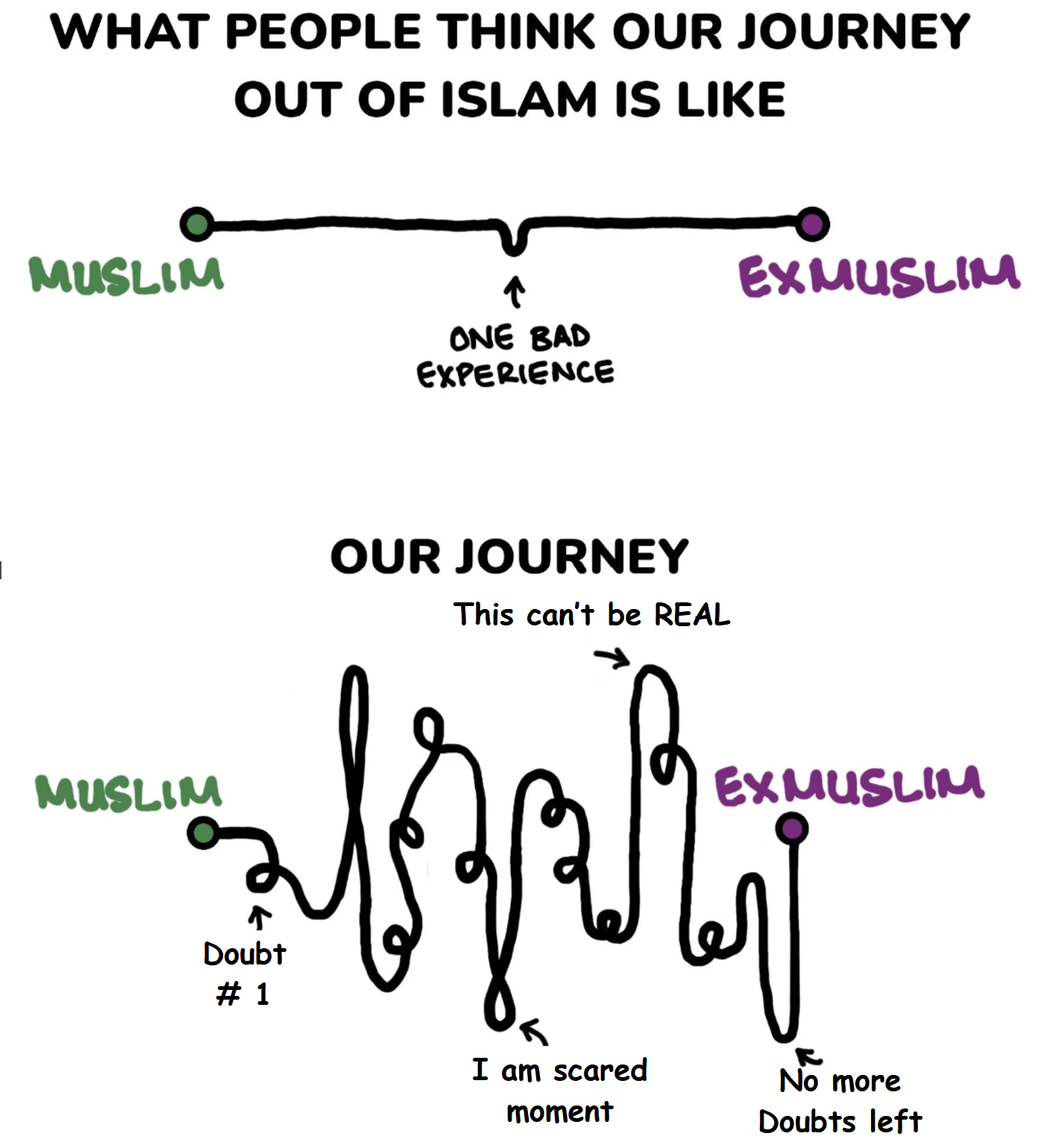
Image courtesy to Haramdoodle.com
The most painful and dangerous ride of our lives
(1) All ex-Muslims were also told as children to believe and fear eternal hellfire and punishment in the grave. Thus, doubting Islam or raising questions about any single Islamic ruling, immediately triggered that extreme fear of eternal hellfire.
(2) All ex-Muslims were also told that Allah is 100% PERFECT and JUSTICE is one of his attributes. But when we come to know about injustices like the rape of captive and slave women against their consent, then it is one of the most painful shocks of our lives.
(3) All of us were aware that doubting Islam would mean our own family would turn against us, expel us from home and we would end up having no family. The fear of being shunned by family and friends, losing social support networks, and facing discrimination weigh extremely heavily on ex-Muslims.
(4) The process of reevaluating deeply held beliefs and ideologies can lead to a profound sense of identity crisis and existential turmoil. Ex-Muslims struggle heavily with feelings of guilt, shame, and confusion as they navigate their new worldview and sense of self.
(5) Leaving Islam also entails grappling with the loss of cultural and religious traditions that were once integral to one's identity. Ex-Muslims experience a profound sense of grief and disconnection from their cultural heritage, as well as the loss of rituals, customs, and communal practices that provided a sense of belonging.
(7) Ex-Muslims face heightened risks of persecution, discrimination, and violence in societies where apostasy is punishable by law or where blasphemy is vigorously enforced. The threat of legal prosecution, imprisonment, or even death can cast a shadow over the decision to renounce Islam.
(8) For many ex-Muslims, leaving Islam involves a complex process of deconstructing and challenging deeply ingrained beliefs about morality, spirituality, and the nature of existence.
Despite these painful challenges and extreme dangers, ex-Muslims are driven by an innate sense of humanity and a commitment to intellectual honesty. The pursuit of truth compels them to challenge the beliefs and ideologies they once held sacred, even at great personal cost.
Not an Immediate, but a Gradual Change in Distinct PHASES
The change doesn't happen overnight; it takes a longer period of time and occurs "gradually" in distinct "phases," often spanning many years.
For example, one ex-Muslim described the phases during his journey in the following words:
1. Grief & Emptiness - feeling a profound sense of loss, confusion, and emptiness
2. Nihilism & Anger - everything seems meaningless and pointless, anger at myself for being fooled and anger at Islam and the horrible things in it
3. Cynicism & Individualism - shoring up my sense of identity after having it shattered when I “uninstalled” Islam from my operating system and regaining a sense of self, figuring out how to navigate society without betraying myself and making sure my needs are met, struggling to maintain empathy and compassion
4. Gratitude & Freedom - realizing I have an entire universe of meaning to draw from, without limit, to construct my sense of self, my understanding of reality (world view), and my relationship with reality, deep gratitude for my freedom and the ability to experience expanded consciousness and opportunity
(Credit: hiJessicaArtemisia)
Allegation by Islamists: Ex-Muslims leave Islam for money, fame, activism, or a career
Our Response:
Contrary to the claims of Islamic apologists, the reality for millions of ex-Muslims, the vast majority of whom reside in Islamic countries, is one of constant fear and persecution. Forced into hiding to evade apostasy and blasphemy laws, as well as the threats posed by extremist religious adherents and even their own families, these individuals live in a perpetual state of vulnerability. In such circumstances, it is implausible to suggest that leaving Islam could bring them any monetary gain, fame, or career advancement.
Even in Western nations, where ex-Muslims may theoretically enjoy greater freedoms, many still choose to conceal their apostasy to avoid risking their familial relationships. The number of openly ex-Muslims is a mere fraction of the total population, with only a small percentage—likely between 2% to 5%—willing to publicly declare their departure from Islam.
While money, fame, and career opportunities are indeed valued pursuits for individuals worldwide, the vast majority of ex-Muslims do not leverage their apostasy for personal gain. In reality, only a minuscule portion—perhaps 1% —of openly ex-Muslims actively pursue such avenues.
This raises the crucial question: what about the remaining 99% of ex-Muslims who do not use their apostasy for any financial or career-related purposes? Their experiences underscore the profound challenges and sacrifices faced by those who dare to question and leave their former faith, highlighting the inherent injustice and hardship inherent in their struggle for freedom of belief and expression.
Allegation by Islamists: Ex-Muslims leave Islam for their sinful lifestyle like Girlfriends/Partying/Dancing
Our Response:
It's then a puzzling question why millions of Muslims in countries such as Tunisia, Iraq, Turkey, and Algeria react with intense anger and vigorously defend their prophet and scripture when faced with criticism or mockery. This fervent reaction persists despite the prevalence of activities like nightclubbing, pre-marital dating, modern music, and even alcohol consumption in these societies.
In Western countries, too, Muslim youth are involved in all these Haram activities, but still, they never eat pork and they stay Muslim.
Moreover, enjoying, partying and dancing are integral parts of human nature.
When Islam puts restrictions on opposite genders interacting with each other, then Islam is going against human nature. Due to this unnatural Islamic system, there is a huge problem of sexual frustration among Muslim youth in Islamic countries. That is why Islamic countries are at the top of the list for watching porno films. Please read our articles:
- The practice of Islamic Hijab and Modesty leads only to sexual frustration
- Are Islamic countries suffering from sexual frustration and ahead in watching Porn movies or is it only false propaganda?
Allegation by Islamists: Ex-Muslims face a SINGLE bad experience in life, blame Allah for it, and leave Islam
Response:
We haven't encountered a single ex-Muslim, where only a SINGLE incident was a reason for leaving Islam.
All former Muslims are acutely aware of the injustices perpetrated by Islam against women. They are well-versed in how Islam encroaches upon women's rights in matters such as marriage, divorce (talaq), domestic violence, compulsory veiling (Hijab), confinement to the home, subservience to men, and the endorsement of polygamy and the exploitation of slave girls. All of them are appalled by the sanctioning of child marriage, where girls as young as six are wedded without their consent and subjected to sexual violence at the age of nine.
Who are those ex-Muslims who didn't know how Islam shows double standards where it wants rights for Muslims to preach Islam to non-Muslims and to convert them to Islam? But if non-Muslims preach their religion and if any Muslim leaves Islam, then Islam kills them.
Who are those ex-Muslims who didn't know the clash between the "Theory of Evolution" and fantasy religious stories of the creation of Adam and Eve and how the devil made them eat the forbidden fruit?
One single incident may be a trigger, but the injustices of Islam are many and all ex-Muslims were aware of them, and all these doubts played a role.
If Muslims fail to see these Islamic injustices, then it is their own problem and they are suffering from religious indoctrination. They should cure their own disease instead of blaming ex-Muslims wrongfully.
Secondly, the problem with Islam is, that it claims that Allah is 100% PERFECT. Thus, even if there is a SINGLE mistake found in Islam, then it destroys the remaining 99.99% of Islam automatically.
For instance, allows Muslim men to rape poor captive/slave women without their consent and even make all children slaves for their entire lives (although they had no role in wars), our innate sense of humanity unequivocally tells us that it is morally wrong. We cannot cherry-pick, accepting Allah as a deity in the majority of cases while denouncing him as oppressive only in instances like the rape of slave women. It's a binary choice: either Allah is divine in all matters, or he is not divine at all.

 Hassan Radwan