
Credit: atheismindia
Excuse of Voluntary Act by Hindutva supporters for Sati
The most common excuse from Hindutva supporters is that Sati was purely a voluntary act. This image highlights the mindset of modern Hindutva followers:
EXPECTATION vs. Voluntary Act
Let’s face it: there is no such thing as a truly voluntary act when society places even the slightest EXPECTATION on you. Practices like Sati and wearing the Hijab are not free choices—they’re chains, cleverly disguised as traditions or religious duties.
The moment society, your family, or your community EXPECTS something from you, it becomes psychological coercion. Forget physical force—this EXPECTATION creates an invisible prison.
Thus, although Hindutva argues that Sati was a choice, but this ignores the reality of social and religious pressure. Unlike women accused of crimes—who at least had a chance to escape execution if proven innocent—widows were given no such opportunity. Their fate was often sealed the moment their husbands died.
Religious INDOCTRINATION vs. Voluntary Act
When a Jihadist does a suicide bombing out of his own freewill and choice (without any person forcing him to do so), is it called a voluntary act or blamed as a result of religious brainwashing?
Imagine a society where death is normalized as an option, where some women are raised to believe that burning themselves alive on their husband’s pyre is not just acceptable but divinely ordained. Think about the generations of brainwashing that would make suicide seem like a righteous, even sacred act. It doesn’t matter whether it’s called "choice." When women are conditioned to see this as their moral duty, it’s not freedom—it’s oppression dressed up as tradition.
The Horrific Life of a Widow, If Not Dying in Sati
Let’s face the brutal truth: if a woman didn’t "choose" Sati, her life didn’t get any better. If she survived, she would be condemned to live as a widow in a society that had no mercy for her. She couldn’t remarry, no matter how young or desperate she was for companionship or care. She was often isolated, stigmatized, and left to struggle with nothing—no support, no future. Her life was reduced to a shadow of what it once was. Society made sure of it. There was no dignity, no second chance, no escape from the cruel fate of being a widow. She wasn’t allowed to mourn or move on; she was forced to live in a constant state of humiliation and despair.
A "Voluntary" Act at the Cost of Small Children?
And let's ask the hard question: what about the children? If the mother was allowed to commit Sati, what would happen to her small children? Who would care for them? In a society that expects a woman’s death as a duty, her children would often be left orphaned, abandoned, with no hope of a better life. Their fate wasn’t considered when this so-called "choice" was glorified as a sacred duty. All that mattered was upholding tradition, no matter the human cost. This wasn’t about free will; it was about a system that stripped women of their rights and their futures, all while pretending to uphold sacred values.
Why did no MAN ever commit SATI as a Sacred & Voluntary Act?
Ask yourself: why was Sati always "sacred & voluntary" for women and never for men? Why didn’t men throughout history get the so-called "option" to burn themselves on their wife’s pyre? Defenders of this barbaric practice remain silent because there are no answers—this was never about choice, or virtue, or anything else, except for a senseless practice to glorify the religion, just like slaughtering animals in the name of gods. The difference? This one demanded human lives.
Sati vs. Modern Assisted Suicide
Modern Hindutva supporters try to deflect criticism of the practice of Sati by pointing to the West’s acceptance of assisted suicide, claiming it’s a case of double standards. They argue that both practices are about "choice," and therefore, if one is acceptable, the other should be too. But this comparison is not only flawed—it’s dangerously misleading. Here’s why:
- Assisted suicide is rooted in compassion and the right to die with dignity, after rigorous psychological and medical evaluations to ensure the decision is informed and free from coercion. Importantly, assisted suicide is a human effort to make the painful process of dying as PAINLESS and PEACEFUL as possible. It is about reducing suffering, not adding to it.
- Sati, on the other hand, was a practice rooted in patriarchy and cultural coercion. It was not about relieving suffering but about enforcing societal expectations on widows, often under immense psychological and social pressure. Moreover, burning ALIVE in fire is perhaps one of the most agonizing and PAINFUL and non-PEACEFUL forms of death imaginable. It is the exact opposite of a painless, dignified end.
Sati vs. LOVE Argument
You will often see the following kind of love argument by Hindutva supporters:
I watched my maternal grandmother cry for YEARS. She was and empty shell of a human being for a long long time. Deep down, I suspect she would have committed Sati if it was legal at the time. Modern degenerates who have 20 sex partners before marriage wouldn't know true love even if it hit them in the skull with a hockey stick.
Please note that:
- Often Hindu Kings were marrying multiple women and having multiple concubines for love, but Hindu wives had to self-immolate themselves in the name of same love.
- Many Rajput warriors (not just kings, but wealthy nobles and feudal lords, known as Thakurs, Ranas, and Rawats) also had multiple wives and concubines (slave girls). While kings had grand harems, even Rajput nobles and warriors followed similar practices, though on a smaller scale. Marrying multiple women was considered a status symbol in Rajput culture.
- Tawaifs (Courtesans): While not exactly slaves, many Rajput nobles maintained relationships with courtesans.
- While Rajput men could have multiple wives and concubines, Rajput women were expected to remain loyal to one husband.
- Widows were forbidden from remarrying and were often pressured into Sati (self-immolation).
- Women had little to no say in these marriages.
If love was the factor, why then in Indian history (or in Hindu sacred books) husbands were never found committing Sati for their wives?
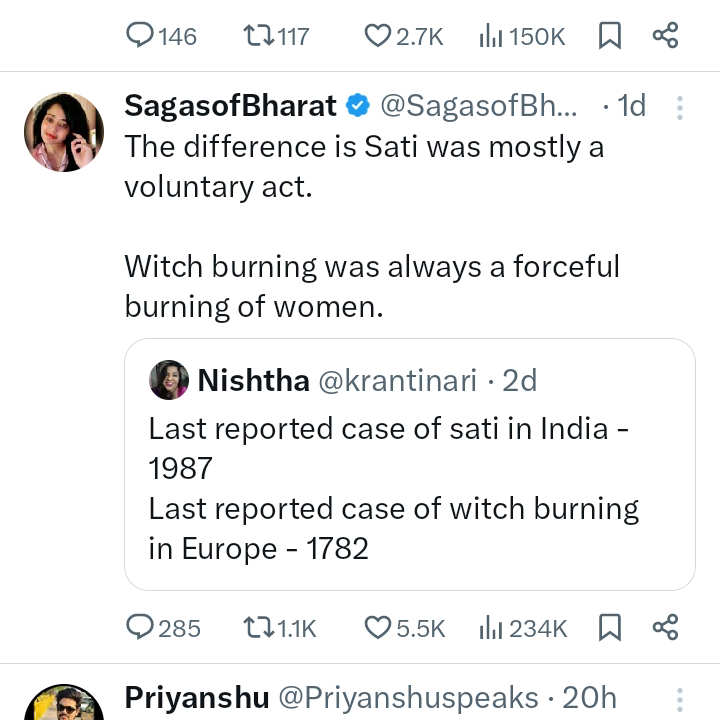
Sati Burning vs. Witch Burning
Whenever Sati is criticized, modern Hindutva supporters try to deflect by bringing up witch burnings in medieval Europe, as if that somehow justifies their own past. Let’s set the record straight.
First, we—modern, secular, non-religious people in the West—are not responsible for burning witches. We don’t even believe witches ever existed. The so-called "witches" who were burned were just innocent women, victims of religious fanaticism. And guess what? We openly condemn the religious people who carried out those atrocities, and we criticize their religious books for containing such dangerous ideas.
Now, compare that to modern Hindutva supporters. Instead of condemning their own religious texts that glorified and encouraged Sati, they defend them. Instead of acknowledging the brutality of their past, they try to point fingers elsewhere. That’s the difference. We reject and criticize the horrors committed in the name of religion, while they try to justify theirs.
And let’s talk about historical facts:
- The last reported case of Sati in India - 1987
- The last reported case of Witch Burning in Europe - 1782
Sati: Just a Local Tradition or a part of Hindu Religious Texts?
Modern Hindutva supporters love to claim that Sati was just a regional tradition.
Let’s cut through the noise and expose the lies: Sati wasn’t just some "local tradition"—it was a widespread, deeply rooted practice encouraged and glorified in Hindu scriptures. Modern Hindutva supporters want to whitewash history, claiming Sati was rare or unrelated to Hinduism. But the facts tell a different story.
Hindu Scriptures Glorified Sati:
-
Rig Veda (10.18.7): The oldest Hindu text mentions widows lying beside their dead husbands on the pyre. Later edits softened the language, but the original intent was clear.
-
Garuda Purana (Chapter 10, Verses 91-92): Explicitly glorifies Sati, claiming a widow who burns herself purifies her family and earns heaven.
-
Mahabharata (Anusasana Parva, Chapter 146): Praises queens who committed Sati, framing it as the ultimate act of wifely devotion.
-
Manusmriti (5:160): While it doesn’t outright demand Sati, it makes a widow’s life so miserable—no remarriage, no joy—that death seems like the only escape.
-
Padma Purana, Agni Purana, Vishnu Dharmasutra: These texts either endorse or celebrate Sati. If it wasn’t tied to Hinduism, why do these scriptures praise it?
Hindutva supporters claim Sati was limited to Bengal or Rajasthan. That’s false. Historical and archaeological evidence shows it was widespread:
-
South India: Ancient Tamil inscriptions describe women being burned alive.
-
Karnataka, Andhra Pradesh, Tamil Nadu: Sati stones (memorials for women who committed Sati) are found across these regions.
-
Gujarat, Maharashtra, Madhya Pradesh, Nepal: Records show Sati was practiced here too.
It wasn’t rare—it was everywhere.
Why the denial? Because Hindutva supporters want to sanitize history, pretending Hinduism has never oppressed women. But history doesn’t lie. Instead of rewriting the past, they should acknowledge it and move forward. Denial won’t erase the truth.
We encourage all to check out the following article, which compiles all references to Sati from Hindu scriptures, along with details on the eras and regions where it was practiced:

 Hassan Radwan