
The term "Islamophobia" is widely used to describe prejudice, hatred, or discrimination directed against Muslims. However, this terminology has generated substantial debate, and understanding why matters more than most people realize.
The Critical Distinction
There's a fundamental difference between two things:
- Criticizing Islam as an ideology - Like any belief system, Islam can be analysed, discussed, and critiqued. This is not bigotry. It's how free societies function. We critique political ideologies, social movements, and yes, religious doctrines. This is protected speech and necessary for progress.
- Prejudice against Muslims as people - Discriminating against someone solely because they're Muslim is wrong. It's bigotry, plain and simple. Hating or mistreating individuals because of their religious identity is never acceptable.
Why the Term "Islamophobia" is Problematic
If we're concerned about discrimination against people, the term should be "Muslimophobia" or "anti-Muslim prejudice." The term "Islamophobia" conflates these two distinct concepts, and this conflation has real consequences. It's often weaponized to shut down legitimate criticism of Islamic doctrine by labelling any critique as "hatred" or "bigotry."
This matters because while we debate terminology in the West, people are dying. Real people. People whose stories you're about to read.
Understanding Kafirophobia: The Other Side of the Coin
While "Islamophobia" dominates Western discourse, there's another form of religiously-motivated hatred that receives almost no attention: Kafirophobia - systematic hostility toward non-Muslims rooted in certain interpretations of Islamic texts.
The Textual Foundation
Many non-Muslims are concerned that certain Quranic verses contain deeply derogatory language about non-believers. These aren't obscure passages - they're central texts that shape attitudes in many Muslim-majority societies.
Here's what the Quran says about non-Muslims (kafirs):
| How Non-Muslims Are Described | Quranic References |
| Compared to animals - asses, dogs, cattle | 62:5, 74:50, 7:176, 7:179, 25:44, 47:12 |
| Called losers | 2:121, 3:85, 5:5, 8:37, 10:95, 27:5, 29:52, 39:63, 39:65 |
| Called wicked, insolent, hard-hearted | 8:37, 6:146, 7:166, 40:75, 67:21, 39:22, 57:16 |
| Called deaf, blind, dumb | 2:171, 5:71, 6:39, 17:97, 30:52, 30:53, 41:44 |
| Called ignorant, miserly, begrudging | 6:111, 39:64, 4:37, 3:120 |
| Called transgressors, corrupting | 5:64, 5:78, 6:110, 7:186, 10:11, 10:74, 37:30, 50:25, 10:40 |
| Called filthy (najis) | 9:28 |
| Called traitors, liars, perverse | 5:13, 22:38, multiple verses, 5:75, 9:30, 10:34 |
| Called "the vilest of animals in Allah's sight" | 8:55 |
| Called "the worst of all creatures" | 98:6 |
| Declared Allah's/Muslims' enemy | 2:98, 8:60, 41:28, 60:1, 4:101, 60:1-2 |
| Allah hates, curses, humiliates them | 35:39, 40:10, multiple verses |
| Allah will destroy, torture them | 3:141, 4:56, 18:29, 22:19-22, 40:71-73 |
| Allah turns them into apes and pigs | 2:65, 5:60, 7:166 |
Modern moderate Muslims often argue these verses applied only to specific 7th-century enemies of Muhammad. They shouldn't be applied to all non-Muslims today.
But here's the uncomfortable truth: Classical Islamic scholars rejected this view entirely. For over a thousand years (8th-19th centuries), the dominant interpretation across all major Islamic schools of law held that these verses apply universally to all non-Muslims, for all time.
Today's "radical" interpretations aren't new inventions. They're revivals of what was mainstream Islamic teaching for most of Islamic history. The moderate reinterpretations are actually the recent innovation, emerging primarily in the 20th century under pressure from modern human rights norms.
This is why strict interpretations still resonate with millions of Muslims worldwide. They're not fringe - they're rooted in centuries of established scholarship.
Kafirophobia in Action Today
The Societal Level
In Western countries, when Muslims face job discrimination, there are protests, media coverage, and public outcry about "Islamophobia."
Meanwhile, in mosques across the Muslim world, sermons openly preach:
- Don't befriend kafirs (non-Muslims)
- Don't participate in their festivals
- Don't trust them
- Remember: all kafirs are one nation against Muslims
A Real Example
The Saudi Grand Mufti, whose influence in Islam is comparable to the Pope in Catholicism, officially teaches (link):
"Undoubtedly the Muslim should hate the enemies of Allaah and disavow them, because this is the way of the Messengers and their followers. Allaah says (interpretation of the meaning):
“Indeed, there has been an excellent example for you in Ibraaheem (Abraham) and those with him, when they said to their people: Verily, we are free from you and whatever you worship besides Allaah, we have rejected you, and there has started between us and you, hostility and hatred for ever until you believe in Allaah Alone” [al-Quran, Surah al-Mumtahanah 60:4]
“You (O Muhammad) will not find any people who believe in Allaah and the Last Day, making friendship with those who oppose Allaah and His Messenger (Muhammad), even though they were their fathers or their sons or their brothers or their kindred (people). For such He has written Faith in their hearts, and strengthened them with Rooh (proofs, light and true guidance) from Himself” [al-Quran Surah al-Mujaadilah 58:22]
Based on this, it is not permissible for the Muslim to feel any love in his heart (for them). "
Imagine if the Pope said this about Muslims. There would be international outrage, diplomatic crises, endless news coverage.
But when the Saudi Grand Mufti says it about non-Muslims? Silence.
The result? In Pakistan alone, thousands of Christians, Hindus, Sikhs, Ahmadis, and Shias are killed by Islamic fanatics. These aren't isolated incidents. They're the logical outcome of systematic dehumanization preached from pulpits.
And here's what's truly alarming that these teachings aren't confined to Muslim-majority countries. Even in Western countries, radical preachers successfully spread these interpretations with little effective challenge.
The State Level: A Tale of Two Systems
| Issue | Muslim-Majority Countries (Saudi Arabia, Pakistan, Iran, etc.) | Western Democracies (US, Germany, France, etc.) |
|---|---|---|
| Preaching Religion | Non-Muslims are prohibited from preaching to Muslims. Punishment can include death. | Muslims freely preach Islam to everyone. No restrictions. |
| Leaving Religion | Muslims who leave Islam face death penalty or imprisonment. Apostates are separated from their wives. Apostates lose children's custody. Details here. | Anyone can leave any religion, including Islam. No penalties. Complete freedom. |
| Criticizing Religion | Criticizing Islam is "blasphemy" - punishable by imprisonment or death. | Anyone can criticize any religion, including Islam. Protected free speech. |
| Marriage | Muslim women cannot marry non-Muslim men. Violators face death by stoning. Strictly enforced by state. | No restrictions on interfaith marriage in any direction. |
| Freedom of Expression | Questioning Islam publicly results in severe legal and social consequences. | Questioning any religion, including Islam, is legally protected. |
Look at that table carefully. This isn't about "cultural differences." This is systematic discrimination written into law and enforced by the state.
The Hidden Victims: Ex-Muslims Living in Islamic Countries
Picture living every single day of your life as a performance. One wrong word, one unguarded moment, one honest conversation could end in your death. Your parents can't know. Your siblings can't know. Even your spouse can't know what you actually think. You must act out religious rituals you don't believe in, day after day, year after year, with no end in sight. There is no escape route. No safe exit. This isn't a dystopian novel. This is the daily reality for millions of ex-Muslims trapped in Islamic countries.
They must express outrage at blasphemy they secretly agree with. They defend Islam in conversations while mentally critiquing every argument they make. Every relationship in their life is built on deception. Perhaps most heartbreaking of all, many must raise their own children as Muslims, teaching them beliefs they've rejected, perpetuating the very system that imprisons them.
Imagine the mental toll of this existence:
Every word must be monitored. Every facial expression controlled. Every reaction calculated. Not a single relationship in your entire life can be authentic. You cannot let your guard down for even a moment. The constant vigilance is exhausting. The loneliness is crushing. The cognitive dissonance of living a lie every waking hour leads to severe depression and anxiety. For many, suicide feels like the only way to ever be free.
Other marginalized groups can find each other. They can build communities, support networks, safe spaces. Ex-Muslims in Islamic countries have none of that:
There's no one safe to confide in. Support groups are illegal. Expressing doubt, even privately, is dangerous. Therapists are required to report apostasy. Even online spaces aren't safe because governments monitor internet activity. They are completely, utterly alone.
These testimonies from the ex-Muslim subreddit reveal the human cost:
"I haven't had a real conversation in 5 years. Everyone I talk to, I'm lying to them about who I am."
"Sometimes I forget what my own voice sounds like when I'm being honest."
"The hardest part isn't the fear. It's that I'll die and no one will have ever really known me."
Read those again. Slowly. These aren't abstract concepts. These are human beings describing what it feels like to live their actual lives. Real people. Right now. Today. Trapped in a prison without walls, where the punishment for honesty is death.
A Note on Sources: What you're about to read comes primarily from the r/exmuslim subreddit, one of the only places ex-Muslims can share their experiences anonymously. Traditional research methods don't work here. You can't survey people who would be killed for answering honestly. You can't interview people who must hide their identity to survive. These testimonies are anonymous and unverifiable, yes. But the consistency across thousands of accounts from different countries, different backgrounds, different time periods tells us something real. And the very fact that they can ONLY speak anonymously is itself proof of the problem.
Ex-Muslim Women:
If you think ex-Muslim men have it bad, ex-Muslim women face additional layers of suffering that are almost unbearable to contemplate.
They must wear the hijab every day of their lives. They cannot remove it even when alone outside (neighbors watch). It's the physical symbol of beliefs they reject, a daily reminder they're trapped.
"Every morning I put on my hijab, I feel like I'm putting on chains. But I have to smile and act like it's my choice."
Families arrange their marriages to "pious" Muslim men. These women must:
- Marry religious men they may resent
- Provide sex services to these men while hiding their true beliefs
- Cannot refuse sex (Islam mandates wives provide sexual access)
- Cannot divorce (too difficult, too dangerous, family won't support it)
- Are trapped for life
Think about the psychological trauma:
- Sharing a bed with someone you must constantly lie to
- Being intimate with someone who might kill you if they knew who you really are
- Teaching your daughters the beliefs that trapped you
"My husband thinks I'm a good Muslim wife. He has no idea I've been secretly taking birth control because I don't want to bring more children into this cage."
"I have to have sex with a man who said he'd kill apostates as Sharia demands. He doesn't know he's sleeping with one."
Let that sink in. She has sex with a man who has openly said he would kill people like her. And he doesn't know he's sleeping with one.
Ex-Muslim mothers cannot trust even their own children because:
- Children might innocently reveal mother's beliefs
- She must indoctrinate her children with beliefs she rejects
- She cannot be authentic even with her own kids
- She watches her daughters being forced into the same prison
- She cannot protect them without exposing herself
This is generational trauma in action:
- She must teach the Quran to her children
- Force her daughters to wear hijab
- Arrange her daughters' marriages to religious Muslim men
- Pass on the oppression to the next generation
- Live with crushing guilt
"My daughter asked why we pray if Allah doesn't answer. I had to tell her to never say that again, when I wanted to hug her and tell her she's right."
"I'm watching my teenage daughter go through what I went through, i.e. questioning, doubting, suffering. And I can't help her. I can't even tell her she's not alone."
A mother watching her daughter suffer, unable to help. Unable to even say "I understand. You're not crazy. You're not alone."
When Death Becomes the Only Freedom
For many ex-Muslims, the psychological strain becomes unbearable:
- Decades of lying stretching ahead
- No possibility of ever living authentically
- Watching their children face the same fate
- No hope for change in their lifetime
Suicide becomes the only escape they can imagine.
"I've written my suicide note 6 times. Each time I think that this is the only way I'll ever be free."
"I don't want to die. I just want to live honestly. But those are the same thing in my situation."
"The only thing stopping me is knowing my family would blame themselves. They don't know they're the prison guards."
The r/exmuslim subreddit contains thousands of these stories. Different countries, different backgrounds, different circumstances. But the same themes repeat over and over:
Why All This Suffering? The Answer is Kafirophobia
All of this, every suicide note, every forced marriage, every terrified ex-Muslim child hiding their doubts, all these stems from one source: Islamic Kafirophobia
The Islamic doctrine teaches:
- Apostasy = death penalty
- Kafirs = najis (impure), worst of creatures
- Leaving Islam = betraying family, community, nation
- Ex-Muslims = corrupting influence to be eliminated
The result:
- Societies police each other's beliefs
- Families monitor their own members
- Children report parents, parents report children
- No privacy, no safety, no freedom
The Double Standard: What Gets Attention and What Gets Ignored
What Generates International Outrage:
When a Western city bans minarets (while still allowing mosques) ... then World's Response:
- International condemnation
- Human rights organizations mobilize
- Media coverage for weeks
- UN resolutions proposed
- "Islamophobia crisis" declared worldwide
When a European country requires face-covering removal for ID photos ... then World's Response:
- Labeled "religious persecution"
- Protests across the Muslim world
- Diplomatic incidents
- Boycott campaigns
- Endless debate about "Islamophobia"
What Gets Ignored:
Ex-Muslims live in 24/7 fear of death in multiple countries ... but World's Response:
- Silence from the international community
- No human rights campaigns
- Minimal media coverage
- No UN resolutions
- Dismissed as "their internal matter"
Ex-Muslim women forced to wear hijab against their will for life ... but World's Response:
- Silence
- Excused as "cultural differences"
- Labelled "internal affairs"
- No solidarity from Western feminists who claim to care about women's bodily autonomy
The Questions No One Asks:
- Why is banning minarets "Islamophobia" but executing apostates not "Kafirophobia"?
- Why is restricting hijab oppression, but forcing hijab not?
- Why are Western critics of Islam attacked as bigots, but Muslims who advocate killing apostates defended or ignored?
- Why do we hear endless discussions about "Islamophobia" but almost nothing about ex-Muslims suffering in Islamic countries?
The answer is uncomfortable: The victims are invisible, and the apologists are loud.
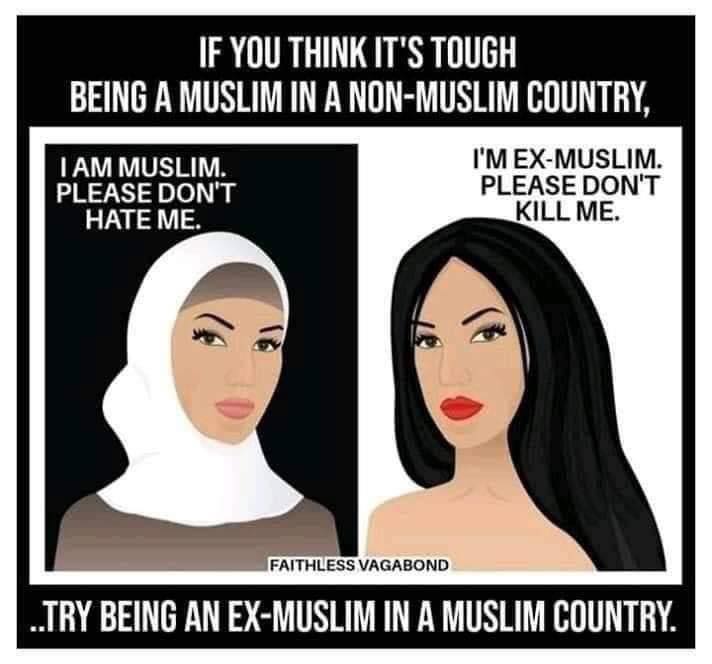
The Cruel Irony
Victims of Islamic law:
- Cannot speak publicly (would be killed)
- Have no platform
- Are silenced by fear
- Die without their stories being told
Defenders of Islamic law:
- Speak freely in the West
- Are protected by Western free speech laws
- Have access to media, universities, international platforms
- Face no danger for their views
The result is that the people who don't suffer control the narrative. The people who do suffer are invisible. And the suffering continues, unnoticed and unaddressed.
How many times did you hear the word "Kafirophobia" as compared to "Islamophobia"?
Most probably, you have never heard the word "Kafirophobia" in your entire life up till now.
Final Thoughts:
The term "Islamophobia" has been weaponized to silence criticism of Islamic doctrine while real people like ex-Muslims, religious minorities, women, LGBT people in Islamic countries, they all suffer in silence.
Meanwhile, "Kafirophobia", the systematic hatred and dehumanization of non-Muslims embedded in certain interpretations of Islamic texts and enforced by law in multiple countries, it receives almost no attention.
This isn't about hating Muslims. Most Muslims are good people trying to live their lives. Many Muslims are also victims of these same oppressive interpretations.
This is about:
- Acknowledging that ex-Muslims exist and are suffering
- Recognizing that criticizing ideology is not the same as hating people
- Demanding consistency, i.e. if religious freedom matters, so does the freedom to leave religion
- Breaking the silence that lets this suffering continue
To ex-Muslims reading this: You are not alone. Your suffering is real. Your desire for freedom is not wrong. You deserve to live authentically. I see you, even if the world doesn't.
To everyone else: These aren't statistics. These are human beings. They're writing suicide notes. They're watching their children suffer. They're dying without anyone ever knowing who they really were.
If you care about human rights, this should matter to you.
If you call yourself a feminist, ex-Muslim women's suffering should matter to you.
If you support religious freedom, the freedom to leave religion should matter to you.
The silence is complicity. And the time to break that silence is now.
For more testimonies and to understand the lived experiences of ex-Muslims, visit r/exmuslim. Their stories deserve to be heard.

 Hassan Radwan