
According to Muhammad and the Quran, there is a belief that:
- An ocean of sweet water exists above the seven heavens.
- This sweet water of rain falls from that ocean above the heavens onto the Earth.
- It is the same ocean upon which the throne of Allah rests.
- Additionally, there are mountains of snow in the heavens, from which Allah sends hail.
This portrayal aligns with a Flat Earth model, where the seven heavens are envisioned as a canopy above the flat Earth.
It is worth noting that this model of rain and the flat Earth appears to have been adopted from the Bible, which, in turn, drew inspiration from earlier civilizations.
Table of Contents:
- Sweet rainwater comes directly from sweet water ocean in the heavens, upon which Allah's throne is resting
- The Barrier between the Salty Water of Earth's Ocean and the Sweet Water of Heavens' Ocean
- The Cloud Model in Muhammad's mind
- The Concept of Thunder and Lightning in Muhammad's mind
- The Model of Hails in Muhammad's Mind
- The Source of sweet water of the Nile and Euphrates in Muhammad's mind
- The concept of the western and the eastern ends of the Flat Earth being extremely HOT in Muhammad's mind
- The Implication
- Response to Common Apologist Excuses
- The Verdict for the Reader
Sweet rainwater comes directly from sweet water ocean in the heavens, upon which Allah's throne is resting
The concept of a sweet water ocean above the heavens was present in Muhammad's understanding, as described in the Quran. Muhammad claimed that two oceans, one with salty water and the other with sweet water, do not mix.
Quran 25:53:
وَهُوَ ٱلَّذِى مَرَجَ ٱلْبَحْرَيْنِ هَٰذَا عَذْبٌ فُرَاتٌ وَهَٰذَا مِلْحٌ أُجَاجٌ وَجَعَلَ بَيْنَهُمَا بَرْزَخًا وَحِجْرًا مَّحْجُورًا
And it is He who has released [simultaneously] the two seas, one fresh and sweet and one salty and bitter, and He placed between them a barrier and prohibiting partition.
But how is it possible, while there exists no ocean on the earth which has sweet water?
The explanation for this lies in the cosmological model that Muhammad and earlier civilizations, such as those mentioned in the Bible or Sumerian and Akkadian civilizations, had in min, a model that included the presence of a sweet water ocean above the heavens.
Various verses in the Quran and Ahadith start aligning perfectly with this cosmological model when we understand the presence of a sweet water ocean in Muhammad's mind. For instance, Muhammad stated that Allah's throne was resting upon the water, a story with parallels in the Bible. This connection can be seen in the verses from the Quran (11:7) and the corresponding passage from Genesis.
Quran 11:7:
وَهُوَ ٱلَّذِى خَلَقَ ٱلسَّمَٰوَٰتِ وَٱلْأَرْضَ فِى سِتَّةِ أَيَّامٍ وَكَانَ عَرْشُهُۥ عَلَى ٱلْمَآءِ
And He it is Who created the heavens and the earth in six Days - and His Throne was upon the water.
This story parallels the biblical account.
(<Genesis 1:7) *In the abeginning God created the heaven and the earth ... And the Spirit of God moved upon the face of the waters ... And God made the firmament, and divided the waters which were under the firmament from the waters which were eabove the firmament ... The earth was formless and empty, and darkness covered the deep waters. And the Spirit of God was hovering over the surface of the waters ... Then God said, “Let there be a space between the waters, to separate the waters of the heavens from the waters of the earth.” And that is what happened. God made this space to separate the waters of the earth from the waters of the heavens. Then God said, “Let the waters beneath the sky flow together into one place, so dry ground (i.e. the Earth) may appear.” And that is what happened.
The Quranic account continues this narrative in the following verse as well, where it claims that He (i.e. Allah) sent down water from the sky.
Quran 23:18:
وَأَنزَلْنَا مِنَ ٱلسَّمَآءِ مَآءًۢ بِقَدَرٍ فَأَسْكَنَّٰهُ فِى ٱلْأَرْضِ ۖ وَإِنَّا عَلَىٰ ذَهَابٍۭ بِهِۦ لَقَٰدِرُونَ
(Pickthall) And we send down from the sky water (i.e. rain) in measure, and We give it lodging in the earth, and lo! We are also Able to withdraw this water.
(Maududi) We sent down water from the sky in right measure, and caused it to stay in the earth, and We have the power< to cause this water to vanish.
(Sahih International) And We have sent down rain from the sky in a measured amount and settled it in the earth. And indeed, We are Able to take it away.
Please reflect upon these words in this verse: "... We can also withdraw/vanish/take it away this water" when referring to the water sent down from the sky.
The problem arises from the fact that during the Flood of Noah, a significant amount of rainwater from this same sweet water ocean above the heavens fell, and it has continued to do so with each rainfall thereafter. Theoretically, this constant rainfall from the heavenly ocean should have flooded the Earth. To avert this, the Quranic writer had to include the notion of withdrawing or vanishing this rainwater to save the Earth from a flood.
The Bible also faces the same question regarding excessive water from the heavens. The rainwater falls directly from the heavenly ocean, leading to inquiries about what happens to the surplus water. The Bible suggests that it stays on Earth, as stated in Isaiah 55:10.
(Isaiah 55:10): For as the rain and the snow come down (directly) from heaven and do not return there (i.e. back to heaven) but water the earth, making it bring forth and sprout, giving seed to the sower and bread to the eater.
Please also see 1 Kings 8:35 and 2 Chronicles 7:13.
Moreover, the stories about rainwater during Noah's flood are also similar in both the Bible and the Quran, with references to the opening of gates or windows in the heavens.
... the same day were all the fountains of the great deep broken up, and the windows of heaven were opened (for rain).
Quran 54:11:
فَفَتَحْنَآ أَبْوَٰبَ ٱلسَّمَآءِ بِمَآءٍ مُّنْهَمِرٍ
Then We opened the gates of the heaven with rain pouring down
However, it is important to note that the understanding presented in the Quran and the Bible regarding the origin and behavior of rainwater is scientifically incorrect. In reality, rainwater does not come from the heavens but is a result of the water cycle, where water on Earth vaporizes, forms clouds, and then precipitates as rain. Water does not disappear or vanish but undergoes changes in form.
The Barrier between the Salty Water of Earth's Ocean and the Sweet Water of Heavens' Ocean
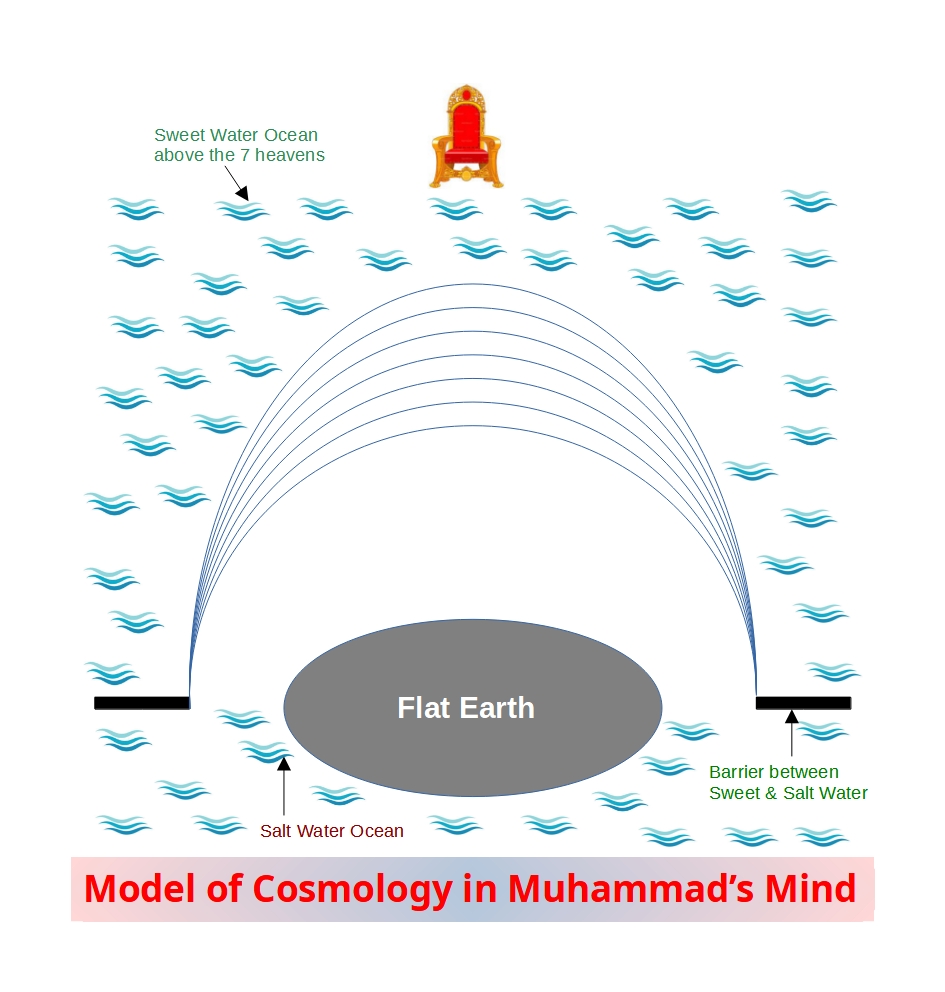
Upon revisiting the verse that mentions two oceans of salty and sweet water, we can now perceive how it aligns with the cosmological model incorporating a sweet water ocean above the heavens. This perspective allows the verse to find coherence and relevance within this framework.
Quran 25:53:
وَهُوَ ٱلَّذِى مَرَجَ ٱلْبَحْرَيْنِ هَٰذَا عَذْبٌ فُرَاتٌ وَهَٰذَا مِلْحٌ أُجَاجٌ وَجَعَلَ بَيْنَهُمَا بَرْزَخًا وَحِجْرًا مَّحْجُورًا
And it is He who has released [simultaneously] the two seas, one fresh and sweet and one salty and bitter, and He placed between them a barrier and prohibiting partition.
Under the commentary of this verse, the Sahaba (companions) also referred to the existence of the two oceans—one in heaven and one on earth.
Tafsir al-Qurtabi (Commentary of Verse 25:53):
.. وقال ابن عباس وابن جبير: يعني بحر السماء وبحر الأرض قال ابن عباس: يلتقيان في كل عام وبينهما برزخ قضاء من قضائه. { وَحِجْراً مَّحْجوراً } حراماً محرّماً أن يعذب هذا الملح بالعذب، أو يملح هذا العذب بالملح.
Ibn Abbas and Ibn Jubayr said: It refers to the ocean of the sky and the ocean of the earth.
Ibn Abbas further explained: They meet each other every year, and between them is a barrier decreed by Allah. "And a barrier between them is forbidden to be crossed." It is forbidden for the salty water to mix with the sweet water or for the sweet water to become salty.
Ibn Kathir recorded from Rab'i bin Anas, under the commentary of verse 11:7:
وقال الربيع بن أنس : ( وكان عرشه على الماء ) فلما خلق السموات والأرض ، قسم ذلك الماء قسمين ، فجعل نصفا تحت العرش ، وهو البحر المسجور .
And Ar-Rabi' ibn Anas said: "And His Throne was upon the water." So when He created the heavens and the earth, He divided that water into two parts, and He placed one half beneath the Throne, and that is the ocean that is known as "Behr-al-Masjoor".
Quranic verse 52:6 again mentions this "Behr-e-Masjoor" (i.e. water under the Throne of Allah), and Ibn Kathir recorded again from Rab'i bin Anas (link):
قال الربيع بن أنس : هو الماء الذي تحت العرش ، الذي ينزل [ الله ] منه المطر الذي يحيي به الأجساد في قبورها يوم معادها .
Rab'i bin Anas said: This is the water which is present under the Throne of Allah, from which Allah sends down the (sweet) rainwater. And this same water will be used to make dead people become alive on the day of judgement
Please note that Islamic apologists offer an explanation that the Quran is mentioning in this verse the meeting of two oceans of the earth. But this explanation may not be accurate, as there is not a single ocean in this world which has sweet water.
Thus, Ibn Juraij (an exegete and hadith transmitter from the Taba' at-Tabi'in) became confused and said (link):
قال ابن جُرَيج: فلـم أجد بحراً عذبـاً إلا الأنهار العذاب
I have not seen any ocean having sweet water. Only rivers have sweet water.
Islamic apologists also present an alternative justification, suggesting that the verse refers to one ocean (of salty water) and one 'river' (of sweet water). However, this interpretation may be questioned since the Quran explicitly uses the term "al-bahrain, ٱلْبَحْرَيْنِ" meaning 'two oceans.' Therefore, it is not plausible to interpret this term as referring to one ocean and one river.
Furthermore, the inclusion of a sweet water ocean above the heavens in Muhammad's cosmological model provides evidence that Muhammad perceived the Earth to be flat. This concept cannot be reconciled with any spherical Earth model.
The Cloud Model in Muhammad's mind
The writer of the Quran, Muhammad, did not reflect modern knowledge of the water cycle. He shared the prevailing understanding of his time, which stated that rainwater originated from the sweet water ocean above the heavens. According to this belief, the "Rain Model" is as under:
- Rainwater was believed to originate from a sweet water ocean located above the heavens.
- The rainwater was thought to descend from the seventh sky to the lowest first sky (of our world).
While, according to this belief, the "Cloud Model" is as under:
- The clouds are situated where the end corners of the 7 heavens meet each other.
- Then Allah sends winds that would carry the clouds to the lowest first sky.
- In the lowest sky, the clouds then absorb the rainwater.
- Initially, the clouds are present as a unified entity at the place where the 7 skies meet each other. They stay as this unified entity till they absorb water from the lowest first sky.
- Eventually, only after that, Allah would break the clouds into fragments and scatter them.
- The rain would fall in specific places as determined by Allah's will.
Here are proofs of the Model of Clouds in Islam:
Quran 30:48:
ٱللَّهُ ٱلَّذِى يُرْسِلُ ٱلرِّيَٰحَ فَتُثِيرُ سَحَابًا فَيَبْسُطُهُۥ فِى ٱلسَّمَآءِ كَيْفَ يَشَآءُ وَيَجْعَلُهُۥ كِسَفًا فَتَرَى ٱلْوَدْقَ يَخْرُجُ مِنْ خِلَٰلِهِۦ ۖ فَإِذَآ أَصَابَ بِهِۦ مَن يَشَآءُ مِنْ عِبَادِهِۦٓ إِذَا هُمْ يَسْتَبْشِرُونَ
Allah (is) the One Who sends the winds, so they raise (the) clouds, then He spreads them in the sky, how He wills, and He makes them fragments so you see the rain coming forth from their midst. Then when He causes it to fall on whom He wills of His slaves, behold! They rejoice.
Suddi said under the commentary of this verse (Link):
عن السدي رضي الله عنه قال: يرسل الله الريح فتأتي بالسحاب من بين الخافقين - طرف السماء حين يلتقيان - فتخرجه ثم تنشره فيبسطه في السماء كيف يشاء، فيسيل الماء على السحاب، ثم يمطر السحاب بعد ذلك.
Narrated by As-Suddi, may Allah be pleased with him, he said: "Allah sends the wind, and it brings the clouds from between the edges - the meeting point - of the sky (خافين). Then He brings them forth and spreads them in the sky as He wills. The water flows within the clouds, and then the clouds rain afterwards."
And Qatada said under the commentary of this verse (link):
عن قتادة رضي الله عنه في قوله { فيبسطه في السماء } قال: يجمعه ويجعله { كسفا } قال: قطعاً.
Qatada said about the verse { فيبسطه في السماء } that Allah first gathers these clouds at one place, and { كسفا } means he then scatters them in fragments
From Tabi'un (i.e. 2nd generation of Muslims after Sahaba), we have recorded traditions that rain comes directly from the sweet water ocean, which is above the 7th heaven (upon which the throne of Allah is resting).
Tafsir Durr-e-Manthur (link):
عن الحسن. أنه سئل المطر من السماء أم من السحاب؟ قال: من السماء، إنما السحاب علم ينزل عليه الماء من السماء.
On the authority of Al-Hasan, he was asked, "Does the rain come from the sky or from the clouds?" He replied, "From the sky. The clouds are a sign that the water will descend upon them from the sky."
عن كعب قال: السحاب غربال المطر، ولولا السحاب حين ينزل الماء من السماء لأفسد ما يقع عليه من الأرض، والبذر ينزل من السماء.
On the authority of Ka'b, he said, "Clouds are the sieves of rain. If it were not for the clouds when the water descends from the sky, it would ruin everything it falls upon on the Earth. And hails (of snow) are also sent down from the sky."
عن خالد بن معدان قال: المطر ماء يخرج من تحت العرش، فينزل من سماء إلى سماء حيث يجمع في السماء الدنيا، فيجتمع في موضع يقال له الايرم، فتجيء السحاب السود، فتدخله فتشربه مثل شرب الاسفنجة، فيسوقها الله حيث يشاء.
On the authority of Khalid ibn Ma'dan, he said, "Rain is water that comes out from beneath the Throne, descending from one sky to another, where it gathers in the lower sky. It then converges in a place known as Al-A'ram. The dark clouds approach and enter it, consuming the water like a sponge. Then Allah drives them wherever He wills."
عن عكرمة قال: ينزل الماء من السماء السابعة
'Ikrama said: Rainwater descends from the 7th heaven.
Since rainwater comes from the 7th heaven in Muhammad's mind (which is closer to the throne of Allah), thus Muhammad declared that rainwater is "blessed" while it was present near Allah.
Anas (b. Malik) reported: It rained upon us as we were with the Messenger of Allah (ﷺ). The Messenger of Allah (way peace be upon him) removed his cloth (from a part of his body) till the rain fell on it. We said: Messenger of Allah, why did you do this? He said: It is because it (is blessed while it) has just come from the Exalted Lord (i.e. from heavens, where the throne of Allah is present).
Furthermore, the claim made by the writer of the Quran that clouds start as one entity and then become fragmented is scientifically incorrect. In reality, when water vapor rises in the atmosphere, it undergoes condensation, forming small, transparent cloud fragments. As more clouds gather in one area, they begin to appear as white-colored clouds. With further concentration of white clouds in the same region, they can develop into dark-colored clouds, from which rainfall eventually occurs. This process demonstrates that clouds start as fragmented entities and can gradually combine to form larger cloud formations before precipitation takes place. (link).
Moreover, it appears that Muhammad also borrowed the "Cloud Model" from the Bible. In Jeremiah 10:13, it is mentioned that God makes clouds rise from the ends of the earth, accompanied by thunder, rain, and wind.
(Jeremiah 10:13) When he thunders, the waters in the heavens roar; he makes clouds rise (towards sky) from the ends of the earth. He sends lightning with the rain and brings out the wind from his storehouses.
(Psalm 135:7) He it is who makes the clouds rise at the end of the earth, who makes lightnings for the rain and brings forth the wind from his storehouses.
Thus, according to the bible, clouds are stored at the ends of the earth, whereas according to the ٰIslam, they are stored between the corners of the skies where they meet each other. Thus, according to both of them, clouds are stored at almost the same places that are beyond the reach of people.

Moreover, According to the bible, God sends the wind from his 'storehouses' (Jeremiah 10:13). And it is the same in the Quran too that Allah sends winds from the "storehouses".
Quran: 16:21-22:
وَإِن مِّن شَىْءٍ إِلَّا عِندَنَا خَزَآئِنُهُۥ وَمَا نُنَزِّلُهُۥٓ إِلَّا بِقَدَرٍ مَّعْلُومٍ وَأَرْسَلْنَا ٱلرِّيَٰحَ لَوَٰقِحَ فَأَنزَلْنَا مِنَ ٱلسَّمَآءِ مَآءً فَأَسْقَيْنَٰكُمُوهُ وَمَآ أَنتُمْ لَهُۥ بِخَٰزِنِينَ
And there is not a thing but that with Us are its storehouses, and We do not send it down except according to a known measure. And We send the winds fertilising, and cause water to descend from the sky, and give it you to drink. It is not ye who are the holders of the store thereof.
He makes clouds rise from the ends of the earth; he sends lightning with the rain and brings out the wind from his treasuries (storehouses).
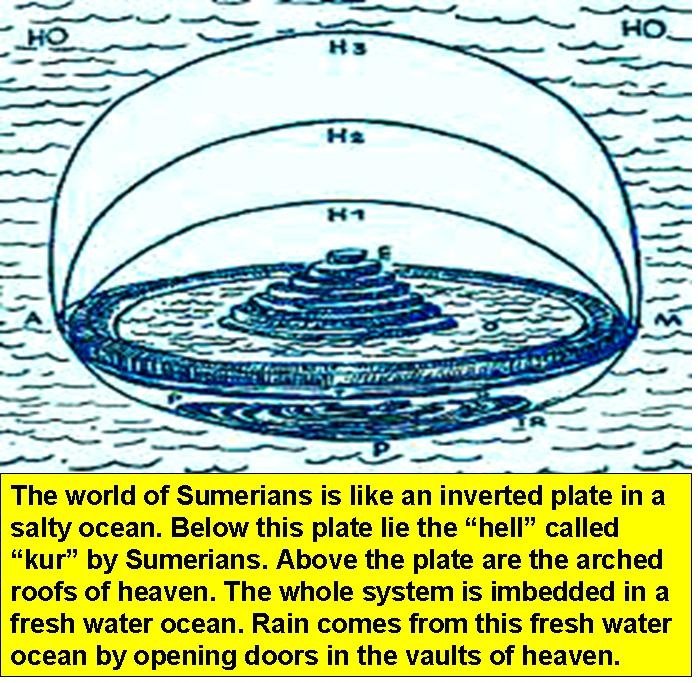
And Sumerian culture also had the same basic model of cosmology and rain as the Bible and Islam have.
Exposing the Deception: Misinterpretation of the Word "Sky" (ٱلسَّمَاء) by Islamic Apologists
It is crucial to address the widespread false propaganda propagated by Islamic apologists, who have successfully indoctrinated both Muslims and non-Muslims into believing that the term "sky" (ٱلسَّمَاء) in the Quran can also mean:
- Atmosphere
- From above
- Clouds
For instance, the Quran mentions the descent of rainwater from the heavens in the following verse:
Quran 2:22:
ٱلَّذِى جَعَلَ لَكُمُ ٱلْأَرْضَ فِرَٰشًا وَٱلسَّمَآءَ بِنَآءً وَأَنزَلَ مِنَ ٱلسَّمَآءِ مَآءً
Who has made the earth your couch, and the heavens ٱلسَّمَآ your canopy; and sent down rain from the heavens ٱلسَّمَآ.
However, modern Islamic apologists claim that the term 'sky' (ٱلسَّمَاءَ) in the Quran can also signify 'atmosphere' or 'from above.' Consequently, they argue that the verse can be interpreted as:
".... and (He) sends down rainwater from the atmosphere (or from above or from clouds)."
Fortunately, the Quranic verse itself provides clarity, leaving no room for the escape of Islamic apologists. The verse utilizes the term 'sky' (ٱلسَّمَاءَ) twice, explicitly conveying that it refers to the heavenly canopy erected by Allah, in contrast to the earthly bed or couch.
It is important to critically examine these interpretations by Islamic apologists, which may deviate from the clear meaning conveyed by the Quranic text itself.
Similarly, look at this verse:
Quran 2.164:
- <
إِنَّ فِى خَلْقِ ٱلسَّمَٰوَٰتِ وَٱلْأَرْضِ وَٱخْتِلَٰفِ ٱلَّيْلِ وَٱلنَّهَارِ وَٱلْفُلْكِ ٱلَّتِى تَجْرِى فِى ٱلْبَحْرِ بِمَا يَنفَعُ ٱلنَّاسَ وَمَآ أَنزَلَ ٱللَّهُ مِنَ ٱلسَّمَآءِ مِن مَّآءٍ فَأَحْيَا بِهِ ٱلْأَرْضَ بَعْدَ مَوْتِهَا وَبَثَّ فِيهَا مِن كُلِّ دَآبَّةٍ وَتَصْرِيفِ ٱلرِّيَٰحِ وَٱلسَّحَابِ ٱلْمُسَخَّرِ بَيْنَ ٱلسَّمَآءِ وَٱلْأَرْضِ لَءَايَٰتٍ لِّقَوْمٍ يَعْقِلُونَ
- <
(If they want a sign for the perception of this Reality) surety there are countless signs for those who use their common sense; they can see alternation of the night and day, in the ships that sail the ocean laden with cargoes beneficial to mankind, and in the rain-water which Allah sends down from the sky and thereby gives life to the earth after its death and spreads over it all kinds of animate creatures, in the blowing of the winds and in the clouds which obediently wait for orders between the sky and the earth.
Hence, this verse not only establishes the distinction between clouds and the sky (ٱلسَّمَاء), but it also explicitly clarifies the location of clouds between the earth and the sky.
It is crucial to acknowledge the gravity of these claims propagated by Islamic apologists. Their influence extends far and wide, significantly impacting the beliefs of millions of Muslims who wholeheartedly trust in these interpretations.
The Concept of Thunder and Lightning in Muhammad's mind
The thunder and lightning phenomenon was regarded as a mystery during the time of ignorance, and Muhammad addressed this lack of understanding by offering explanations that gained respect and instilled awe as someone knowledgeable about the unseen world.
Accordingly, Muhammad presented the following narrative:
- There is an angel named R'ad who oversees the clouds. And the THUNDER that we hear, it is actually the voice of that angel R'ad which comes when he drives the clouds.
- Additionally, LIGHTNING occurs when the angel R'ad strikes the clouds with his iron whip. Subsequently, Allah employs the lightning as a means to punish those who defy Him.
Quran 13:13:
وَيُسَبِّحُ ٱلرَّعْدُ بِحَمْدِهِۦ وَٱلْمَلَٰٓئِكَةُ مِنْ خِيفَتِهِۦ وَيُرْسِلُ ٱلصَّوَٰعِقَ فَيُصِيبُ بِهَا مَن يَشَآءُ وَهُمْ يُجَٰدِلُونَ فِى ٱللَّهِ وَهُوَ شَدِيدُ ٱلْمِحَالِ
And the thunder declares His glory with His praise, and the angels too for awe of Him; and He sends the thunderbolts and smites with them whom He pleases, yet they dispute concerning Allah, and He is mighty in prowess.
It is the same in the Bible too that God thunders to kill his enemies:
Psalm 18:13-14 (NIV):
"The Lord thundered from heaven; the voice of the Most High resounded. He shot his arrows and scattered the enemy, with great bolts of lightning he routed them."
Furthermore, Muhammad introduced additional elements to this narrative in the following tradition.
Musnad Ahmad bin Hanbal, Hadith 2479 (link):
Ibn Abbas said: Once some Jews came to Muhammad and they said: "We will ask you five questions, and if you can answer them correctly, then we will accept that you are the true prophet of God, and we will follow you" ... They asked the fourth question: "What is Thundering of clouds?" Muhammad replied: "There is an angel which Allah stipulated for supervising clouds. He has a whip of iron with which he hits the clouds (due to which lightning is produced), and drives them to go wherever Allah had ordered them to go ... and the thunder is the voice of that angel. Upon that the Jews testified Muhammad.
Grade: This is a Sahih (authentic) Hadith (link).
During the time of ignorance, people had no means to verify or refute such stories. Consequently, they began to accept Muhammad as a prophet of God and became more receptive to his teachings.
However, modern scientific knowledge has challenged these traditional tales. Scientific explanations have provided precise reasoning for natural phenomena such as thunder, lightning, earthquakes, and eclipses, contradicting Muhammad's narratives.
The Model of Hails in Muhammad's Mind
During the time of ignorance, people commonly observed that snow was found in mountains. This led to the belief that there were "mountains of snow" in the heavens, from which hail accompanied rainwater.
In line with this prevailing understanding, the writer of the Quran (i.e. Muhammad) also incorporated this concept from the time of ignorance into the Quranic verses.
Quran 24:43:
وَيُنَزِّلُ مِنَ ٱلسَّمَآءِ مِن جِبَالٍ فِيهَا مِنۢ بَرَدٍ فَيُصِيبُ بِهِۦ مَن يَشَآءُ وَيَصْرِفُهُۥ عَن مَّن يَشَآءُ
And He sends down hail from the sky, from mountains within it, and it strikes whomever He wills and diverts it from whomever He wills.
Imam Qurtabi wrote under the commentary of this verse (link):
{ وَيُنَزِّلُ مِنَ ٱلسَّمَآءِ مِن جِبَالٍ فِيهَا مِن بَرَدٍ } قيل: خلق الله في السماء جبالاً من بَرَد، فهو ينزِّل منها بَرَداً وفيه إضمار، أي ينزِّل من جبال البرد بَرَدا، فالمفعول محذوف. ونحو هذا قول الفرّاء لأن التقدير عنده: من جبال برد فالجبال عنده هي البرد. و«بَرَدٍ» في موضع خفض ويجب أن يكون على قوله المعنى: من جبالٍ بردٍ فيها، بتنوين جبال. وقيل: إن الله تعالى خلق في السماء جبالاً فيها برد فيكون التقدير: وينزل من السماء من جبال فيها برد.
And He sends down from the sky hail from mountains within it, containing hailstones. It is said that Allah created mountains of hail in the sky, and He sends down hail from them ... It is also said that Allah created mountains in the sky containing hail, so the intended meaning is: "And He sends down from the sky from mountains within it containing hail.
Ibn Kathir writes under commentary of this verse 24:43 (link):
(and He sends down from (Min) the sky, from (Min) mountains in it of (Min) ice,). Some of the grammarians said that the first Min describes the place from which it is coming, the second specifies from which part of the sky it comes, and the third means some kind of mountains. This is based on the view of those scholars of Tafsir who say that, مِن جِبَالٍ فِيهَا مِن بَرَدٍ from (Min) mountains in it of (Min) ice, means that there are mountains of hail in the sky from which Allah sends down ice.
Once again, Muhammad copied this concept from the bible.
(Isaiah 55:10): For as the rain and the snow come down (directly) from heaven and do not return there but water the earth, making it bring forth and sprout, giving seed to the sower and bread to the eater.
(<Job 38:22): Hast thou entered into the treasures (storehouses) of the snow? or hast thou seen the treasures of the hail? [Commentary: "the treasures" That is, the treasuries, the magazines. Snow and hail are represented as having been created and laid up in great storehouses in the heavens or above them]
The Source of sweet water of the Nile and Euphrates in Muhammad's mind
The Prophet (ﷺ) said: .... (On the night of ascension, where he went to heavens) Then I was shown Sidrat-ul-Muntaha (i.e. a tree in the seventh heaven) and I saw its Nabk fruits which resembled the clay jugs of Hajr (i.e. a town in Arabia), and its leaves were like the ears of elephants, and four rivers originated at its root, two of them were apparent and two were hidden. I asked Gabriel about those rivers and he said, 'The two hidden rivers are in Paradise, and the apparent ones are the Nile and the Euphrates.'
Abu Huraira reported Allah's Messenger (ﷺ) as saying: Saihan, Jaihan, Euphrates and Nile are all among the rivers of Paradise.
Now, these Ahadith have become a challenge and a headache for Islamic apologists as they do not align with any cosmological models. They are unable to provide an answer regarding how the water, which is flowing from the root of a tree in paradise, reaches the earth.
Furthermore, modern science has already identified the true sources of the sweet water in the Nile and the Euphrates rivers.
During the time of Muhammad, people lacked knowledge about the true origins of the sweet water in the Nile and the Euphrates rivers. This led Muhammad to present alternative accounts regarding their sources. However, modern science offers different explanations regarding these rivers' origins.
Furthermore, this issue is further resolved when we discover a similar story in the Bible, albeit with a slightly different concept.
Muhammad was adapting various stories from the Bible, including the creation of the heavens and the earth, and the account of Adam and Eve. However, a fundamental issue arose: while he had heard these biblical narratives, he was not a scholar of the Bible. Consequently, there are distinct differences in his retelling of these ancient narratives.
One such clear difference occurred regarding the "Garden of Eden" (the paradise where Adam and Eve resided):
-
According to the Bible, the Garden of Eden (Garden of Eden) where Adam and Eve lived was located right here on Earth.
-
Muhammad, however, understood that the paradise they inhabited was located up in the heavens.
Accordingly, the Bible mentions four earthly rivers originating from the Garden of Eden in the following words:
8. And the Lord God planted a garden eastward in Eden (on Earth); and there he put the man (Adam) whom he had formed...<
9. And out of the ground made the Lord God to grow every tree that is pleasant to the sight, and good for food; the tree of life also in the midst of the garden, and the tree of knowledge of good and evil...<
10. And a river went out of Eden to water the garden; and from thence it was parted, and became into four heads...<
11. The name of the first is Pison: that is it which compasseth the whole land of Havilah, where there is gold...<
12. And the gold of that land is good: there is bdellium and the onyx stone...<
13. And the name of the second river is Gihon: the same is it that compasseth the whole land of Ethiopia...<
14. And the name of the third river is Hiddekel (Tigris): that is it which goeth toward the east of Assyria. And the fourth river is Euphrates.
The difference between the biblical story and Muhammad's account is as follows:
- In the Bible, the "Garden of Eden" where Adam and Eve resided, along with the forbidden tree, was located on Earth. Therefore, it was logical for the Bible to state that the waters of the Tigris and Euphrates rivers originated from the Garden of Eden.
- However, Muhammad's rendition differs from the biblical account. He claimed that Adam, Eve, and the forbidden tree were situated not on Earth but in paradise in the heavens. This posed a challenge in explaining how the water from the root of a tree in heaven could reach the earthly rivers.
Muhammad, while drawing from biblical narratives, was not a formally educated scholar. This may account for certain variations in his retelling of these ancient accounts.
The concept of the western and the eastern ends of the Flat Earth being extremely HOT in Muhammad's mind
The Western Edge: The Sun Sets in a Spring of Hot Water
حَتَّىٰٓ إِذَا بَلَغَ مَغْرِبَ ٱلشَّمْسِ وَجَدَهَا تَغْرُبُ فِى عَيْنٍ حَمِئَةٍUntil, when he reached the setting place of the sun, he found it setting in a spring of hot water (or dark mud).
Ibn Kathir explains the cause of the heat explicitly in cosmological terms, i.e. the water is hot because the western edge of the earth is physically closer to the spot where the sun sets, and the sun's rays strike it directly without any barrier.
Ibn Kathir wrote under the commentary of verse 18:86:
Ibn Jarir said, “There are two well-known recitations (i.e. the sun disappears in black mud, or the sun disappears in the spring of hot water) and whichever one the reciter recites is correct.” And I (i.e. Ibn Kathir) say, there is no contradiction between their two meanings, as it may be the water is hot because it is near the glare of the sun at sunset (i.e. the western edge of the flat earth is closer to sun), and it meets the rays without a barrier.
It is crucial to note what Ibn Kathir is doing here. He is not describing a local hot spring or a desert mirage. He is offering a physical explanation for why the water is hot, namely, its proximity to the sun's setting place.
On a spherical earth, no "edge" could be closer to the sunset than any other, as the sun is approximately 150 million kilometers away, and its distance is effectively constant regardless of one's location on the globe. The very idea that one could travel to a "setting place of the sun" where the water is scorched by solar proximity presupposes a flat plane where the sun descends to a specific, reachable location.
The Eastern Edge: The Sun Rises on a People Scorched by Proximity
حَتَّىٰٓ إِذَا بَلَغَ مَطْلِعَ ٱلشَّمْسِ وَجَدَهَا تَطْلُعُ عَلَىٰ قَوْمٍ لَّمْ نَجْعَل لَّهُم مِّن دُونِهَا سِتْرًاUntil, when he came to the rising place of the sun, he found it rising on a people for whom We had provided no shelter against it.
Qatadah said, "It was mentioned to us that they were in a land where nothing grew (due to heat while it is closer to the place of sun rise), so when the sun rose they would go into tunnels until it had passed its zenith, then they would come out to go about their daily lives ... And once an army came to them, and they (the locals) said to them: 'You should not be here when the sun rises.' But they said, 'We will not leave until the sun rises. But what type of bones are these that are lying here?' They (the locals) said, 'These are the carcasses of an army (which came here before you). The sun rose on them here, and they died.''"
The phrase "where nothing grew (due to heat while it is closer to the place of sun rise)" is the critical detail. Qatadah, like Ibn Kathir, is not describing a mere local climate; he is attributing the lethal heat to the region's physical proximity to the place where the sun rises. The eastern edge of the earth is uninhabitable for the same reason the western edge is: in a flat-earth model, these are the points nearest to the sun's path.
Modern apologists sometimes argue that these verses merely describe what Dhulqarnain saw from his perspective, perhaps a mirage, or a local hot spring, without endorsing a literal flat-earth cosmology. This reading, however, collides with the classical commentators themselves. Neither Ibn Kathir nor Qatadah treat the "hot water" or the "scorched people" as optical illusions or regional oddities. Both explain the phenomena by reference to the sun's physical proximity at the edges of the earth. If the text were compatible with a spherical earth, we would expect the tafsirs to say so, but instead, they supply a flat-earth physics to make sense of the heat.
Furthermore, if the Quran merely meant to say that Dhulqarnain saw a mirage, it would be strange for the text to specify that the water was hot because it was near the sun's setting place, or that an entire people lived in tunnels to escape the sunrise. These details only cohere within a cosmology where the sun moves close to the earth's surface at its eastern and western boundaries.
Taken together, these paired verses and their classical exegesis reveal a consistent underlying model, i.e., the earth is a flat expanse with edges that lie dangerously close to the sun's path. This is not a peripheral detail in the narrative; it is the structural premise that makes the story intelligible.
This also proves that Earth was flat in Muhammad's mind.
The Implication
These are not minor metaphors or translation errors. They are specific, testable, factual claims about the physical world.
If the Quran and Hadith were truly from the Creator of the universe, the one who designed the water cycle, the electromagnetic properties of lightning, the geological origins of rivers, and the spherical shape of the Earth, we would expect accuracy. Instead, we find the scientific beliefs of 7th-century Arabia:
-
A flat Earth with edges
-
A solid sky canopy holding back a celestial ocean
-
Weather phenomena caused by angels with tools
-
Heavenly origins for earthly rivers
-
A mythological "lowest heaven" just above the Earth containing Adam and angelic guards
Response to Common Apologist Excuses
These are the ever repeating common apologist excuses:
| Apologist Excuse | Our Answer |
| "It's metaphorical" | Why did no classical scholar treat it as metaphor? Why did they write detailed tafsirs explaining the literal mountains of hail and celestial ocean? |
| "You're taking it out of context" | The context of creation, rain, and cosmology is exactly where scientific accuracy would matter most. |
| "Science changes; the Quran is eternal" | Science has confirmed the water cycle, spherical Earth, and electrical nature of lightning for centuries. These are not "changing theories", but they are settled Scientific Facts. |
| "The Quran isn't a science textbook" | Then why does it make so many specific, falsifiable scientific claims? And why are they all wrong according to modern knowledge? |
The Verdict for the Reader
You have now seen the evidence from both sides, the Quran and Hadith on one hand, modern science on the other.
The question is not whether Muhammad believed these things. He clearly did, as the texts and classical commentaries show.
The question is: Can these errors be reconciled with the claim that the Quran is perfect, divine, and from the all-knowing Creator?
Islamic apologists will offer reinterpretations. But ask yourself:
-
Why would a divine book need constant reinterpretation to align with basic science?
-
Why did no Muslim scholar understand these verses as "metaphors" until science disproved the literal meaning?
-
Why does the Quran describe a flat Earth, a solid sky, and a celestial ocean — exactly the cosmology of ancient Mesopotamia and the Bible?
You are the judge and jury. The evidence has been presented honestly.
Now, the conclusion is yours.

 Hassan Radwan